Jonathan Omer-Man, leader in Jewish meditation who met with the Dalai Lama, dies at 89
He looked to infuse Jewish practice with techniques and insights drawn from Eastern religions
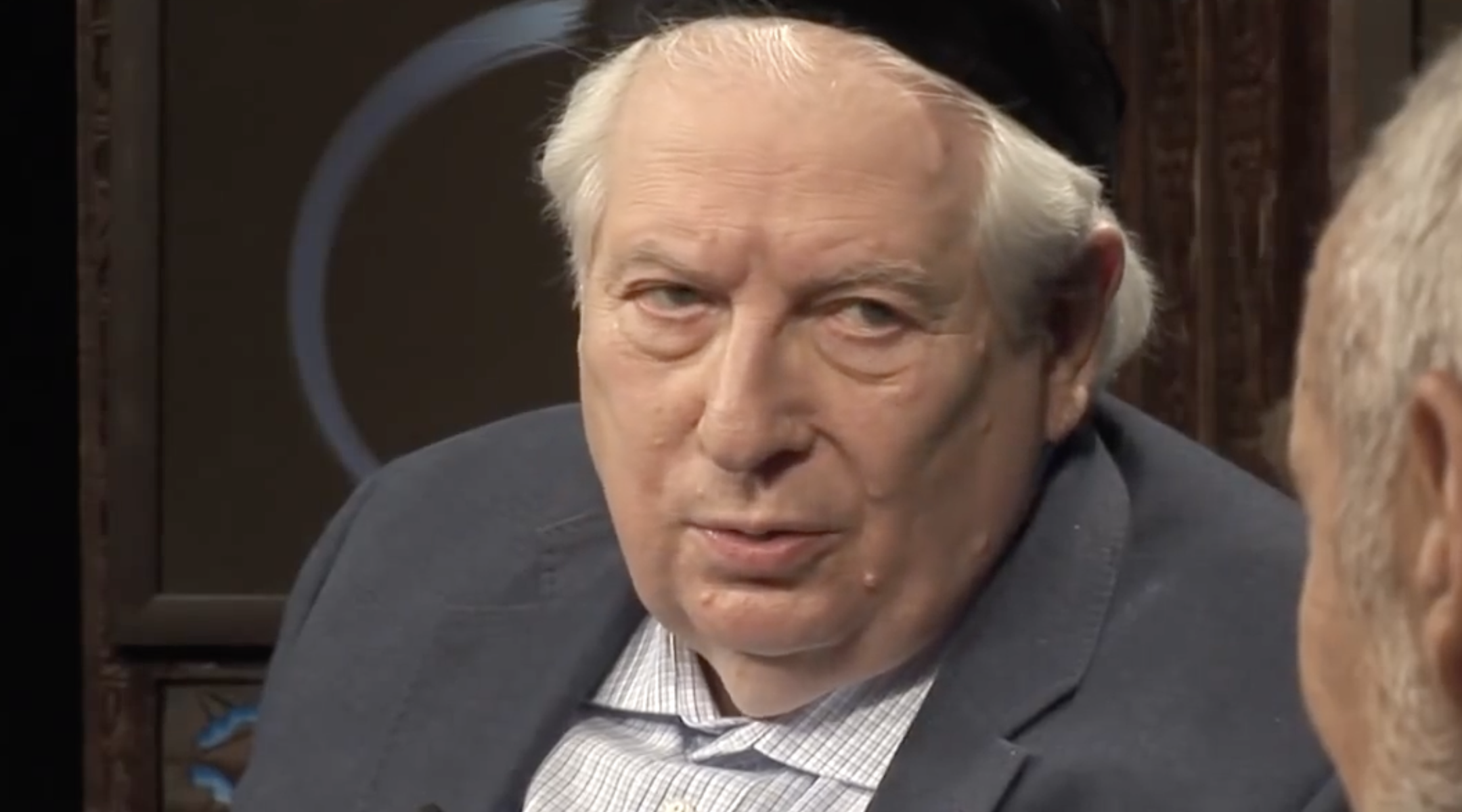
Rabbi Jonathan Omer-Man, pictured in 2011. (Screenshot from YouTube)
(JTA) — Jonathan Omer-Man, a rabbi and pioneer in Jewish meditation whose meeting with the Dalai Lama in 1990 was described in Rodger Kamenetz’s best-selling book “The Jew in the Lotus,” died on Tuesday. He was 89.
Omer-Man was part of a delegation of Jews, including rabbis of various denominations, who went to Dharamshala, India as part of an interfaith dialogue with the exiled leader of Tibetan Buddhism. Kamenetz’s 1994 book focused in large part on rabbis and Jewish thinkers like Omer-Man who were looking to infuse Jewish practice with techniques and insights drawn from Eastern religions, and perhaps understand why many young Jews were drawn to traditions other than their own.
To that end, Omer-Man was also the founder of Metivta, an egalitarian, nondenominational Jewish community based in Los Angeles that emphasizes learning Jewish texts and meditation. Omer-Man rooted his lessons and techniques in Jewish mystical traditions, including the Kabbalah and the teachings of Hasidic masters.
“There have always been Jews who followed a traditional mystical path, and there’s never been a rabbinic consensus,” he told an interviewer in 2004. “All there has been is ‘our group versus their group.’”
Born Derek Orlans in Portsmouth, England in 1934, Omer-Man spent years working on a kibbutz in Israel before his legs were paralyzed by polio. He moved to Jerusalem where he found various jobs as an electrician, a teacher and in the publishing industry before he was captivated by the study of Jewish mysticism in his mid-30s.
He received a private rabbinic ordination from Rabbi Zalman Schachter-Shalomi, the founder of the Jewish Renewal movement, and in 1981 he moved to Los Angeles, where he was invited by the Los Angeles Hillel council to set up an outreach program for “religiously alienated Jews” — specifically those interested in faiths like Hinduism and Buddhism.
“He worked for a number of years on a one-on-one basis,” Kamenetz wrote in “The Jew and the Lotus.” “Jonathan had struck up a conversation with some Jewish kids from Los Angeles. When they heard that Jonathan would soon be opening a school of Jewish meditation, they immediately signed up to study with him.”
Omer-Man was one of the founding teachers of the Institute for Jewish Spirituality, an organization founded in 1999 that develops and teaches Jewish spiritual practices including meditation, yoga, Torah study, song and niggunim, or the singing of wordless melody. He was the author of multiple essays, short fiction and verse, and taught and lectured widely,
Omer-Man, who resided in Berkeley, California, was married to Nan Gefen, a fiction and nonfiction writer. Their blended family has seven children and 10 grandchildren. The family recently welcomed a great-grandson.
“People are very much into bringing more fun into Judaism,” Omer-Man told Kamenetz in “The Jew in the Lotus.” “But fun is not joy. Joy is ecstatic knowledge with all parts of one’s being, an integrated way of knowing. It’s truly a quest.”
This article originally appeared on JTA.org.
This is a moment of great uncertainty. Here’s what you can do about it.
We hope you appreciated this article. Before you go, we’d like to ask you to please support the Forward’s independent Jewish news this Passover.
This is a moment of great uncertainty for the news media, for the Jewish people, and for our sacred democracy. It is a time of confusion and declining trust in public institutions. An era in which we need humans to report facts, conduct investigations that hold power to account, tell stories that matter and share honest discourse on all that divides us.
With no paywall or subscriptions, the Forward is entirely supported by readers like you. Every dollar you give this Passover is invested in the future of the Forward — and telling the American Jewish story fully and fairly.
The Forward doesn’t rely on funding from institutions like governments or your local Jewish federation. There are thousands of readers like you who give us $18 or $36 or $100 each month or year.
Support our mission to tell the Jewish story fully and fairly.