The cast of Broadway’s ‘Parade’ says Kaddish before each show, says star Micaela Diamond
‘It is an expression of community as we tell this hard story,’ writes the actress who plays Lucille Frank in a show about the antisemitic lynching of Frank’s husband Leo.
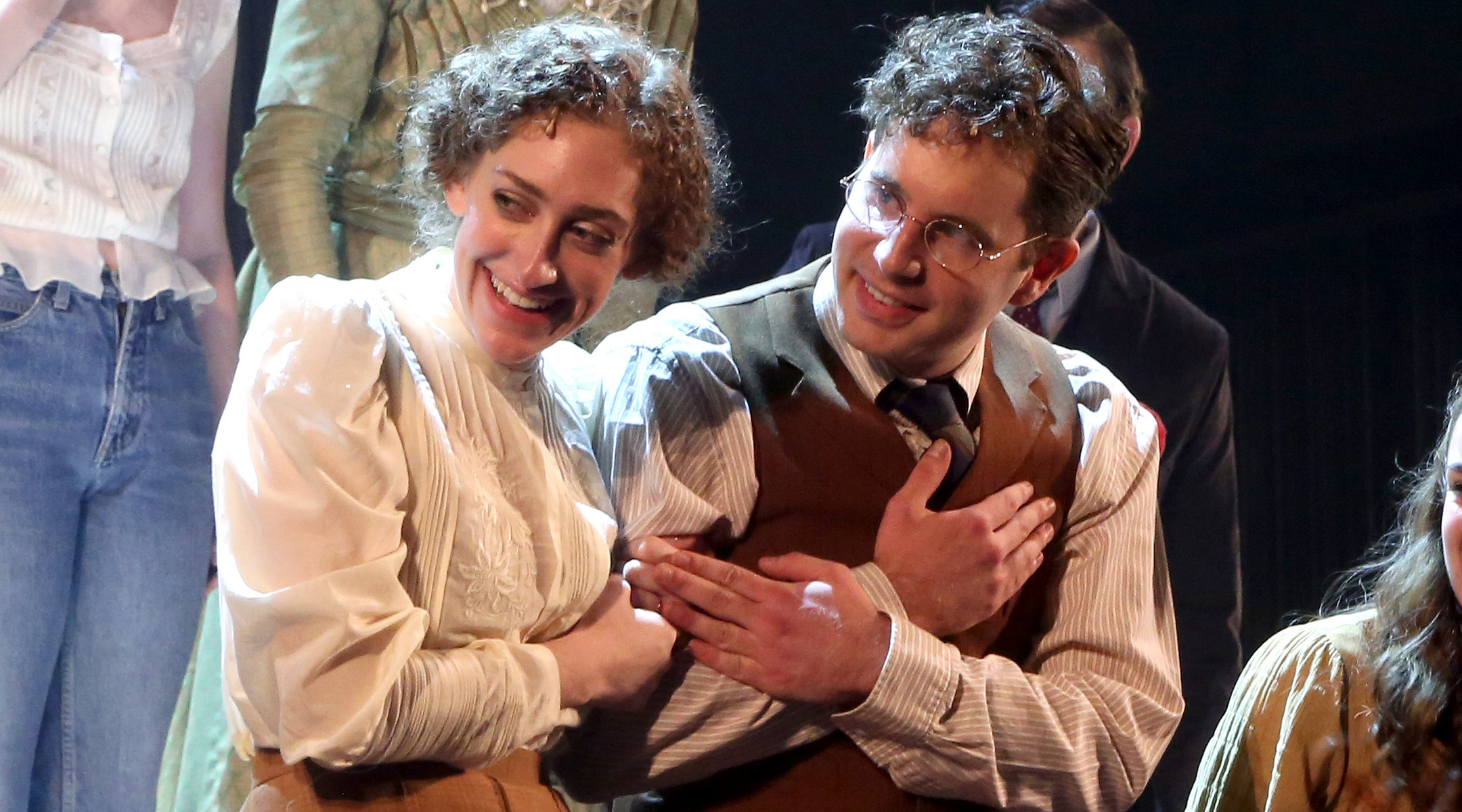
Micaela Diamond and Ben Platt during the opening night curtain call for “Parade” at New York City Center, Nov. 1, 2022. (Bruce Glikas/WireImage/GettyImages)
(JTA) — Eight times a week, audiences at Broadway’s “Parade” see the curtain rise on a retelling of an act of antisemitism. What they don’t see is the Jewish ritual that comes first.
In an essay for The New York Times, 23-year-old star Micaela Diamond writes that before almost every performance, the cast members stand in a circle and say the Mourner’s Kaddish, the Jewish prayer for the dead.
“It is an expression of community as we tell this hard story,” writes Diamond, who plays Lucille Frank, the wife of Jewish lynching victim Leo Frank.
It’s not the only prayer recited every night: Ben Platt, playing Leo Frank, recites the Shema just before he is killed by a lynch mob, in the final moments of a musical dramatizing his 1913 arrest and 1915 murder. The historical consensus is that Frank was innocent of the rape and murder charges against him.
In her essay, Diamond shares what she has learned from playing Lucille Frank, to whom she feels connected.
“I can relate to Lucille — her Jewishness, her lack of Jewishness, her insistence on assimilation,” Diamond writes. “There are so many parts of my identity that feel more at the forefront than my Jewishness, like being an actor, being queer, being a good cook. … Yet our identities are as nuanced as our roots are indelible.”
People like Lucille Frank considered themselves “Southern first, American second, Jewish later,” according to Alfred Uhry, the writer of “Parade.” But in her essay, Diamond notes that order doesn’t matter to antisemites — and she had seen it for herself.
On the opening preview night of the “Parade” revival in February, neo-Nazis rallied outside the Bernard Jacobs Theatre.
“A play that was meant to be a revival of a century-old story suddenly had contemporary implications,” Diamond writes, echoing Platt’s take offered on Instagram that night. “It was a haunting reminder of this story’s immediacy.”
Diamond also notes the connections between antisemitism and anti-Black racism in the story of Leo Frank and today. “Parade” offers a condemnation of a criminal justice system that “fails to protect all of those without power” by pitting Black people and Jews against each other, she writes, pointing to how the Frank family’s Black housekeeper is urged to testify against Leo Frank with evidence fabricated by the prosecution.
“If we refuse to embrace our inherent otherness — the parts that make us definitively Jewish Americans — we forget our common struggle with other marginalized people,” Diamond writes.
“Parade,” which is set to run until at least early August, is up for six Tony Awards this weekend, including best actor for Platt and best actress for Diamond.
This article originally appeared on JTA.org.
This is a moment of great uncertainty. Here’s what you can do about it.
We hope you appreciated this article. Before you go, we’d like to ask you to please support the Forward’s independent Jewish news this Passover. All donations are being matched by the Forward Board - up to $100,000.
This is a moment of great uncertainty for the news media, for the Jewish people, and for our sacred democracy. It is a time of confusion and declining trust in public institutions. An era in which we need humans to report facts, conduct investigations that hold power to account, tell stories that matter and share honest discourse on all that divides us.
With no paywall or subscriptions, the Forward is entirely supported by readers like you. Every dollar you give this Passover is invested in the future of the Forward — and telling the American Jewish story fully and fairly.
The Forward doesn’t rely on funding from institutions like governments or your local Jewish federation. There are thousands of readers like you who give us $18 or $36 or $100 each month or year.
Support our mission to tell the Jewish story fully and fairly.