Russia labels Moscow’s former chief rabbi a ‘foreign agent’
Rabbi Pinchas Goldschmidt, who had been Moscow’s chief rabbi since 1993, fled Russia just weeks into the war in March 2022
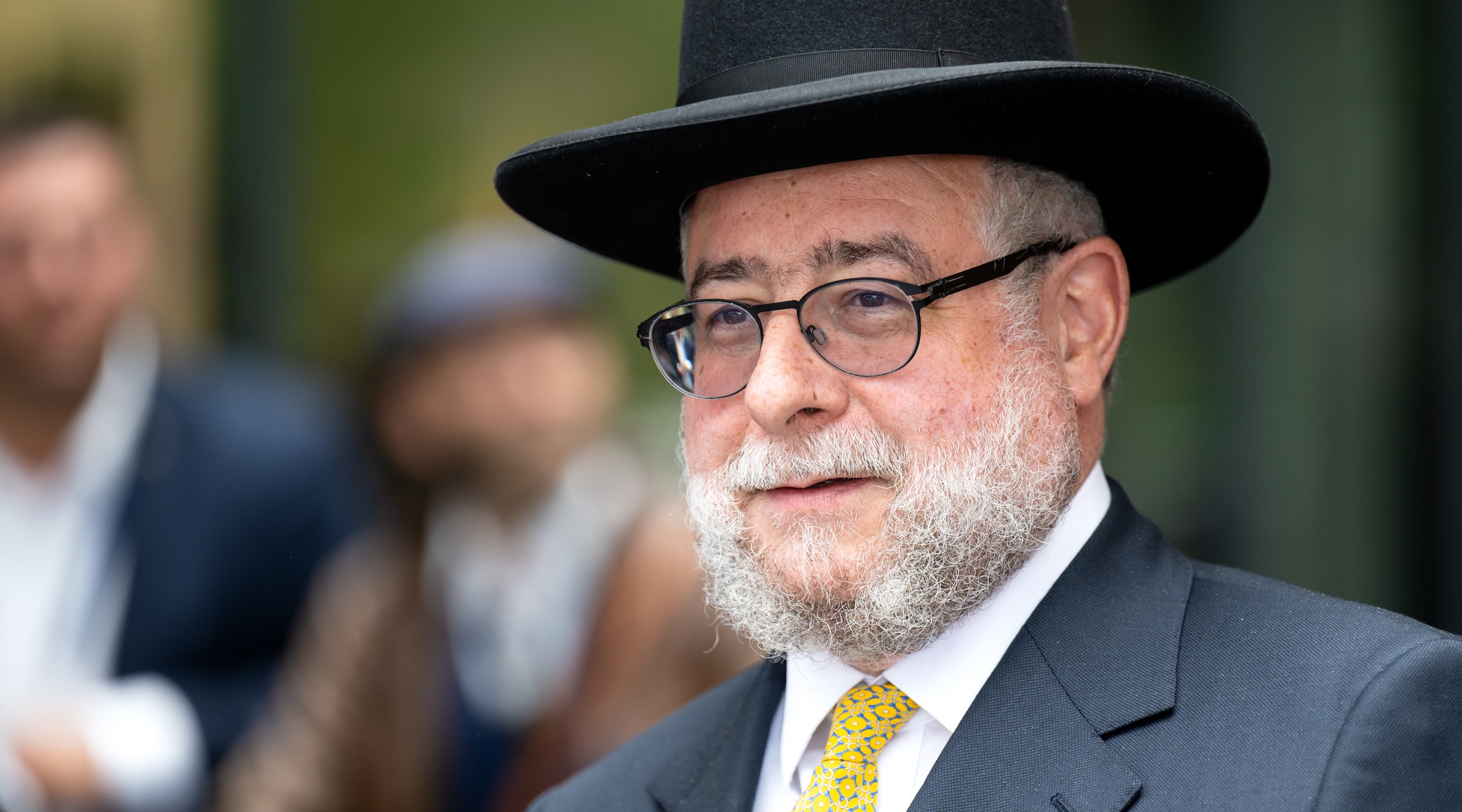
Pinchas Goldschmidt in Munich, May 30, 2022. (Sven Hoppe/picture alliance via Getty Images)
(JTA) — Russia has labeled Pinchas Goldschmidt, the former chief rabbi of Moscow, a “foreign agent” a year after he left the country and refused to pledge his support for the war in Ukraine.
The designation cannot be contested in court and bars those assigned it from participating in many aspects of public life in Russia. The Russian government expanded the definition last year amid a crackdown on dissent following Russia’s invasion of Ukraine, and it has threatened to apply the label to the Jewish Agency for Israel, which helps Russian Jews emigrate.
In Goldschmidt’s case, the label is likely symbolic, as he has acknowledged that he will not return to Russia after openly criticizing the war and, from abroad, warning Russian Jews to flee.
On Saturday, in response to the foreign agent designation, he reiterated that call, saying as he has before that Russia is on the verge of an antisemitic campaign.
“Russia has changed its face,” he said in a statement that reiterated comments he first made in December. “I call on the Jewish community to leave the country, before it is too late.”
Many Russian Jews have left the country since the beginning of the war in February 2022, with tens of thousands emigrating to Israel. Goldschmidt, who had been Moscow’s chief rabbi since 1993, was among them, leaving Russia just weeks into the war in March 2022. He later acknowledged that he had done so after facing pressure to support the war.
“I resigned because to continue as chief rabbi of Moscow would be a problem for the community because of the repressive measures taken against dissidents,” he told the Guardian in December.
He added that throughout Russian history, “whenever the political system was in danger you saw the government trying to redirect the anger and discontent of the masses towards the Jewish community.”
“We’re seeing rising antisemitism while Russia is going back to a new kind of Soviet Union,” he said, “and step by step the Iron Curtain is coming down again. This is why I believe the best option for Russian Jews is to leave.”
Jews were not allowed to practice their religion and were restricted from leaving the country while living under the Soviet regime.
Now living in Israel, Goldschmidt continues to serve as the head of the Conference of European Rabbis, a title he has had since 2011. He is not affiliated with the Hasidic Chabad-Lubavitch movement, whose leading rabbis in Russia have had a much closer relationship with President Vladimir Putin.
But while Russian Chief Rabbi Berel Lazar and his top spokesperson Boruch Gorin have remained in the country, Chabad leaders have expressed concerns about the war. In September, a gathering of dozens of Russian Chabad rabbis released a statement reading: “We pray that no more blood be spilled, and call upon people of good conscience everywhere to help aid those in need, including refugees, and end the suffering.”
A Russian official soon after described the Chabad movement as a “neo-pagan cult” striving for “global domination” in an op-ed that he later apologized for.
This article originally appeared on JTA.org.
This is a moment of great uncertainty. Here’s what you can do about it.
We hope you appreciated this article. Before you go, we’d like to ask you to please support the Forward’s independent Jewish news this Passover.
This is a moment of great uncertainty for the news media, for the Jewish people, and for our sacred democracy. It is a time of confusion and declining trust in public institutions. An era in which we need humans to report facts, conduct investigations that hold power to account, tell stories that matter and share honest discourse on all that divides us.
With no paywall or subscriptions, the Forward is entirely supported by readers like you. Every dollar you give this Passover is invested in the future of the Forward — and telling the American Jewish story fully and fairly.
The Forward doesn’t rely on funding from institutions like governments or your local Jewish federation. There are thousands of readers like you who give us $18 or $36 or $100 each month or year.
Support our mission to tell the Jewish story fully and fairly.