In my Passover memories, the magnolia trees of Brooklyn are always in bloom
When I was growing up in Borough Park, springtime arrived with the scent of latkes and blossoming trees
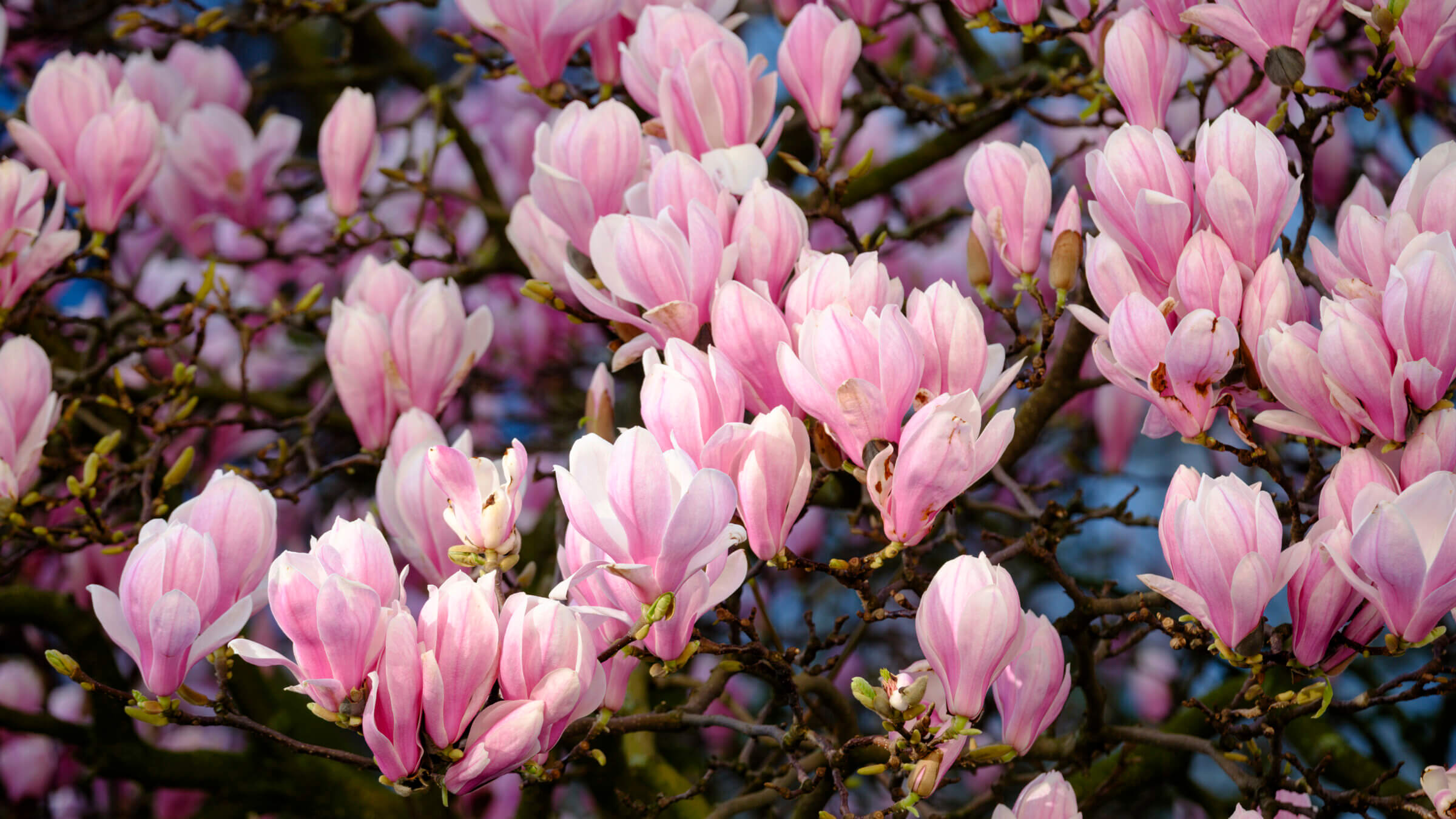
The author recalls springtime full of magnolias the color of ballet slippers. Photo by Getty Images
It’s inevitable — the beginning of spring and the scent of magnolias always remind me of Passover.
Growing up, I lived with my parents in a two-bedroom apartment on the second floor of a three-story apartment building in Borough Park, Brooklyn. The living room window faced the street. A beautiful magnolia tree grew in front of that window, partially obscuring the houses across the way. In late March or early April, I’d start to notice the buds on the magnolia’s branches morph into a rich velvety green that would grow and grow, and soon unravel into huge blossoms, the color of pink ballet slippers.
There was a fire escape in front of that window, and when I was a teenager I’d sit on the windowsill and swing my feet onto the rusty rungs. It was a good place to imagine, to think, write and stare at that beautiful tree, coming alive.
I’d often try to extend my arm and reach a flower, but since I was afraid of heights and didn’t look down, I could usually only graze it. Once in a while, though, with heart thumping and some wobbly finesse I could manage to stand and quickly snip off several blossoms. The delirious scent of spring in Brooklyn, its air vacuumed fresh and clean was unbelievable — winter was finally gone and spring was here. The large pink flower felt like my very own special bouquet. Excitedly, I would take one or two of the petals, press them between my fingers, desperately trying to extract its perfume and dab it behind my ears, before I placed the flower in a small vase.
Meanwhile, inside the house, my very petite mother would busily iron our crisp, white damask tablecloth until it was smooth as paper. With sturdy fingers she would then unfurl it on our dining room table.
Then, my mother would climb a ladder to reshelve all our dairy and meat dishes in the top cupboard, making sure they were out of sight and out of mind for Passover; she’d cover them with a long layer of aluminum foil just to make sure.
Then, out came the blue bubble Depression-era glass dishes, Bakelite knives, forks and spoons with bright red handles, pots, pans and heavy crystal wine glasses.
Like the magnolia tree outside, all these dishes and silverware felt like welcome guests who we hadn’t seen for a year.
Soon, that beautifully ironed tablecloth was layered with all things Passover — the Seder plate; the Maxwell House Haggadah; the treasured well-worn haggadah from The Home of the Sages of Israel on the Lower East Side; Elijah’s cup, not just for Elijah, but for all the relatives, long gone, who couldn’t be present. And, of course, the bottle of Manichewitz grape wine, matzo and matzo balls the size of tennis balls sloshing around in a bowl of chicken soup; hard-boiled eggs; saltwater; a jar of potent horseradish capable of inducing actual tears; velvet and satin yarmulkes, the inside imprinted with someone’s Bar Mitzvah or wedding date. Finally, aunts and uncles on one side of the table, my cousins and I on the other.
On the table, in addition to the wine, there were blue and green seltzer bottles, delivered by the seltzer man. In those days, it was either water from the faucet or seltzer. My cousins and I would press the siphon into the little bit of wine we were allocated and concoct our own, not so good, drinks. Inevitably, someone would accidentally tip over a glass of wine and those beautiful white damask roses would suddenly be transformed into purple ones.
Soon, the magnolia tree would shed all its blossoms and create a beautiful pink blanket on the ground. My mother would take our dairy and meat dishes down from the top shelves in the cupboard, and Passover, like those blossoms, would once again become a memory.
No longer a teenager, I now live in the suburbs, my house surrounded by grass and trees, but not that magical magnolia.
Sometimes, though, while I’m walking, I’ll see one of those trees. I’ll stop and stare at its blossoms scattered on the grass and remember those Passovers past.

Did you know that only 2% of Forward readers donate to support our nonprofit newsroom? That 2% make it possible for millions to read the Forward without a paywall or subscription — removing any barriers to the full and fair Jewish story.
But while the Forward is free to read, it isn’t free to produce. Big stories — like deep dives into the antisemitism data, political scoops or reporting trips to college campuses — take months of research and fact-checking. All while we keep you informed of what you need to know each day.
— Rachel Fishman Feddersen, Forward Publisher & CEO
Support our mission to tell the Jewish story fully and fairly.