Historic synagogue in Tunisia heavily damaged in rioting tied to Israel-Gaza war
The location is also the burial site of a 16th-century rabbi whose grave has been a draw for Jewish pilgrims
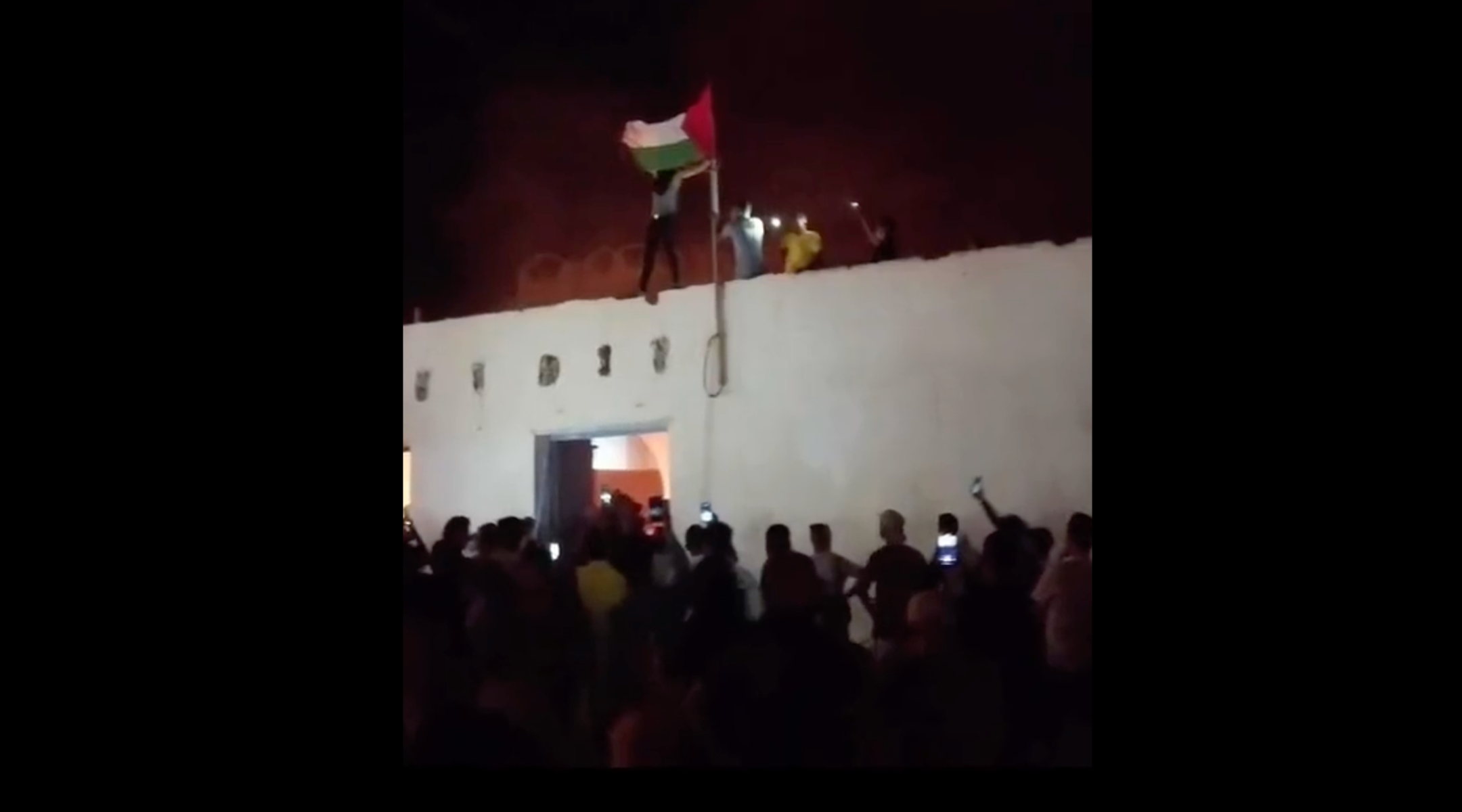
Tunisian protesters fly a Palestinian flag as a historic synagogue in Al Hammah burns, Oct. 17, 2023. (Screenshot via X)
(JTA) – A historic but defunct synagogue in Tunisia was reduced to rubble on Tuesday amid mass rioting after an explosion in Gaza that Hamas blamed on Israel.
Hundreds of people were filmed setting fire to a synagogue in the central Tunisian city of Al Hammah in the hours after the explosion, at a Gaza City hospital where Hamas said many people died. Videos that circulated widely on social media showed people planting Palestinian flags and chipping away at the synagogue building’s stone walls, all without any police intervention.
Some users shared the video of the arson alongside a “#Palestine” hashtag. A video taken Wednesday shows heavy damage to the site, including to the fenced-off grave of a 16th-century rabbi that been a historic pilgrimage site for some Jews.
Images de la destruction de la synagogue filmées ce matin à El Hamma pic.twitter.com/NmO8Iah3ir
— Joseph Hirsch (@josephhirsch5) October 18, 2023
The incident, which has deprived Al Hammah of a key vestige of its Jewish past, comes amid attacks on other Jewish and Israeli sites around the world — including Germany, France, Portugal, China, and Australia — as Israel retaliates in the Gaza Strip following Hamas’ sweeping, deadly attack on Israel Oct. 7.
Protests against Israel ramped up Tuesday night after the hospital explosion. Dozens of rioters targeted the Israeli embassy in Amman, Jordan. Riots also broke out in Palestinian areas of the West Bank, Hebrew media reported.
Israeli and U.S. officials said they believed with near certainty that the blast was caused by an errant rocket fired by Palestinian Islamic Jihad.
The Al Hammah synagogue was not an active site of worship, as no Jews live in the city; however, it is the site of the tomb of 16th-century Kabbalist Rabbi Yosef Ma’aravi. The same site was previously damaged during the 2011 Arab Spring protests, which were not about Israel.
The American Jewish Committee denounced the vandalism in a statement.
“We are horrified by the burning and destruction of the Al Hammah synagogue in Tunisia,” the group said on X, adding that it was “closely monitoring the situation” and in touch with Tunisian Jewish community leaders.
Tunisia’s small Jewish population of around 1,000 also contended with a deadly terrorist attack earlier this year when a gunman stormed a synagogue on the island of Djerba. Five people died, including two Jewish pilgrims who had traveled to the area from Israel and France, and wounding several others.
In response to the Djerba attack, Tunisia’s president, Kais Saied, pledged he would increase security for the country’s Jewish residents. Saied also drew criticism for using the occasion of the attack to criticize Israel.
Since the latest explosion of violence in Israel and Gaza, Tunisians have taken to the streets in large numbers to support Palestinians. Tunisian schoolchildren have saluted the Palestinian flag, and Saied has pledged to stand by Palestinians while continuing to snuff out any talk of normalization with Israel, a path that four Arab countries took in 2020.
This article originally appeared on JTA.org.
This is a moment of great uncertainty. Here’s what you can do about it.
We hope you appreciated this article. Before you go, we’d like to ask you to please support the Forward’s independent Jewish news this Passover. All donations are being matched by the Forward Board - up to $100,000.
This is a moment of great uncertainty for the news media, for the Jewish people, and for our sacred democracy. It is a time of confusion and declining trust in public institutions. An era in which we need humans to report facts, conduct investigations that hold power to account, tell stories that matter and share honest discourse on all that divides us.
With no paywall or subscriptions, the Forward is entirely supported by readers like you. Every dollar you give this Passover is invested in the future of the Forward — and telling the American Jewish story fully and fairly.
The Forward doesn’t rely on funding from institutions like governments or your local Jewish federation. There are thousands of readers like you who give us $18 or $36 or $100 each month or year.
Support our mission to tell the Jewish story fully and fairly.