Holocaust survivor who became a bat mitzvah at 91 dies in Buenos Aires
Eugenia Unger was a founding member of the Holocaust Museum of Buenos Aires
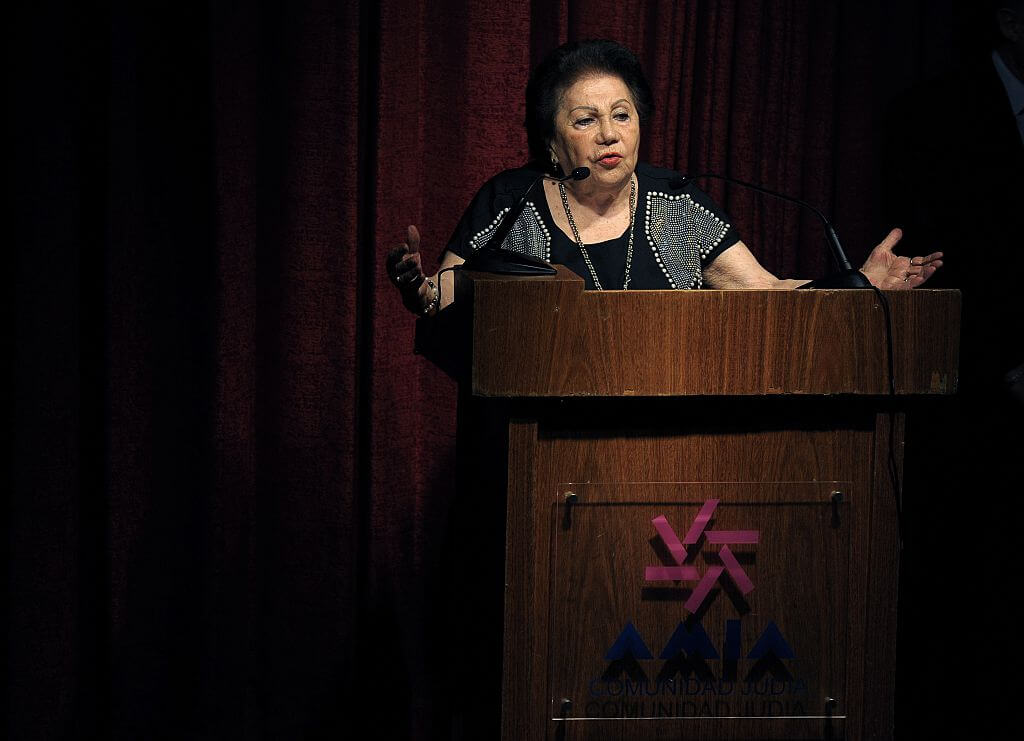
Holocaust survivor Eugenia Unger in Buenos Aires, Argentina in 2015. Photo by Getty Images
BUENOS AIRES (JTA) — Eugenia Unger, a Holocaust survivor and one of the founding members of the Holocaust Museum of Buenos Aires in 2000, died Dec. 19 in a private hospital in Buenos Aires. She was 97.
In 2017, after decades in which she shared her experiences of surviving the Majdanek and Auschwitz concentration camps, she made national news by celebrating her bat mitzvah at age 91. She was called to the Torah at the Herzliya Jewish community center and synagogue in Buenos Aires, which also organized a birthday celebration in her honor.
She told Argentine media that “the culmination of my whole life is my bat mitzvah. It is a ritual that is very important in Jewish life.”
“She had an absolute commitment to transmitting the Shoah both in Sherit Haplietá [an organization of survivors who lived in displaced persons camps] and in her fundamental role in the creation of the Holocaust Museum in Buenos Aires,” said Jonathan Karszenbaum, executive director of the museum. “She left a mark in all the testimonies she gave throughout the country, through her books, interviews, films or many other formats.”
Genia Rotsztejn was born in Warsaw, Poland on March 30, 1926. She lived in the Warsaw Ghetto as a teen and was later taken to the two Nazi camps with her family, including her parents, two brothers and a sister. She was identified by the Nazis with the number “48914.”
Unger is the only member of her family who survived the Holocaust. When she was liberated by Soviet forces, she weighed slightly more than 59 pounds.
When she returned to Warsaw, she slept on the street. “The Poles who were our friends closed the door in our faces,” she recalled in a testimony to the Shoah Foundation’s “Broken Silence” project. “When the Jews returned and claimed our properties, they killed us.”
After a journey across central Europe, she lived for two years in a refugee camp in Modena, Italy, where she met her future husband, David Unger. Both immigrated to Argentina in 1949.
She started a family; her two sons and six grandsons survive her. She wrote three books about her experiences.
In 2011, she was declared Outstanding Personality by the Buenos Aires city parliament.
“We will remember her for providing an exemplary testimony of strength in the face of adversity, demonstrating by her unwavering example that love always prevails over hate, and that life ultimately triumphs over death,” the parliament declared in an official proclamation.
This article originally appeared on JTA.org.
This is a moment of great uncertainty. Here’s what you can do about it.
We hope you appreciated this article. Before you go, we’d like to ask you to please support the Forward’s independent Jewish news this Passover. All donations are being matched by the Forward Board - up to $100,000.
This is a moment of great uncertainty for the news media, for the Jewish people, and for our sacred democracy. It is a time of confusion and declining trust in public institutions. An era in which we need humans to report facts, conduct investigations that hold power to account, tell stories that matter and share honest discourse on all that divides us.
With no paywall or subscriptions, the Forward is entirely supported by readers like you. Every dollar you give this Passover is invested in the future of the Forward — and telling the American Jewish story fully and fairly.
The Forward doesn’t rely on funding from institutions like governments or your local Jewish federation. There are thousands of readers like you who give us $18 or $36 or $100 each month or year.
Support our mission to tell the Jewish story fully and fairly.