21 Israeli soldiers killed in Gaza building collapse
On the streets of Tel Aviv, confusion and concern mount on the war’s 109th day
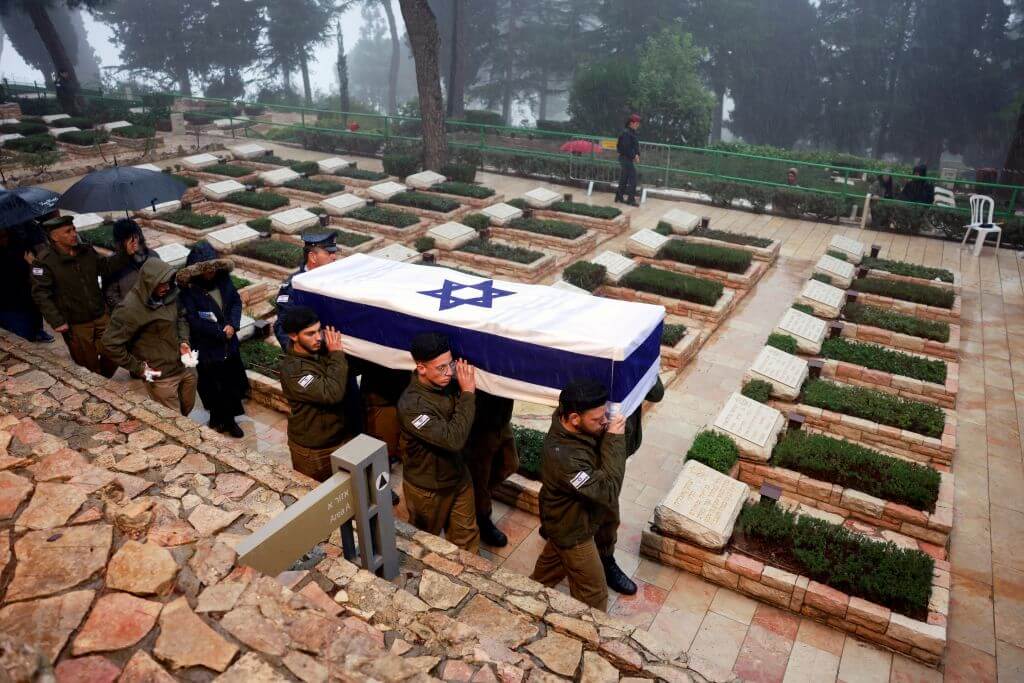
Israeli troops carry the coffin of fellow soldier Captain Elkana Vizel during his funeral in the Mount Herzl military cemetery in Jerusalem on January 23, 2024, a day after he was killed in combat in Gaza. Photo by Getty Images

By Susan Greene January 23, 2024
TEL AVIV — Israelis woke up Tuesday morning to confusion about news that 21 reservists died Monday in the IDF’s single deadliest incident so far in the Gaza war.
People throughout Tel Aviv doomscrolled, struggling to understand if the fatal collapse of structures that killed 19 of those reservists was caused by their own mines planted to demolish the buildings or by a rocket launched by a Palestinian rocket-propelled grenade that an IDF spokesperson said simultaneously hit a tank that was protecting them, killing two Israeli soldiers inside.
“Probably both,” said Udi Weiss, taking cover under a café awning from heavy rain here on this 109th day of the war. “Sounds like the shot set off the explosives, making it worse.” He added, trailing off, “As if we needed things to get worse …”
Smartphones in hand, Tel Avivians on buses, in a north Jaffa neighborhood laundromat and a City Center barber shop combed through the list of fallen reservists in search of names they recognized.
“Yoav Levi? Could that be Yaron’s boy?” one woman mumbled to another at a bus stop.
The fatal explosion in South Gaza, plus the deaths of three other Israeli soldiers killed in the area early Monday, brings the IDF’s ground operation death toll to 219.
Meanwhile, the Hamas-run Health Ministry in Gaza reported that 195 people there were killed by Israeli strikes in the last 24 hours. Many of them died as the IDF says its forces completed its siege of Khan Younis, a city in southwest Gaza, overnight. The death toll in Gaza surpassed 25,000 earlier this week, according to the ministry.
As morning commuters kept updating their news feeds, 11 “Red Alerts” — real-time notices about rocket attacks on Israel — buzzed on their phones about shelling in Northern Israel. Then came news alerts that Hezbollah claimed responsibility for shelling IDF’s aerial surveillance equipment in Mount Meron as retribution for “assassinations in Lebanon and Syria.” That was later followed by two more two more Red Alerts about rocket attacks in the Galilee.
By midday, news broke that a man had been arrested for allegedly setting fire to an art installation in Tel Aviv created to honor Israeli soldiers still being held in Gaza. And people lunching in Jaffa discussed headlines that the Israeli government offered Hamas’ Gaza-based leaders exile in exchange for a cease-fire.
It is, they agreed, a head-spinning news day.
This is a moment of great uncertainty. Here’s what you can do about it.
We hope you appreciated this article. Before you go, we’d like to ask you to please support the Forward’s independent Jewish news. All donations are still being matched by the Forward Board - up to $100,000 until April 24.
This is a moment of great uncertainty for the news media, for the Jewish people, and for our sacred democracy. It is a time of confusion and declining trust in public institutions. An era in which we need humans to report facts, conduct investigations that hold power to account, tell stories that matter and share honest discourse on all that divides us.
With no paywall or subscriptions, the Forward is entirely supported by readers like you. Every dollar you give is invested in the future of the Forward — and telling the American Jewish story fully and fairly.
The Forward doesn’t rely on funding from institutions like governments or your local Jewish federation. There are thousands of readers like you who give us $18 or $36 or $100 each month or year.

Support our mission to tell the Jewish story fully and fairly.