AIPAC to increase pressure on House Republicans to pass Israel aid bill
Congressional leaders are expected to address AIPAC’s national gathering in Washington this week
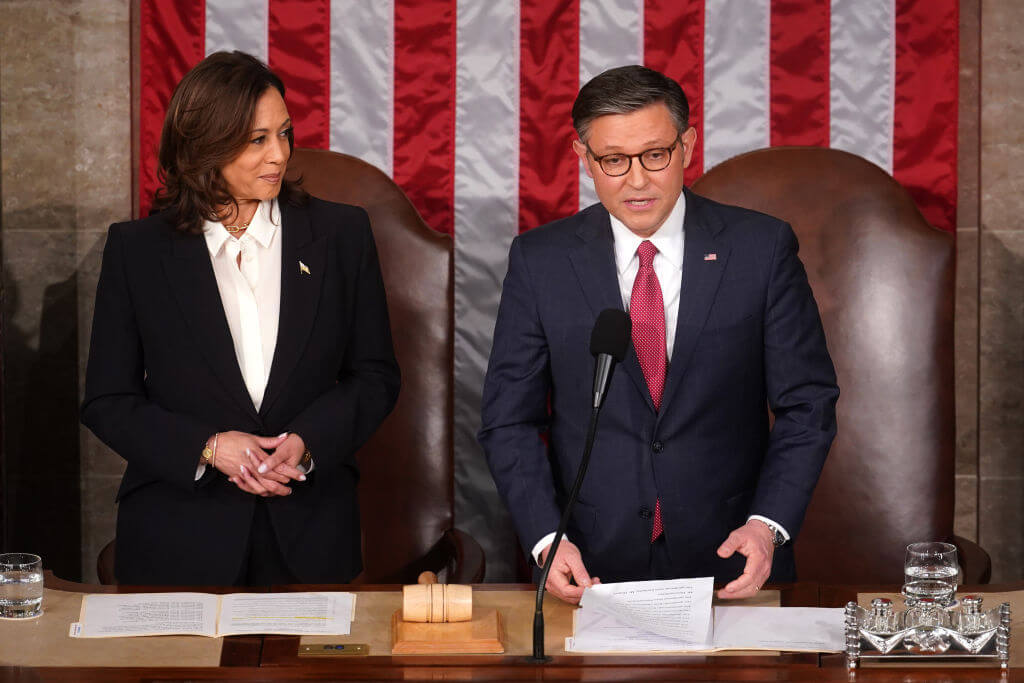
House Speaker Mike Johnson ahead of President Joe Biden’s State of the Union address on March 7, 2024. Photo by Al Drago/Bloomberg via Getty Images

By Jacob Kornbluh March 11, 2024
AIPAC lobbyists are headed to Capitol Hill this week to increase pressure on Congress to pass a bipartisan Israel aid bill.
“The priority lobbying message will be to House Republicans” to pass the bill “without conditions,” said AIPAC spokesperson Marshall Wittman.
House Speaker Mike Johnson has so far resisted bringing a $95 billion foreign aid bill to a floor vote. That bill, approved by the Senate last month, would support Ukraine in its efforts to repel Russia’s invasion, and send $14.1 billion to Israel, which is fighting against Hamas in Gaza and Hezbollah on its northern border. House Democrats voted against Johnson’s stand-alone $17.6 billion Israel aid bill, introduced last month. It was dismissed by the White House as a “ploy” to bypass aid for Ukraine and avoid a compromise on immigration.
The American Israel Public Affairs Committee, the pro-Israel lobbying group, plans to mobilize its 4 million members to press their senators and representatives for swift passage of the aid bill.
AIPAC is expected to play a significant role in the 2024 elections.
More than 1,600 AIPAC leaders and activists are expected to attend this year’s national congressional summit in Washington, D.C., which begins Monday. All four congressional leaders — Speaker Johnson, Senate Majority Leader Chuck Schumer, Democratic House leader Hakeem Jeffries and Republican Senate leader Mitch McConnell — are scheduled to address attendees.
The White House didn’t respond to a question about whether it will send a senior administration official to the summit, as in previous years.
Despite disagreements between the Biden administration and the Israeli government over its military campaign in Gaza, President Joe Biden has pledged not to halt or limit aid for Israel’s defense.
A smaller footprint
AIPAC has shrunk its gatherings since its last policy conference, at the start of March 2020, when more than 15,000 attended. Both the 2021 and 2022 conferences were canceled due to the coronavirus pandemic. Last year, Defense Secretary Lloyd Austin and congressional leaders addressed 1,000 political leaders and activists at its political leadership forum, and Secretary of State Antony Blinken spoke at the national policy summit in the summer.
In addition to intensifying efforts to pass the emergency funding proposal, AIPAC’s legislative agenda will focus on Congress’ annual military assistance package for Israel, the Iran Sanctions Enforcement Act and the Stop Harboring Iranian Petroleum Act, legislation to prevent Iran from developing nuclear weapons.
AIPAC supports pro-Israel candidates through its super PAC, the United Democracy Project. The group is expected to invest about $100 million this year to defeat progressive Democrats critical of Israel.
Editor’s note: This post was updated to mention the House GOP’s stand-alone Israel aid bill.
This is a moment of great uncertainty. Here’s what you can do about it.
We hope you appreciated this article. Before you go, we’d like to ask you to please support the Forward’s independent Jewish news this Passover. All donations are being matched by the Forward Board - up to $100,000.
This is a moment of great uncertainty for the news media, for the Jewish people, and for our sacred democracy. It is a time of confusion and declining trust in public institutions. An era in which we need humans to report facts, conduct investigations that hold power to account, tell stories that matter and share honest discourse on all that divides us.
With no paywall or subscriptions, the Forward is entirely supported by readers like you. Every dollar you give this Passover is invested in the future of the Forward — and telling the American Jewish story fully and fairly.
The Forward doesn’t rely on funding from institutions like governments or your local Jewish federation. There are thousands of readers like you who give us $18 or $36 or $100 each month or year.

Support our mission to tell the Jewish story fully and fairly.