This year’s USPS Hanukkah stamp is a simple menorah with a warm backstory
The stamp was designed by an artist whose mother escaped the Nazis on the Kindertransport
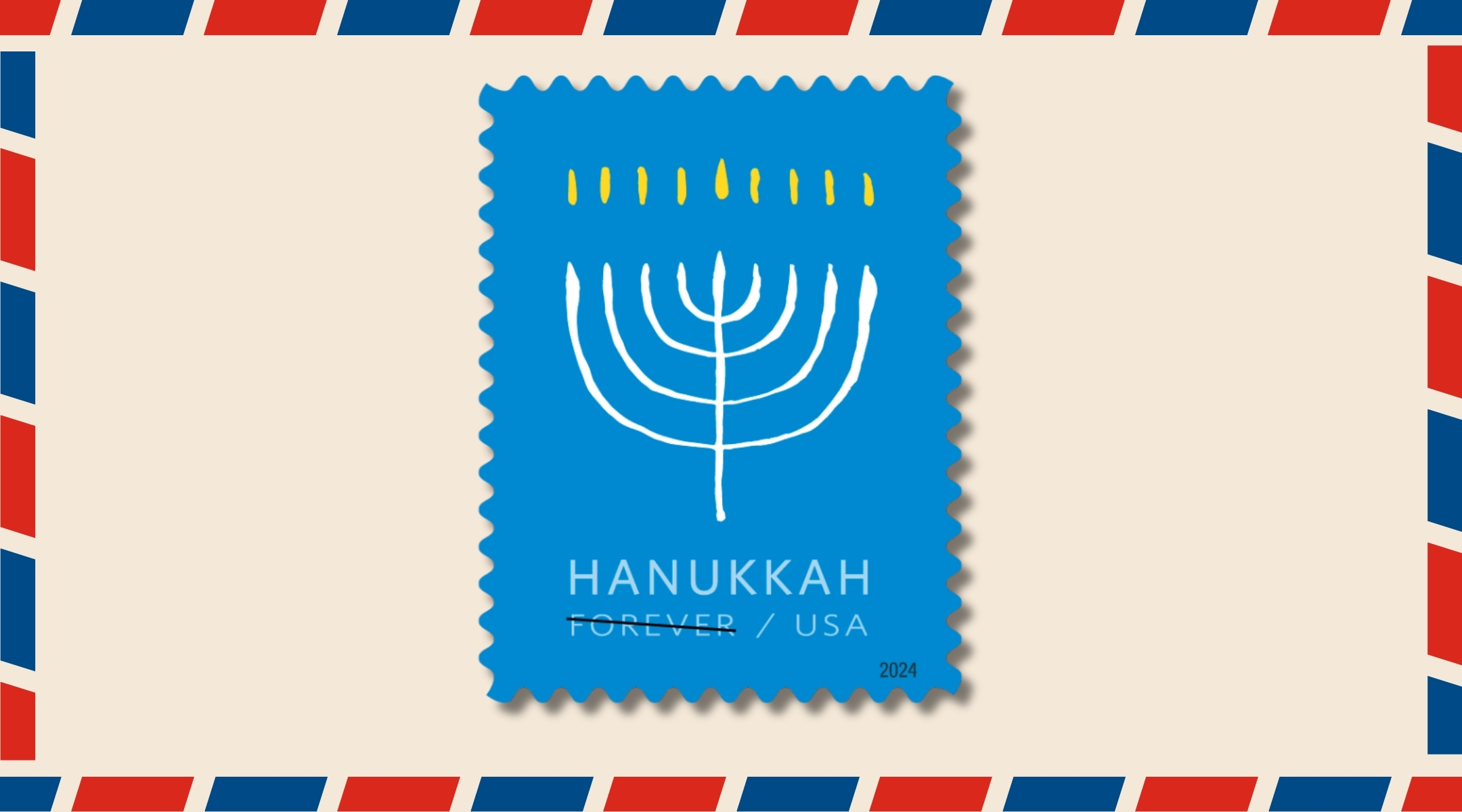
This year’s new Hanukkah stamp was designed by Jewish artist and USPS art director Antonio Alcalá. (Courtesy of USPS. Design by Jackie Hajdenberg)
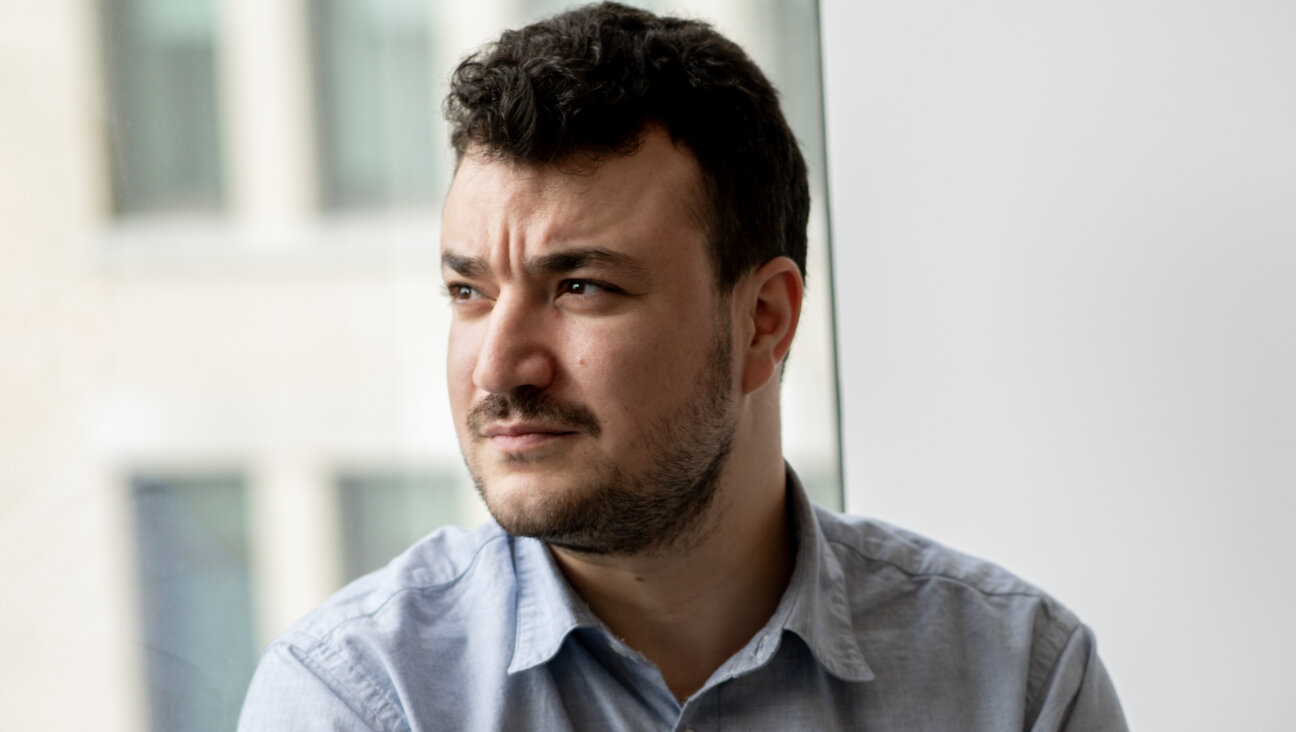
(JTA) — As an art director at the United States Postal Service, Antonio Alcalá has designed stamps honoring Woodstock, the Emancipation Proclamation and Ezra Jack Keats’ children’s book classic “A Snowy Day.” But this year’s Hanukkah stamp is the first that honors an important piece of his own heritage.
“My mother escaped Nazi Germany on the Kindertransport. Many of her family members did also survive, including my grandparents,” Alcalá told the Jewish Telegraphic Agency.
He added, “So when I was a child, we would celebrate multiple holidays, including Hanukkah, and as the youngest of three boys, I was the one who always got to light the first candle.”
The postal service has issued Hanukkah stamps since 1996, more than three decades after it first started issuing Christmas stamps. Previous versions have drawn on traditional Jewish art forms — the 2022 stamp drew on a synagogue stained-glass look — included dreidel imagery and depicted a range of menorahs, real and illustrated.
Alcalá’s stamp also showcases a menorah. But unlike the others that Americans have used to mail Hanukkah cards, his doesn’t feature any candles.
That’s by design. “The flames are shown, but the candles themselves are not present,” Alcalá said. “They’re implied. And to me, that sort of alludes to this sort of aspect of faith that’s both tied to this and also to the larger sort of religious experience.”
The Hanukkah stamp is the only Jewish stamp created by the USPS, which also produces holiday stamps for Christmas, Eid, Kwanzaa and Diwali.
In drafting this year’s stamp (a process that began in 2022), Alcalá began on the computer, and eventually shifted to paper and ink, which he said “conveyed a lot more humanity to it, than sort of more mechanical, perfectly-created geometric illustration.”
His influences included Andy Warhol, the mid-century pop artist, and the illustrations of Ben Shahn, the Jewish artist known for his work in social realism.
“I don’t think it’s anything that I invented, but it was the language that I thought was appropriate,” Alcalá said. “I was really interested in something that was not so sterile-feeling, but also very simple.”
Alcalá also channeled his upbringing in what he said was “a secular Jewish family” in San Diego, California. Designing a Hanukkah stamp, he said, was a “huge thrill” given his background and all his mother went through to continue the family’s Hanukkah traditions.
According to an account written by his brother based on a diary their grandfather kept when fleeing Hamburg in 1941, Alcalá’s German grandparents traveled to the United States on the same ship from Portugal as Rabbi Menachem Mendel Schneerson, the last leader of the Chabad-Lubavitch Hasidic sect. Other members of the family were murdered by the Nazis, and Alcalá’s mother and her siblings went years without direct contact with their parents.
“It’s one of those things where you wish some of your relatives were still around to see that day. But my brothers are still around, and they’ll get to see it,” Alcalá said about designing the Hanukkah stamp.
“I’m very excited,” he added. “It’s a piece of my family history that I get to see distributed across the country.”
This year’s stamp will be formally issued at an event free to the public at the Capital Jewish Museum in Washington, D.C., on Sept. 19.
This is a moment of great uncertainty. Here’s what you can do about it.
We hope you appreciated this article. Before you go, we’d like to ask you to please support the Forward’s independent Jewish news. All donations are still being matched by the Forward Board - up to $100,000 until April 24.
This is a moment of great uncertainty for the news media, for the Jewish people, and for our sacred democracy. It is a time of confusion and declining trust in public institutions. An era in which we need humans to report facts, conduct investigations that hold power to account, tell stories that matter and share honest discourse on all that divides us.
With no paywall or subscriptions, the Forward is entirely supported by readers like you. Every dollar you give is invested in the future of the Forward — and telling the American Jewish story fully and fairly.
The Forward doesn’t rely on funding from institutions like governments or your local Jewish federation. There are thousands of readers like you who give us $18 or $36 or $100 each month or year.

Support our mission to tell the Jewish story fully and fairly.