Biden after Israeli attack on Iran: ‘My hope is this is the end’
Iran said it had the right to respond to the attack but did not vow to do so
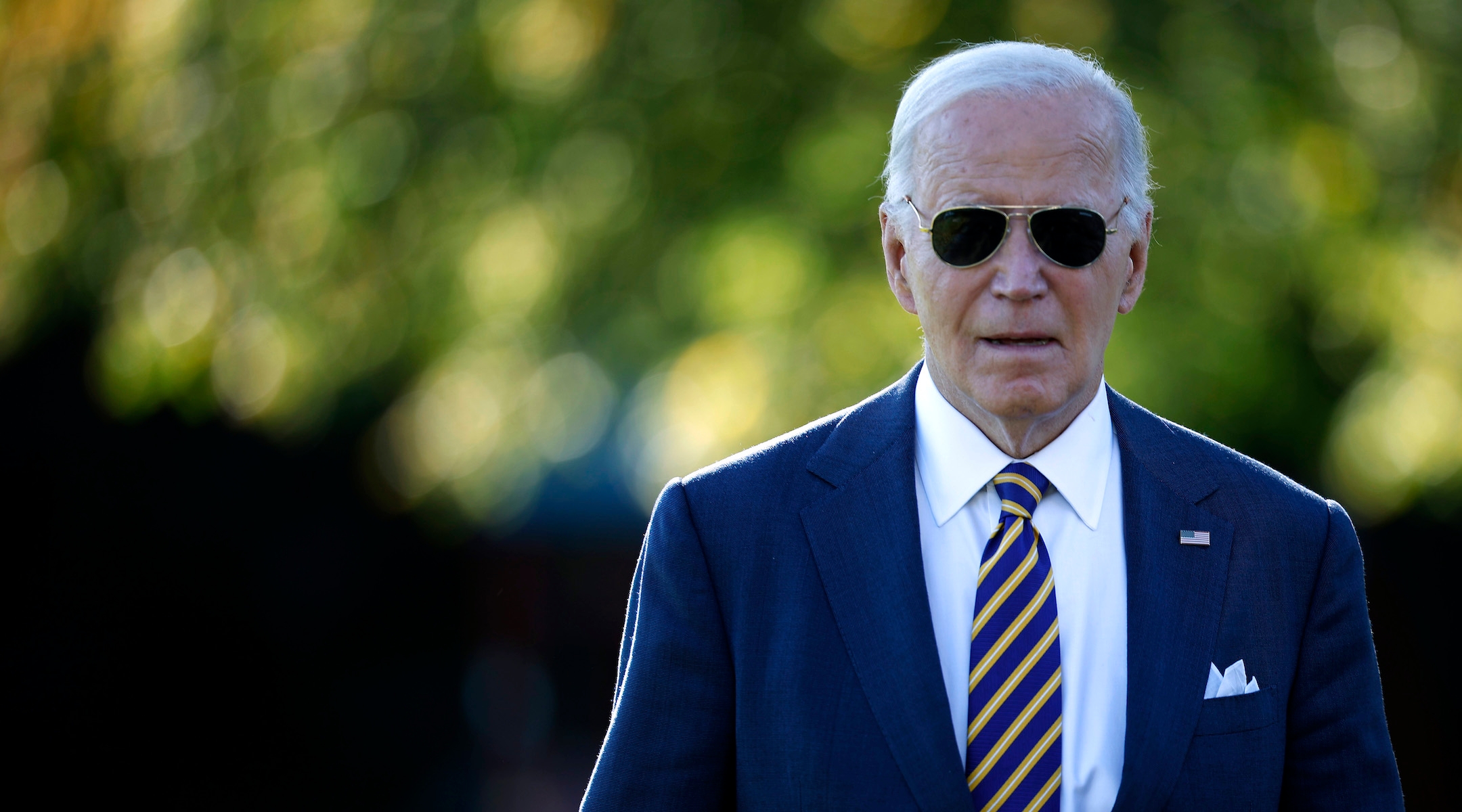
President Joe Biden, pictured on Oct. 24, 2024. (Chip Somodevilla/Getty Images)
(JTA) — President Joe Biden said he wants Israel’s strike on Iran to be “the end” of direct fighting between the two countries, as Iran said it had the right to respond to the attack but did not vow to do so.
Israel said that it had concluded its strikes against Iran, and warned Iran against beginning what it called a “new round.”
The Israeli attack on Saturday came in response to Iran firing more than 180 missiles at Israel on Oct. 1, and was supported by the Biden administration. But American officials had pressed Israel to avoid bombing nuclear or oil facilities, fearing that the conflict could spiral into a wider regional war.
Israel’s strike early on Saturday morning appeared to heed that request: A group of more than 100 Israeli aircraft set off for Iran, according to The New York Times, bombing military sites in Syria and Iraq en route. In Iran, Israel struck some 20 targets, including sites that produce long-range missiles, as well as air defense sites. Four Iranian soldiers were killed in the attack.
Speaking to reporters on Saturday, Biden said he had spoken with intelligence officials about the strike.
“It looks like they didn’t hit anything other than military targets,” he said. “My hope is this is the end.”
The attack came less than two weeks before the United States presidential election, and both major candidates said they supported Israel’s strike. Former President Donald Trump had reportedly told Israeli Prime Minister Benjamin Netanyahu, “Do what you have to do.” And Vice President Kamala Harris echoed Biden’s position.
“We maintain the importance of supporting Israel’s right to defend itself,” Harris told reporters. “And we are also very adamant that we must see de-escalation in the region going forward, and that will be our focus.”
Iran expressed outrage at the attack and linked it to Israel’s conflicts with Hamas in Gaza and Hezbollah in Lebanon, both Iranian proxies. But the statement by Seyed Abbas Araghchi, Iran’s foreign minister, did not promise an Iranian response to this attack.
Araghchi also confirmed that Israel struck military targets.
“We strongly condemn the criminal attack on Iranian military centers as a violation of international law and the UN Charter,” his statement said. “We fully reserve our right to duly respond to this aggression, which cannot be separated from Israel’s genocide in Gaza and bloodshed in Lebanon. The world must unite against this common threat to international peace & security.”
This is the second round of direct conflict between Iran and Israel this year following years of indirect fighting. In April, following the reported Israeli assassination of Iranian officials in Syria, Iran fired hundreds of projectiles at Israel, causing little damage. Israel responded with a strike on a military target in Iran.
Iran’s Oct. 1 attack, which also caused little damage, came after Israel killed the head of Hezbollah, Iran’s largest proxy, in Lebanon. Following Saturday’s operation, Israeli military spokesman Daniel Hagari said that Israel had no further plans to attack Iran, and cautioned against a response.
“We conducted targeted and precise strikes on military targets in Iran, thwarting immediate threats to the state of Israel,” he said. “The Israel Defense Forces has fulfilled its mission. If the regime in Iran were to make the mistake of beginning a new round of escalation, we will be obligated to respond.”
But Israeli politicians both in Netanyahu’s coalition as well as the parliamentary opposition chided him for not hitting Iran harder. Yair Lapid, the centrist leader of the opposition, praised the military for the attack but said it should have gone further.
“The decision not to attack strategic and economic targets in Iran was a mistake,” Lapid tweeted. “We could have and should have exacted a much higher price from Iran.”
Itamar Ben-Gvir, Israel’s far-right national security minister, said Israel should attack Iran again.
“The attack on Iran was important as an opening blow before hitting Iran’s strategic assets, which must be the next stage,” he tweeted. “We have a historic duty to remove the Iranian threat to destroy Israel.”
This is a moment of great uncertainty. Here’s what you can do about it.
We hope you appreciated this article. Before you go, we’d like to ask you to please support the Forward’s independent Jewish news this Passover. All donations are being matched by the Forward Board - up to $100,000.
This is a moment of great uncertainty for the news media, for the Jewish people, and for our sacred democracy. It is a time of confusion and declining trust in public institutions. An era in which we need humans to report facts, conduct investigations that hold power to account, tell stories that matter and share honest discourse on all that divides us.
With no paywall or subscriptions, the Forward is entirely supported by readers like you. Every dollar you give this Passover is invested in the future of the Forward — and telling the American Jewish story fully and fairly.
The Forward doesn’t rely on funding from institutions like governments or your local Jewish federation. There are thousands of readers like you who give us $18 or $36 or $100 each month or year.
Support our mission to tell the Jewish story fully and fairly.