Lawmakers push to block US involvement in Iran as Trump signals willingness to join fight
‘This is not our war,’ said Kentucky Republican Rep. Thomas Massie
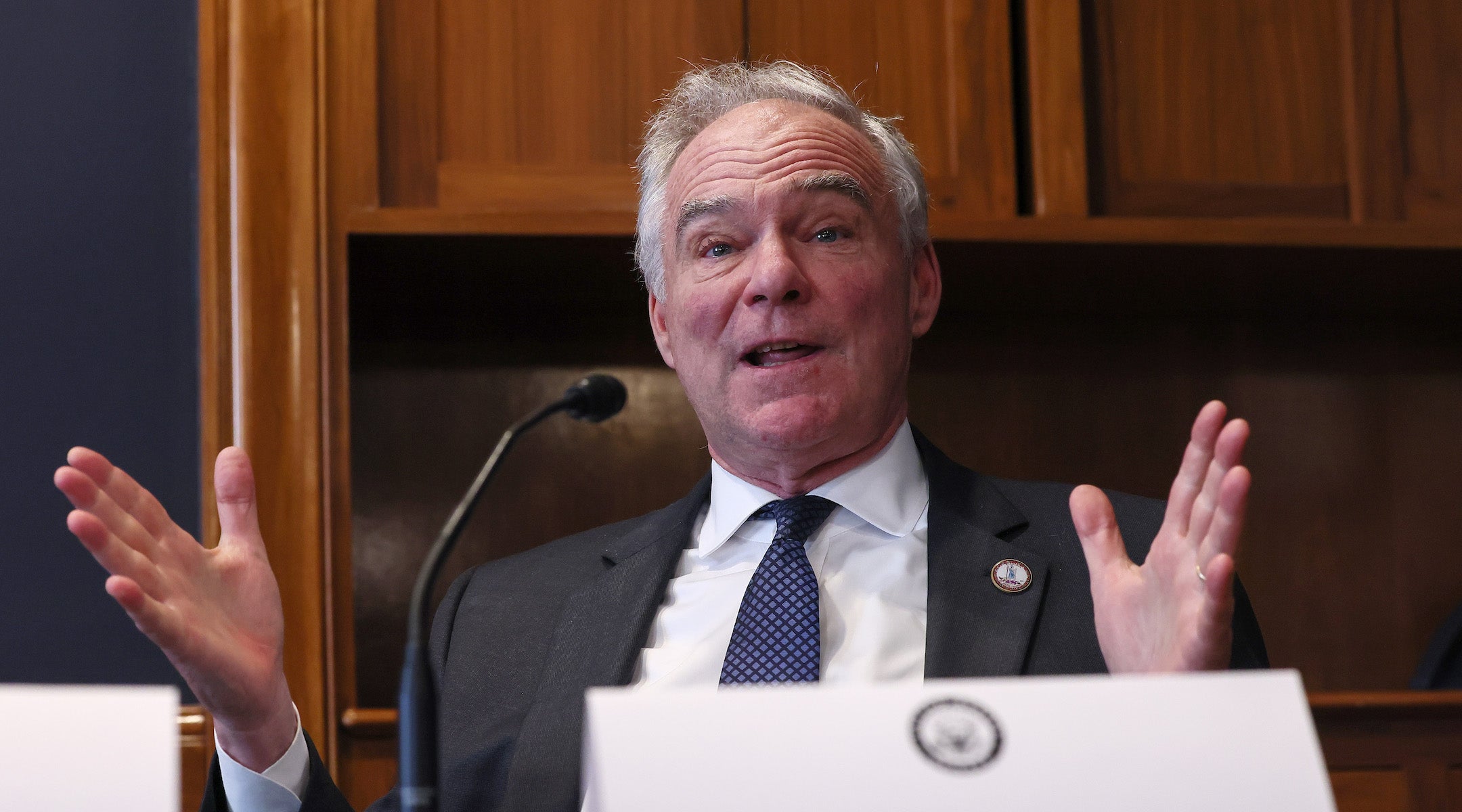
Sen. Tim Kaine, a Virginia Democrat, on May 14, 2025 in Washington, DC. (Jemal Countess/Getty Images for Student Borrower Protection Center)
(JTA) — Lawmakers from both parties are pushing to block President Donald Trump from bringing the United States into Israel’s ongoing conflict with Iran.
A Senate bill and a resolution introduced in both the House and Senate landed this week as Trump has signaled to officials and in public comments that he may be leaning towards intervening against Iran in the campaign launched by Israel last week.
The bill and resolutions aimed at limiting the United States’ involvement come from a bipartisan bloc of lawmakers seeking to constrain Trump’s power and from Jewish Sen. Bernie Sanders, the Independent from Vermont.
The resolution introduced in both the House and Senate invokes a 1973 federal law barring the president from entering an armed conflict without Congress’ approval.
In the House, Kentucky Republican Rep. Thomas Massie and California Democratic Rep. Ro Khanna jointly introduced the resolution, which would prohibit “United States Armed Forces from unauthorized hostilities in the Islamic Republic of Iran.” They used a form of legislation that could force a full House vote.
“This is not our war,” Massie, who often stands alone among his Republican colleagues and has drawn opposition from Republican Jews, in a post on X Monday. “But if it were, Congress must decide such matters according to our Constitution. I’m introducing a bipartisan War Powers Resolution tomorrow to prohibit our involvement.”
“No war in Iran. It’s time for every member to go on record,” said Khanna in a post on X Monday comparing the current conflict to the United State’s involvement in Iraq in 2003. “Are you with the neocons who led us into Iraq or do you stand with the American people?”
Fourteen House Democrats, including New York Rep. Alexandria Ocasio-Cortez and Minnesota Rep. Ilhan Omar, have joined the resolution, which has received pushback from some pro-Israel lawmakers.
“If AOC and Massie are a yes, that’s a good bet that I’ll be a no,” said New York Republican Rep. Mike Lawler in a post on X Monday. “A nuclear Iran will seek to eradicate Israel and all but ensure WWIII. We cannot allow that to happen. We must stand with Israel.”
Virginia Democratic Sen. Tim Kaine introduced a companion resolution in the Senate Monday, calling for a debate and vote in Congress before using any military force against Iran.
“It is not in our national security interest to get into a war with Iran unless that war is absolutely necessary to defend the United States. I am deeply concerned that the recent escalation of hostilities between Israel and Iran could quickly pull the United States into another endless conflict,” said Kaine in a statement.
“The American people have no interest in sending servicemembers to fight another forever war in the Middle East. This resolution will ensure that if we decide to place our nation’s men and women in uniform into harm’s way, we will have a debate and vote on it in Congress,” the statement continued.
Sanders’ No War Against Iran Act, which seven Democratic senators have signed, seeks to prohibit the use of federal funds for military action against Iran without authorization from Congress.
“Netanyahu’s reckless and illegal attacks violate international law and risk igniting a regional war. Congress must make it clear that the United States will not be dragged into Netanyahu’s war of choice,” Sanders said in a statement announcing the bill. “Our Founding Fathers entrusted the power of war and peace exclusively to the people’s elected representatives in Congress, and it is imperative that we make clear that the President has no authority to embark on another costly war without explicit authorization by Congress.”
Senators that have signed onto Sanders’ bill include Peter Welch of Vermont, a cosponsor; Elizabeth Warren of Massachusetts; Chris Van Hollen of Maryland, who was among the earliest critics of Israel’s attack on Iran; Ed Markey of Massachusetts; Tammy Baldwin of Wisconsin; and Tina Smith of Minnesota.
Sanders first introduced the legislation in January 2020, and at the time Sen. Chuck Schumer, the Jewish New York Democrat and Senate minority leader, signed onto it. Schumer has not supported the new legislation, underscoring a lack of support from the majority of Democrats who have expressed support for Israel’s attack on Iran.
Some opposing U.S. intervention have taken a stronger stance, saying that the United States simply should not enter the war, with or without congressional debate. They include some in Trump’s MAGA movement who have been openly feuding with him.
This is a moment of great uncertainty. Here’s what you can do about it.
We hope you appreciated this article. Before you go, we’d like to ask you to please support the Forward’s independent Jewish news this Passover. All donations are being matched by the Forward Board - up to $100,000.
This is a moment of great uncertainty for the news media, for the Jewish people, and for our sacred democracy. It is a time of confusion and declining trust in public institutions. An era in which we need humans to report facts, conduct investigations that hold power to account, tell stories that matter and share honest discourse on all that divides us.
With no paywall or subscriptions, the Forward is entirely supported by readers like you. Every dollar you give this Passover is invested in the future of the Forward — and telling the American Jewish story fully and fairly.
The Forward doesn’t rely on funding from institutions like governments or your local Jewish federation. There are thousands of readers like you who give us $18 or $36 or $100 each month or year.
Support our mission to tell the Jewish story fully and fairly.