Supreme Court allows US terrorism victims to sue Palestinian entities
The ruling will be applied to attacks that occurred during the Second Intifada in the 2000s that killed 33 as well as the 2018 murder of Ari Fuld
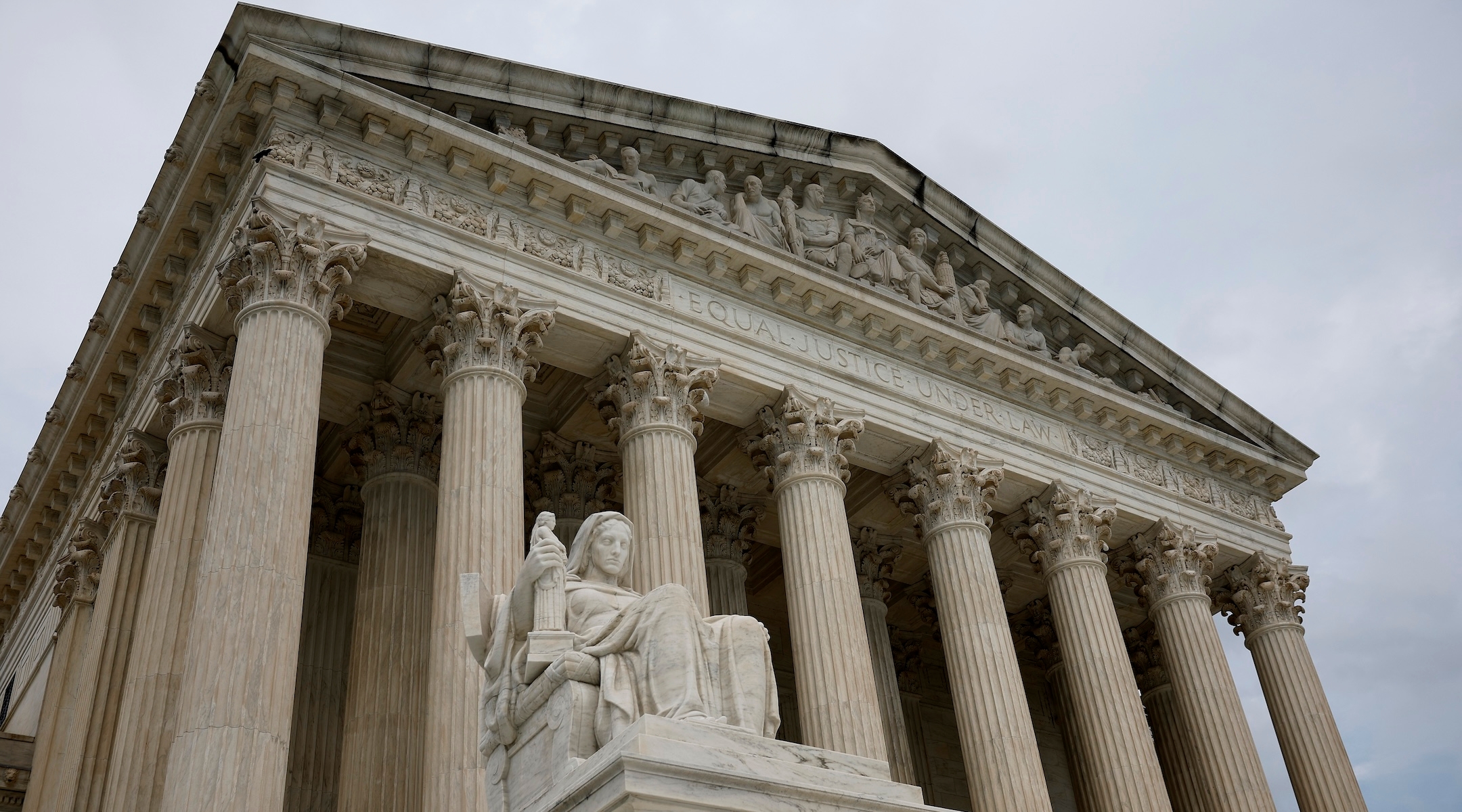
The U.S. Supreme Court in Washington, D.C., is pictured on July 30, 2024. Photo by Kevin Dietsch/Getty Images
(JTA) — The Supreme Court upheld a law allowing the families of victims of terrorism to sue Palestinian entities in U.S. courts, reviving decades-old lawsuits against the Palestine Liberation Organization and the Palestinian Authority.
The ruling, which was delivered June 20 in a case naming the murdered American-Israeli activist Ari Fuld, upheld the 2019 Promoting Security and Justice for Victims of Terrorism Act and found that the law did not violate the due process of the Palestinian entities.
The Supreme Court found that the law accounted for “sensitive foreign policy matters within the prerogative of the political branches,” Chief Justice John Roberts wrote for the court.
The court has “recognized the national government’s interest in holding accountable those who perpetrate an ‘act of violence against’ US nationals — who, even when physically outside our borders, remain ‘under the particular protection’ of American law,” Roberts wrote. “So too the national government’s corresponding authority to make ‘the killing of an American abroad’ punishable as a federal offense ‘that can be prosecuted in (US) courts.”
The ruling will be applied to attacks that occurred during the Second Intifada in the 2000s that killed 33 as well as the 2018 murder of Fuld, who was the named plaintiff in the case before the Supreme Court.
The Palestinian entities have argued that the cases should not be fought in American courts. The federal appeals court in New York had previously ruled in favor of the Palestine Liberation Organization and the Palestinian Authority.
The Supreme Court’s decision will likely lay the foundation for other U.S. victims of terrorism by Palestinian groups to seek damages through litigation in U.S. courts.
In March, the U.S. Justice Department announced a task force that will seek redress for the victims of Hamas’ Oct. 7, 2023 attack on Israel by prosecuting people who participated in the attack as well as Hamas leaders who orchestrated it.
This is a moment of great uncertainty. Here’s what you can do about it.
We hope you appreciated this article. Before you go, we’d like to ask you to please support the Forward’s independent Jewish news this Passover.
This is a moment of great uncertainty for the news media, for the Jewish people, and for our sacred democracy. It is a time of confusion and declining trust in public institutions. An era in which we need humans to report facts, conduct investigations that hold power to account, tell stories that matter and share honest discourse on all that divides us.
With no paywall or subscriptions, the Forward is entirely supported by readers like you. Every dollar you give this Passover is invested in the future of the Forward — and telling the American Jewish story fully and fairly.
The Forward doesn’t rely on funding from institutions like governments or your local Jewish federation. There are thousands of readers like you who give us $18 or $36 or $100 each month or year.
Support our mission to tell the Jewish story fully and fairly.