America’s oldest synagogue closed. Then an unlikely group tended its cemetery.
For decades after its congregation faded, one of America’s oldest Jewish cemeteries endured — preserved by both Christians and Jews
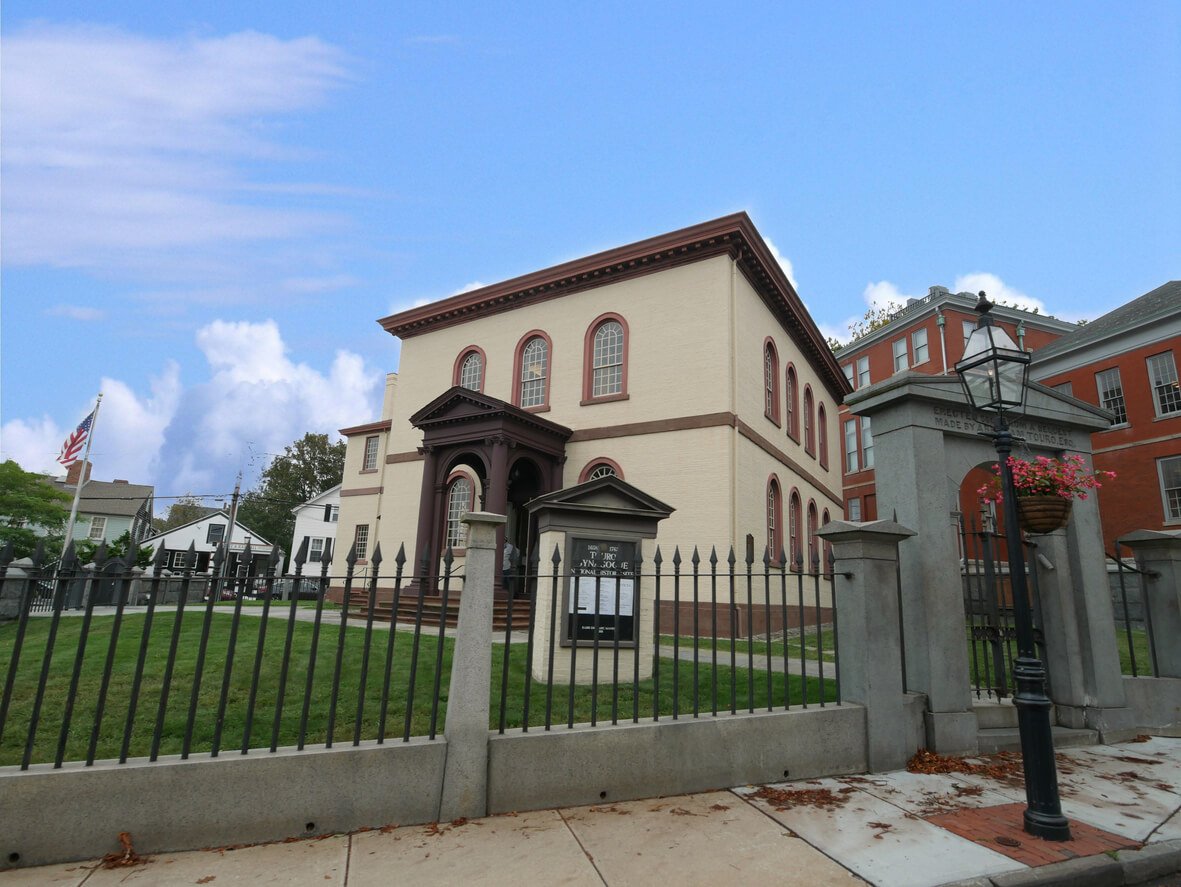
The Touro Synagogue in Newport, Rhode Island. Photo by iStock
By Austin Albanese March 29, 2026
In 1833, Herald of the Times, a Newport, Rhode Island, newspaper, reported that the remains of Mrs. Rebecca Lopez had been brought from New York by steamboat and placed inside Touro Synagogue.
Dedicated in 1763, the building is now recognized as the nation’s oldest surviving synagogue. Newport had once been home to a thriving colonial Jewish community, but after the Revolutionary War and the city’s economic decline, that community had largely faded. The cemetery remained, and so did the synagogue. It was during that long interval of near-absence that Lopez’s funeral briefly reopened Jewish ritual life in Newport.
After prayers were read by Rabbi Isaac Seixas of New York, the body was carried to the cemetery on Touro Street, with “the clergy, town council, and a numerous concourse of spectators” joining the funeral procession. The paper noted that a Jewish ceremony had not been performed there “for the space of forty years.”
Newport’s Jewish burial ground dated to 1677. In 1822, Abraham Touro left money for the upkeep of the cemetery, the synagogue, and the street on which they stood. The fund was placed under trustees appointed by the Rhode Island legislature, and Newport’s Town Council was later authorized to use the interest for repairs.
While Newport’s Jewish population declined, the endowment ensured that the synagogue building and cemetery grounds continued to be maintained. In 1826, the Town Council reported that it had tried to repair the synagogue using the Touro fund, but could not proceed because it had not been able to obtain the keys from Shearith Israel in New York. Many of Newport’s former Jewish residents had relocated there, and the congregations had longstanding ties.
In 1842, the council contracted to enclose the synagogue lot with a substantial stone wall and an ornamental cast-iron fence, modeled on the fence around the Jewish cemetery. The work included a Quincy granite base and a gateway on Touro Street designed to correspond with the synagogue’s portico. The project cost $6,835.
The synagogue’s doors rarely opened, and often only for moments of mourning. In June 1854, Newport received the body of Judah Touro, one of the most prominent American Jews of his era, a native of the town and brother of Abraham Touro. The Herald of the Times reported that “the streets was [sic] crowded with people, the stores all closed, and the bells tolled.”
The City Council assembled at City Hall and marched in procession to the synagogue, where “thousands remained outside” during the service. At the funeral, Newport’s mayor, William C. Cozzens, spoke of the trust that had long existed between the city and local Jewish families, recalling that the synagogue and cemetery had been left in Newport’s care and maintained there “with ample means for their preservation.”
When Henry Wadsworth Longfellow visited Newport’s Jewish cemetery that same year, he wrote of the graves as “silent beside the never-silent waves.” He noticed, too, what endured there: “Gone are the living, but the dead remain,” he observed, “and not neglected.”
Newport’s preservation of Jewish sacred space was shared. Jews endowed these places and returned to bury their dead there. Christian officials repaired, protected, and publicly honored them. In this way, a Jewish inheritance was carried forward until communal life returned.
In 1883, Touro Synagogue was rededicated and a new Jewish community established in Newport. But even in the window of years when the congregation was gone, the dead were not abandoned.
The graves were kept.
Did you know that only 2% of Forward readers donate to support our nonprofit newsroom? That 2% make it possible for millions to read the Forward without a paywall or subscription — removing any barriers to the full and fair Jewish story.
But while the Forward is free to read, it isn’t free to produce. Big stories — like deep dives into the antisemitism data, political scoops or reporting trips to college campuses — take months of research and fact-checking. All while we keep you informed of what you need to know each day.
— Rachel Fishman Feddersen, Forward Publisher & CEO
Support our mission to tell the Jewish story fully and fairly.