Garry Trudeau was a prep school kid, but he identified with the Jewish outsider in ‘Doonesbury’
Trudeau had more in common with ‘Megaphone Mark’ Slackmeyer than you might think
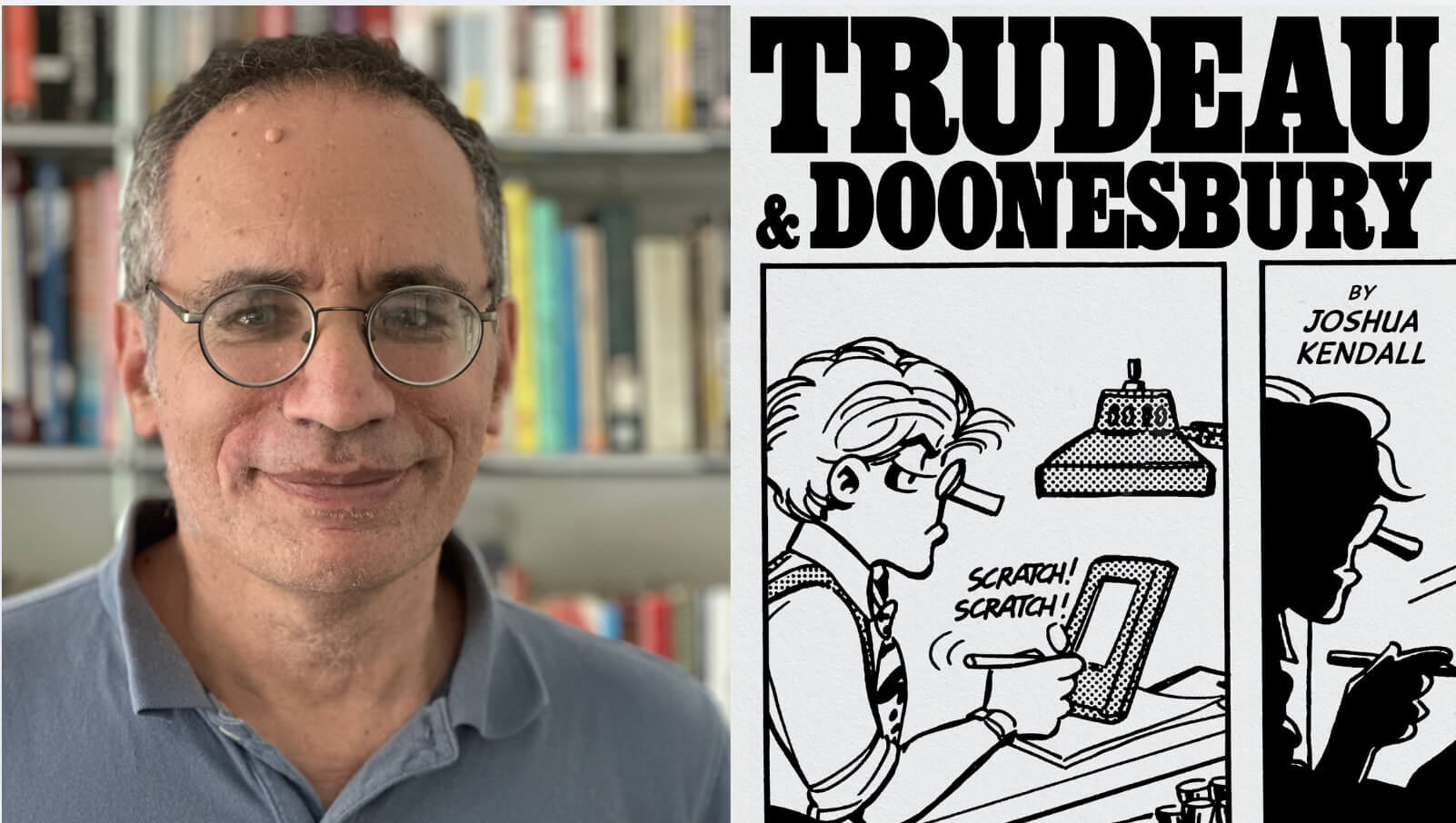
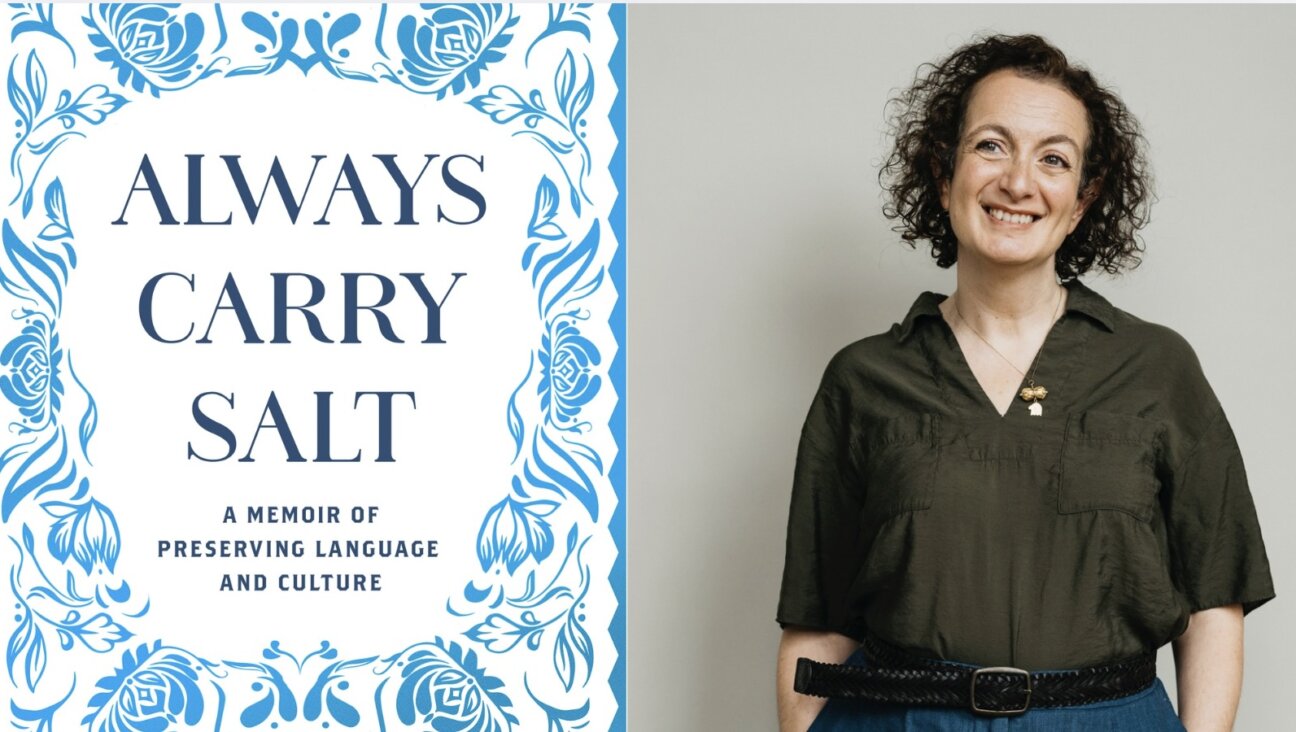
Joshua Kendall’s latest biography is ‘Trudeau and Doonesbury: The Cartoonist Who Turned the News into Art.’ Courtesy of Abrams Press
Doonesbury made its debut in Oct. 1970, appearing in 28 newspapers across the nation, including The Washington Post, The Chicago Tribune and The Boston Globe. Just a few weeks later, its creator, the 22-year-old Garry Trudeau, who had received his Yale sheepskin the previous spring, introduced mainstream America to Mark Slackmeyer — the campus radical who happened to be a Jew.
At the beginning of the 20th century, whole strips had sometimes focused on the Jewish experience. Harry Hirschfield’s Abie the Agent chronicled the life of a Jewish car salesman and ran in numerous papers in major metropolitan areas from 1914 to 1940. Likewise, the characters in George Herriman’s Krazy Kat, which flourished during roughly the same period, occasionally lapsed into Yiddish.
But by the 1950s, Jews and Jewish references had all but disappeared. As cartoonist and cartoon historian Brian Walker told me, “Once the power of syndicates such as King Features increased dramatically after World War II, the comics pages became much more homogenized. These national players began fearing that characters that were too specific — say, Jews or Blacks — might alienate readers in one part of the country — namely, the South.”
While the influence of Jews on the cartoon world could still be seen in the 1950s and 60s — consider the popularity of the Superman strip created by Jerry Siegel and Joe Schuster during the Depression — Jewish creators were often forced to operate behind the scenes.
Trudeau’s “Megaphone Mark” — who sported long hair and a bushy beard —was modeled on Mark Zanger, the leader of the Yale chapter of SDS (Students for a Democratic Society). Mark’s first act in the strip is to take over the office of President King, the WASPy president of Walden College, who was based on the actual Yale president, Kingman Brewster. Over the next few months, Trudeau increasingly used Mark’s clashes with his father Phil, a New Jersey stockbroker desperate for his son to “succeed,” to dramatize tensions within postwar Jewish life.
Phil represents a generation of upwardly mobile Jews who believed acceptance in corporate and suburban America required conformity, restraint and the concealing of ethnicity. Mark, by contrast, is openly confrontational, culturally self-aware, and seems uninterested in assimilationist respectability.
Mark’s Jewish identity was not made explicit until the middle of 1971, when he and his college buddy Mike Doonesbury attend a talk by a famous religious crusader. Asked why he has not yet chosen to join the fold and lead a proper Christian life, Mark deadpans, “I’m Jewish.”
At Yale, Trudeau hardly knew Zanger and had much less in common with him than he had with Kingman Brewster, whose ancestors sailed to America on the Mayflower. Trudeau was descended from three generations of Ivy-League-educated physicians. Like his father, the hardworking family doctor Frank Trudeau, the cartoonist attended St. Paul’s — one of the most blueblood of all New England prep schools. And though the young Yalie, like the genteel Brewster, opposed the war in Vietnam, he wanted nothing to do with radical politics.
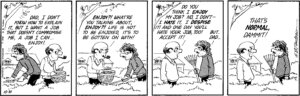
But Trudeau identified closely with some of the personal struggles of Megaphone Mark. After all, he was also bucking family tradition by becoming an artist rather than a doctor. As Trudeau told me, some of Mark’s quarrels with his father hit close to home. Consider the line that Phil tells Mark in the fall of 1973: “Life is not to be enjoyed, it’s to be gotten on with!” Those words came verbatim from the mouth of Frank Trudeau, though, the younger Trudeau said, “my father and I ended up getting along pretty well and later came to laugh about such harsh comments.”
A key reason why Trudeau saw a part of himself in his Jewish cartoon character is that this ultimate insider also knew what it felt like to be an outsider. For many American Jews of the postwar era, especially those attending elite institutions historically dominated by WASP norms and values, Jewishness came with a sense of conditional acceptance, of not fully belonging. Trudeau had an emotionally similar experience at St. Paul’s, where he felt deeply estranged from the school’s rigid social hierarchy and its obsessive emphasis on athletic status. As the cartoonist later stressed, his four years there were “a tortured time for me.” He hated the school’s culture and never felt fully at home within it.
At Yale, Trudeau tended to surround himself with other St. Paul’s alums who had felt just as alienated during high school, such as his roommate Charles Pillsbury. Pillsbury, whose family name inspired that of the strip’s protagonist, Mike Doonesbury, told me, “Like Garry, I constantly felt as if I was being ranked by my fellow students on where I stood in athletics or popularity.”
Another aspect of St. Paul’s that completely horrified both Trudeau and Pillsbury was the virulent harassment directed toward its token Jews. “I once saw a classmate approach a Jewish kid and throw some coins in his direction, shouting, ‘Go pick up your shekels.’ I was glad to get out of there,” Pillsbury said.
The emergence in the comic pages of “Megaphone Mark” also reflected the demographic changes that most Ivy League schools underwent in the late 1960s. In Yale’s class of 1968 — which included future president George W. Bush — 40% of students came from public schools and 60% from prep schools. In Trudeau’s class of 1970, the percentages were reversed. And with the elimination of the quota system that had long restricted the admission of minority students, Trudeau’s class contained nearly 250 Jews — more than twice as many as the previous class.
A graduate of a public high school in Queens, biographer Ron Chernow, like Trudeau, started Yale in the fall of 1966. The Pulitzer Prize-winning author told me that, early in his first semester at Yale, he went to an orientation meeting at Yale’s Hillel where the school’s rabbi proudly proclaimed, “’My brethren, it is wonderful to see many of you here! You will hear it said that for the last fifty years, there were quotas on Jewish students. But this is a malicious lie. It’s purely coincidental that between 108 and 110 Jewish students attended Yale every year.’”
Mark’s battles with his father in Trudeau’s 1970s strips also reflect the society-wide divide between the Greatest Generation and the Baby Boomers that defined the decade. Phil can’t seem to understand why his son wouldn’t want to become part of the establishment — say, land a well-paying job and join his suburban golf club. Unfortunately, like many Jews who came of age during the 1950s, Phil feels he needs to pretend not to be Jewish in order to make his way in the world. As Trudeau stressed, Phil is so disconnected from his own identity that he doesn’t even consider himself a Jew.
In a Sunday strip from late 1973, Phil — who, like Frank Trudeau had graduated during World War II from the same college that his son now attended — encourages Mark to join his old fraternity because “those people can help you later on in life.” Mark protests, arguing that “the guys in it are all snobby jerks.” Phil then berates Mark, exclaiming that “you always reject people from your own background,” before adding, “I’ll bet you’re even dating some Jewish girl!” After Mark reminds Phil that they are Jewish, his father is forced to concede, “Oh, that’s right.”
But in the end, it took a preppy WASP to broach the tension between assimilationist anxiety and a self-assured, unapologetic Jewish sense of identity to mainstream America in the funny papers.

Hello, fellow Forward reader! I’m Joel Brown, a Forward reader and supporter for more than 15 years, and currently the chair of the board of directors.
I’m an avid Forward reader because it ticks so many of my essential boxes: excellent journalism, Jewish focus and diverse viewpoints. In today’s political climate, what I most appreciate is the Forward’s independence — made possible by the generosity of its membership.
The Forward is committed to bringing you unbiased, nuanced Jewish news. From my position as board chair, I see an exciting future as we expand our position as the definitive independent voice of contemporary American Judaism.
That’s why I’m paying it Forward, by matching $36,000 of reader gifts. It’s an investment in the Forward’s newsroom, to continue telling the American Jewish story with truth and independence.
— Joel Brown, Forward board chair
Support our mission to tell the Jewish story fully and fairly.