Jack Kirby finally gets his corner of the city that made him super
The comic book artist and writer who couldn’t wait to leave the Lower East Side is now immortalized there
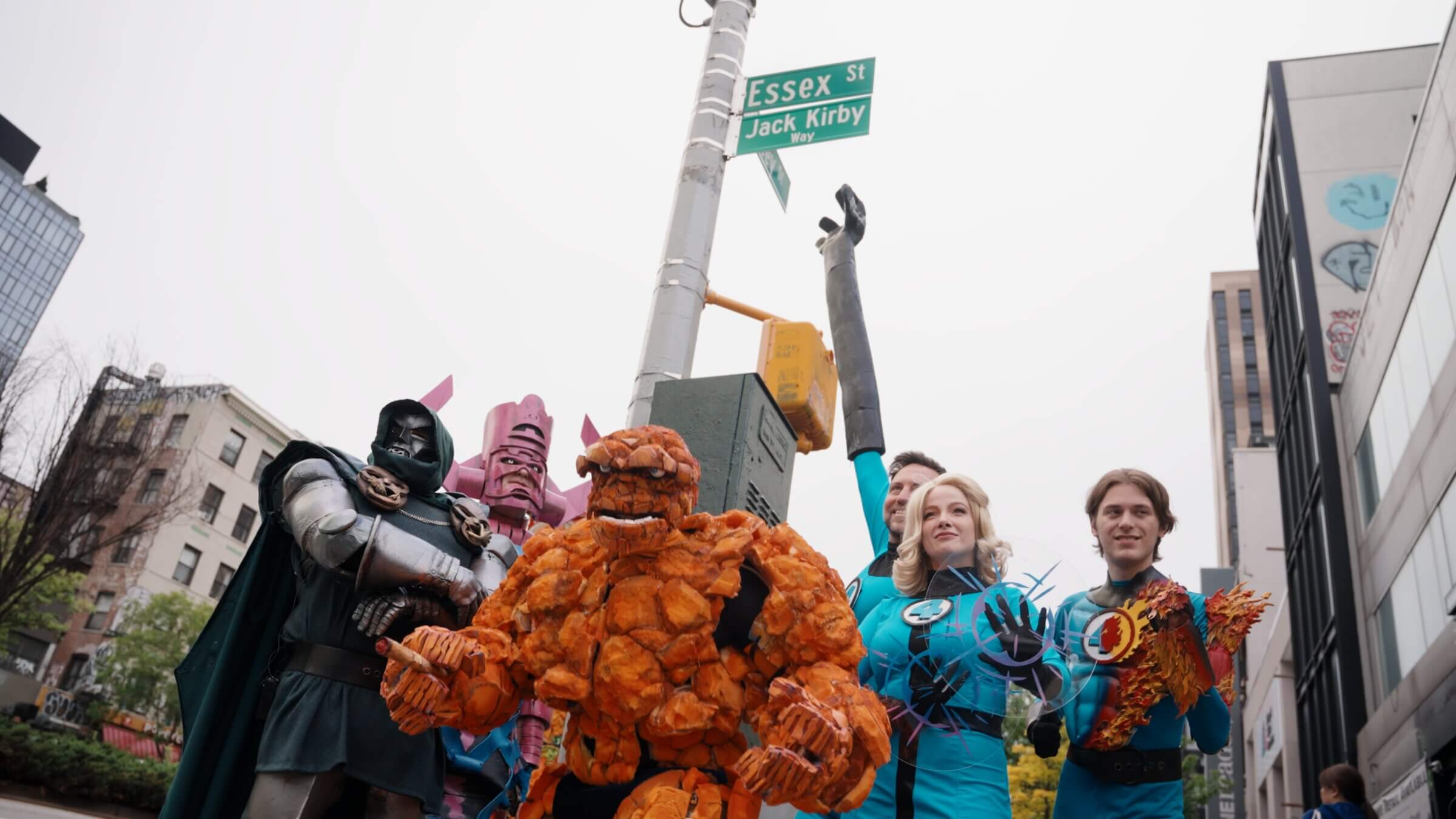
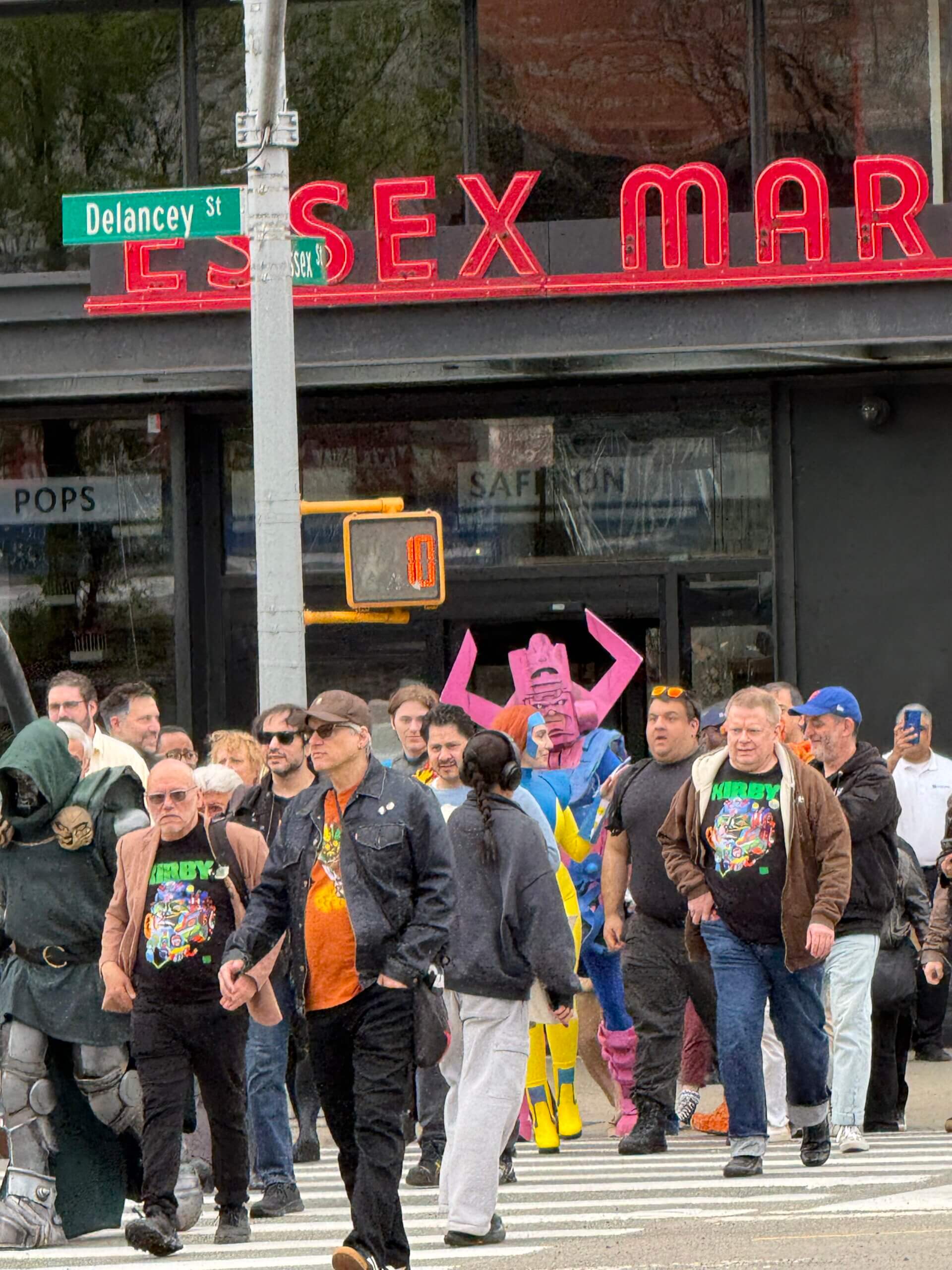
Cosplayers honor Jack Kirby after the unveiling of Jack Kirby Way. Courtesy of Lower East Side Partnership
By PJ Grisar May 13, 2026
Jack Kirby Way is located at the intersection of Essex and Delancey Street and at the crossroads of a created universe.
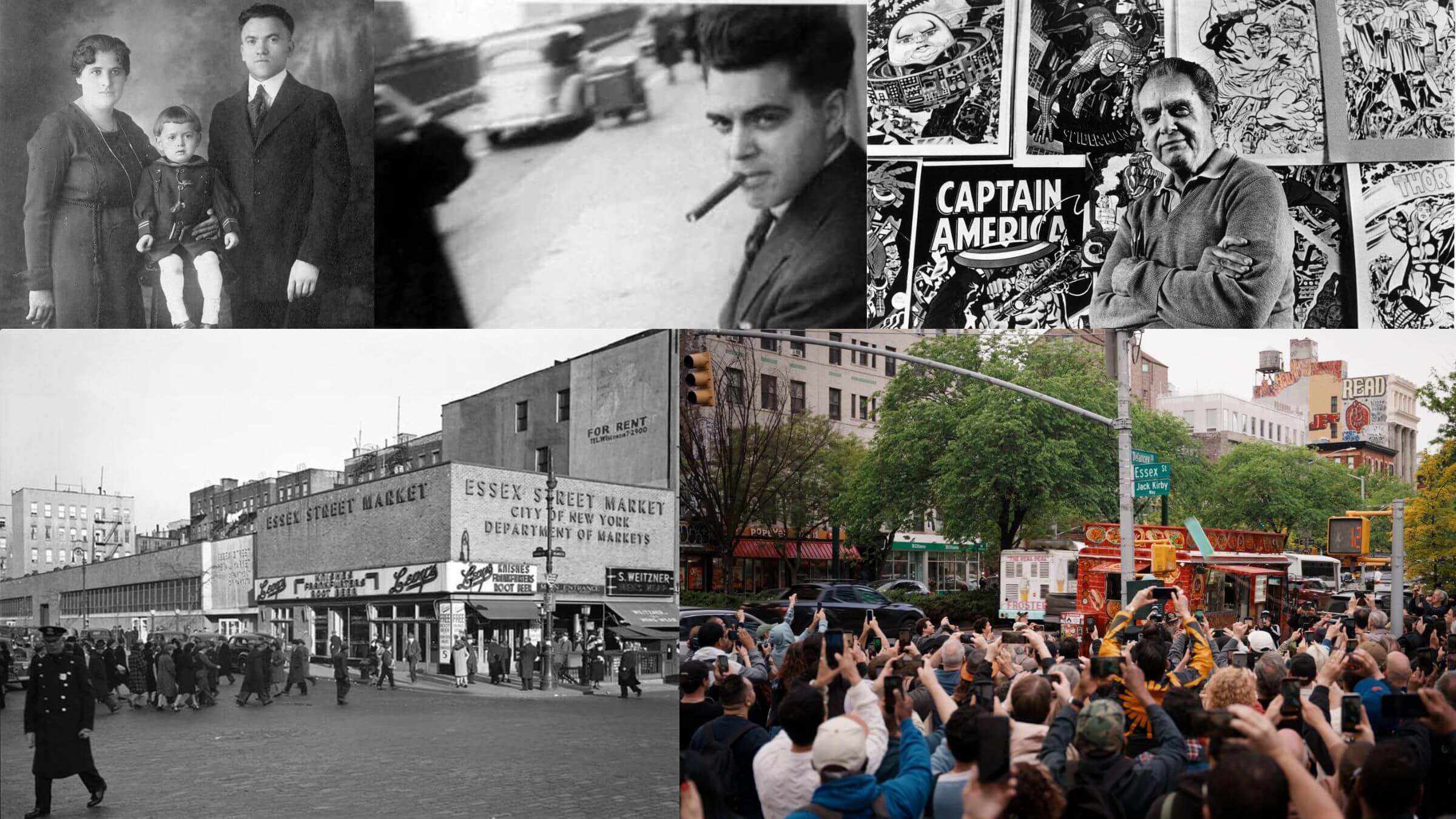
More prosaically, it shares a corner with a McDonald’s and a halal truck. Across the street is the subway stop and the old, permanently closed Essex Street Market building from whence Levy’s sold its famous frankfurters. If you cross Delancey, you reach the new Essex Market, boasting world cuisines and the singular hybrid food of macaroni-and-cheese pancakes at Shopsins General Store.
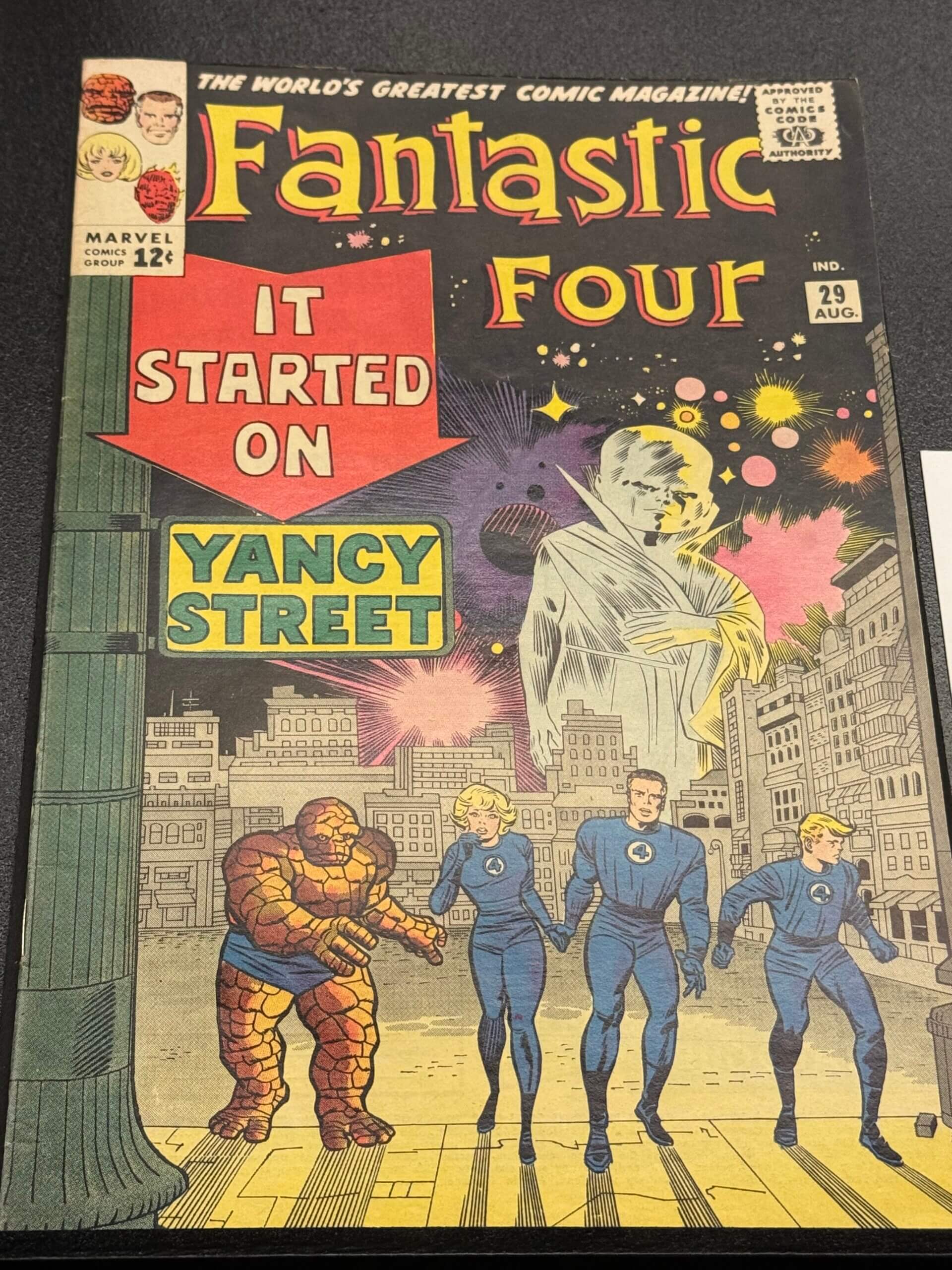
A few blocks away: Forget it, Jack, it’s Chinatown. But in this small patch of the world, Jacob Kurtzberg came of age amid the pushcarts and street melees he documented in his graphic story Street Code and reimagined in Yancy Street, the home turf of the Fantastic Four’s Ben Grim.
“You became a toreador at an early age, just dodging ice wagons,” Kirby, born on 147 Essex, later recalled, not disguising his fear of “the ghetto,” and his desire to break free from a world that all but required membership in a street gang to survive.
On May 11, Kirby made a homecoming nonetheless. Dozens, many in costume, gathered to witness the dedication of the street that now bears his name. The word on everyone’s lips: “overdue.”
“I think everyone on Earth at this point knows something Jack Kirby made without knowing the name,” said Alex Baglio, dressed in the original, Kirby-designed costume of Captain America’s sidekick Bucky Barnes.
For years, devotees of King Kirby have had to settle for hints of his massive influence in Marvel’s new age of mass appeal — a forgettable Eternals film here, an homage to his art there.
“I was just excited by the wall painting in the back of Thor: Ragnarok; it took so little for me to be happy,” said Baglio, there with his coworker Kris Nedelka, who was dressed like Captain America.
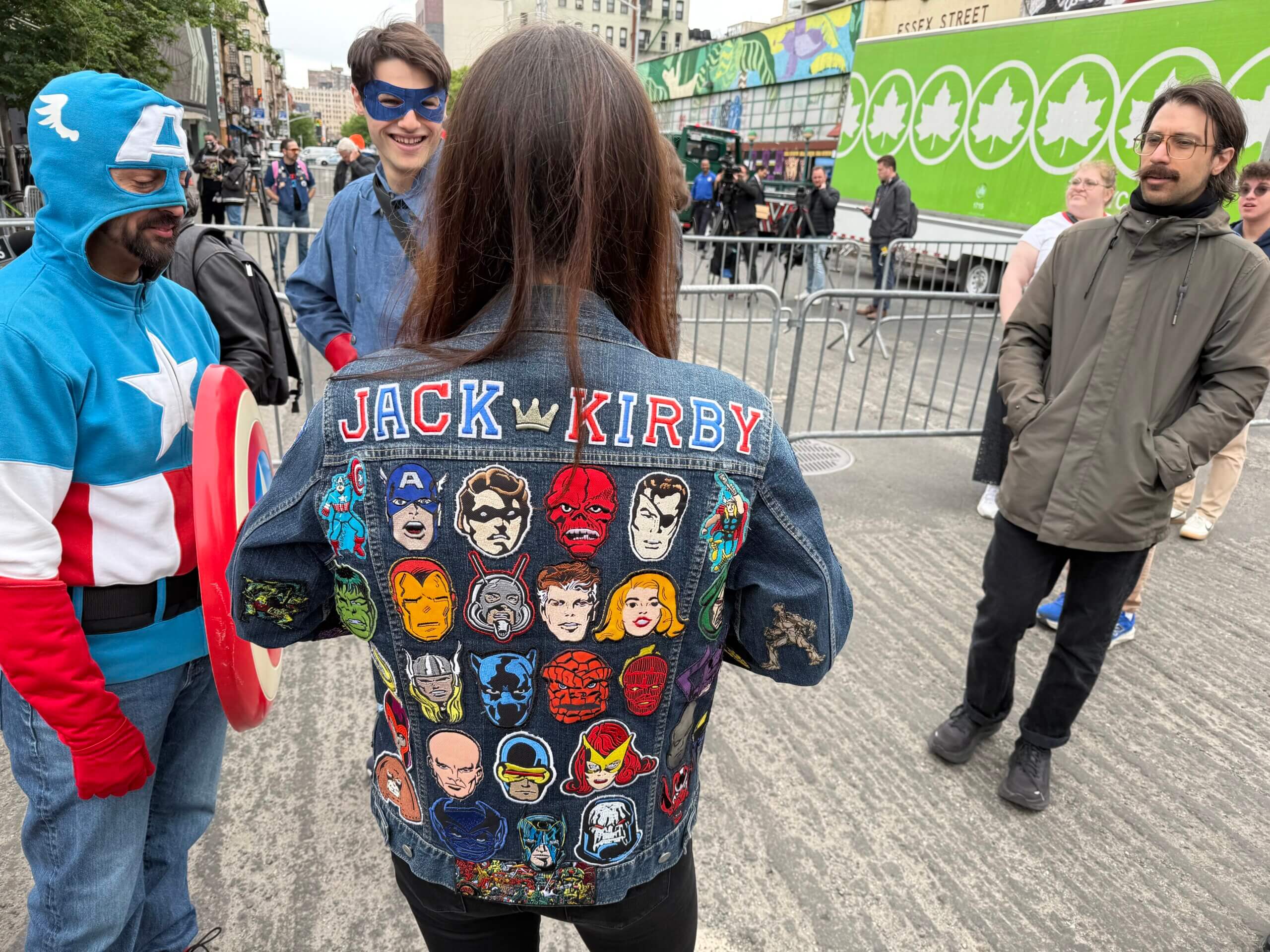
More professional cosplayers were also in attendance; the Thing kicked off the occasion with the cry of “it’s clobberin’ time.” (Another, amateur Thing was so committed to character he kept his mask on, rendering his interview inaudible.)
The naming was more than symbolic recognition. For many, it was justice for a creator whose contributions were eclipsed, and arguably erased, by his creative partner and boss, the writer and editor Stan Lee, with whom he developed the Fantastic Four, X-Men, Black Panther and Thor, to name just a few.
Marvel has been slow to give him his full credit even after it exploded into a multibillion dollar multimedia franchise over a decade after Kirby’s 1994 death. (Lee, who wrote the credits on the comics, had a way of fudging exactly who had what idea.)
The effort to get Kirby his street cred due — there’s a Stan Lee Way in Lee’s old neighborhood in the Bronx — was fan-driven, following an earlier, one-day renaming at the same intersection in advance of last summer’s film Fantastic Four: First Steps.
“The street naming on July 9, 2025, what was meant as a homage and was done with full hearts, struck me as almost an injustice, because Jack Kirby deserved the street name in perpetuity,” said Roy Schwartz, a comic historian and Forward contributor who spearheaded the renaming effort.
It took the help of council member Chris Marte, who spoke movingly of Kirby’s origins and how they mirrored his own.
“His story is more than just the story of an incredibly influential comic book artist. His story is the story of the Lower East Side,” Marte said.
Both men were the children of immigrants (Kirby’s from Galicia, Marte’s the Dominican Republic) and garment factory workers. Both are alumni of PS 20. Both went to the Henry Street Settlement — in Kirby’s day, the Boys Brotherhood Republic — to escape their rough neighborhood.
A key difference: Kirby left. But never in his imagination, or arguably, his ethics.
The subtext of the ceremony, like the very intersection itself, was very Jewish.
Former president of DC Comics Paul Levitz remarked “the reason he’s Jack Kirby and not Jacob Kurtzberg is the name Jacob Kurtzberg would have been an anchor holding him down from doing what he dreamed and what he wanted to do.” (In 1990, when Kirby was asked if he changed his name because antisemitism was prevalent at the time, he said “Yes. A lot of it… And it hasn’t changed.”)
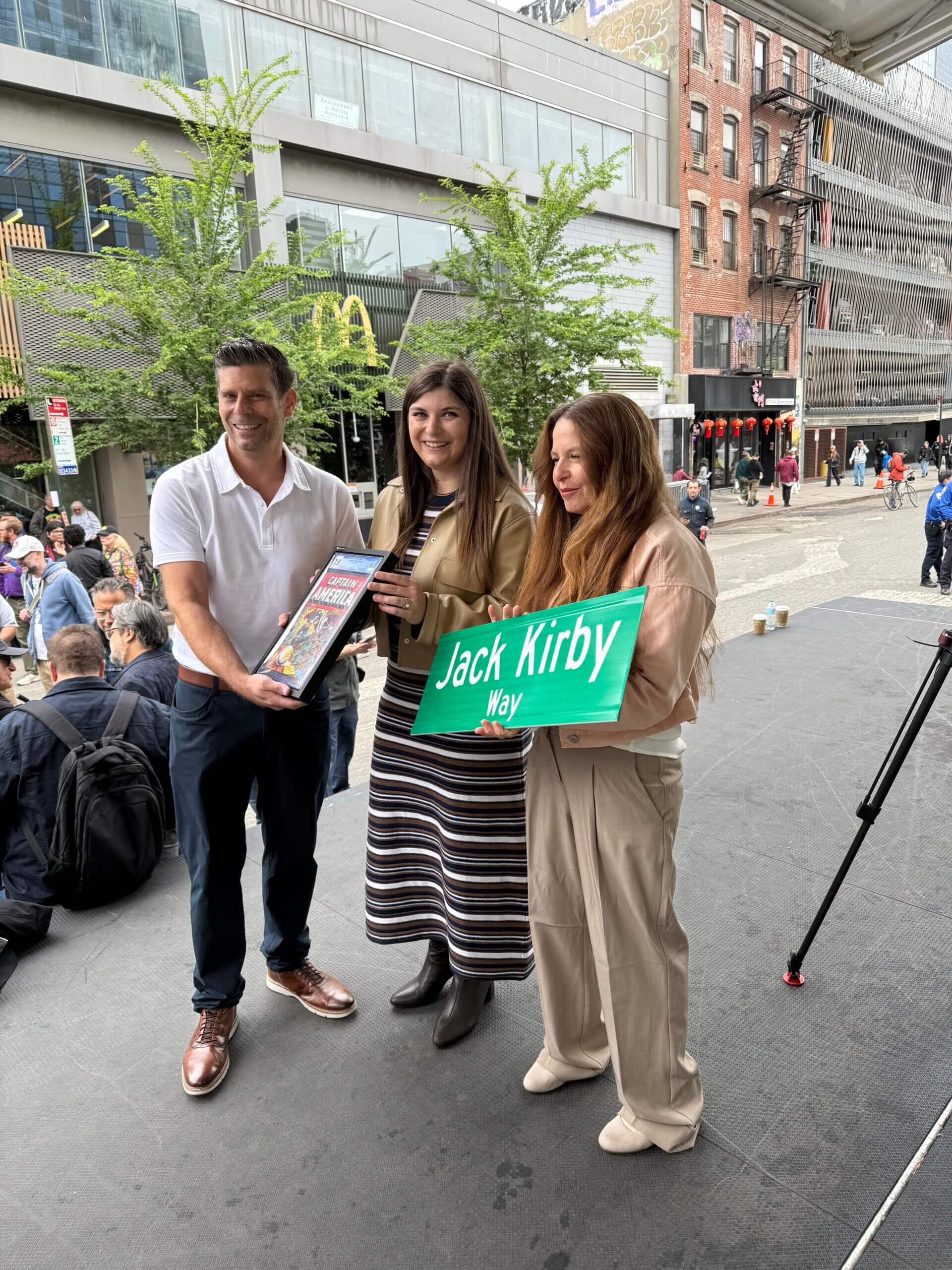
Kirby’s youngest granddaughter, Jillian, explained how his “acts of mitzvah” inspired her nonprofit Kirby4Heroes, which helps comic book workers in financial and medical need. Keeping with the theme, she read a letter from her father, Kirby’s son, Neal, who described his first visit to his dad’s neighborhood, for a cousin’s bar mitzvah, in 1962.
The service was in an Orthodox shul, conducted in Yiddish, English and Hebrew. Afterwards there was a kiddush in the foyer. Neal watched as his father, seeing an elderly man at the door of the temple, got up, took the man by the arm to an empty table, filled a platter with food and brought it to him without exchanging a word.
“I didn’t realize it then as a 14 year old, but the stereotype of the Lower East Side producing nothing but tough guys was a myth,” Kirby wrote. “When you grow up and every family is as poor as yours, and your friends and enemies alike are as poor as you are, I believe that breeds a compassion and empathy that most of us cannot understand. When you hear the expression that someone is in the same boat as you, in the case of the Lower East Side immigrant community, it probably was literally true.”
The neighborhood, largely Asian and Latino, looks different now— though a few kippot were in the crowd, along with a crew of Yeshiva boys who passed by — but the tribute, Jillian Kirby hoped, would continue to inspire, even as the family now lives on the West Coast.
With the move to Southern California in December 1968, Kirby’s creative life continued, and arguably became more Jewish. As an exhibit at the American Jewish Historical Society, coinciding with the naming, notes, it was in his California era that Kirby developed his New Gods series for DC.
“Even the New Gods, which is the space opera, like warring gods and faraway planets, all the bad guys are based on Nazi archetypes, and all the good guys are based on Jewish archetypes,” Schwartz said.
The Kirbys joined Temple Etz Chaim in Thousand Oaks, and Kirby made personal art — on display at the Center for Jewish History — of God, Jacob wrestling the angel and Joshua at the battle of Jericho. They are replete with Kirby’s signature “krackles” of negative space and the sci-fi piping he drew into characters like Galactus.
Jack was a family man; he and his wife Rosalind (Roz) hosted the Passover Seders. His granddaughter Tracy told me they hid the afikomen in the exact same spot every year: inside the piano bench. For Hanukkah, he sent a greeting card featuring the Thing with a kippah and siddur, on view at the AJHS exhibit.
Daniel Greenberg arrived early to the show, there in part to scope out evidence of Kirby’s neglected writing and story credits on his comics with Stan Lee.
“Jack Kirby’s place in history was stolen by a guy named Stan Lee,” said Greenberg, who is involved with a social media campaign to recognize Kirby as the primary author of his collaborations with Lee.
There are hints that the narrative is now breaking in Kirby’s favor in the years since Lee’s passing and the end of his cameos in the Marvel Cinematic Universe.
Fantastic Four: First Steps seemed to acknowledge Kirby’s pivotal role in the Marvel Universe, calling the world in which it takes place Earth-828 and explicitly acknowledging the origin of that number: Kirby’s birthday of Aug. 28.
The film also follows Ben Grimm — Kirby’s not-so-secret avatar — to Yancy St. where he meets a Hebrew school teacher named Rachel Rozman (Roz, no doubt a tribute to Kirby’s wife) and spends some time bearded and in shul.
A small but scrappy film crew was at the renaming, gathering footage for a documentary on Kirby. But real awareness starts at home.
“The city is recognizing that the city itself owes something to comics and that the city is a key player in comic books,” said Miriam Mora, a historian of American immigration, who sported X-Men earrings at the dedication.
“It’s not just this corner on the Fantastic Four, and it’s not just comics creators like Kirby, who grew up right here, it’s comics creators who grew up in Cleveland who still place their comics in New York City. It’s comic creators who grew up in San Diego, and still set their comics in New York, because there’s something magical about this space, and it’s where heroes come from.”
Curiously, a benediction was offered, just before the green paper covering was tugged away to reveal the bright new signage, not by a rabbi, but a reverend. Perhaps that speaks not only to the changed character of the neighborhood, but to the nature of Kirby’s universal appeal.
While Neal Kirby, due to health issues, couldn’t be there in person to see his father honored, he made the case for the neighborhood’s role in shaping Kirby’s life’s work.
“If you examine my father’s characters and you peel away the muscles, peel away the sinew and peel away the superpowers, you are left with a character of compassion, tolerance and empathy for his fellow man,” he wrote. “I believe that is the true legacy of being born and raised on the Lower East Side.”

Did you know that only 2% of Forward readers donate to support our nonprofit newsroom? That 2% make it possible for millions to read the Forward without a paywall or subscription — removing any barriers to the full and fair Jewish story.
But while the Forward is free to read, it isn’t free to produce. Big stories — like deep dives into the antisemitism data, political scoops or reporting trips to college campuses — take months of research and fact-checking. All while we keep you informed of what you need to know each day.
— Rachel Fishman Feddersen, Forward Publisher & CEO
Support our mission to tell the Jewish story fully and fairly.