Israel and Hamas have agreed to hostage release deal as part of phased peace plan
Hostages could be released as soon as this weekend
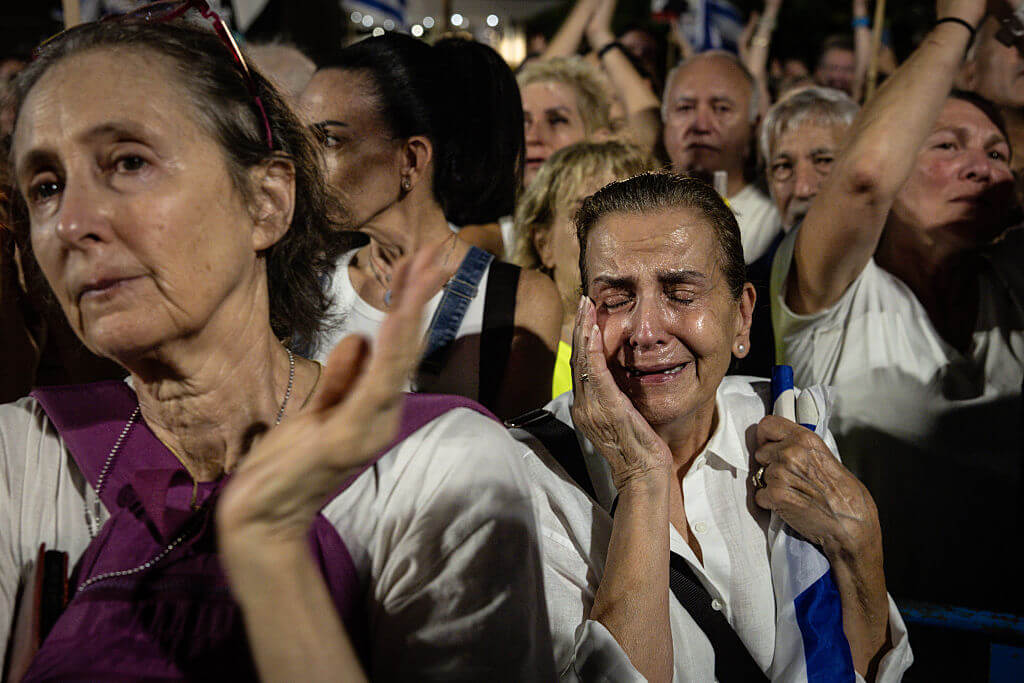
A woman reacts while listening to speeches by family members of hostages during a solidarity protest in Tel Aviv Oct. 4. Photo by Chris McGrath/Getty Images

By Julie Moos October 8, 2025
All remaining living hostages taken on Oct. 7, 2023, could be released this weekend as part of a multi-phase deal proposed by President Donald Trump, with the first phase agreed to by Israel and Hamas, according to the president and the groups’ leaders.
The plan, if adopted in full, would eventually end the two-year war that started when Hamas killed almost 1,200 people in Israel and kidnapped about 250. Israel’s attacks on the Gaza Strip, where the hostages were taken, have since killed at least 66,000 Palestinians, the Gaza Health Ministry says, and left much of the enclave in ruins.
The new deal would require Israel to release Palestinian prisoners in exchange for the 20 living hostages and approximately 28 remaining dead hostages; two previous agreements followed the same parameters in November 2023 and earlier this year.
Israel agreed to pause its military offensive late last week when Hamas indicated a willingness to release the hostages and consider the peace plan, assuming details could be negotiated. This new agreement would also require Israel to pull troops back to an agreed-upon line.
The deal was announced by Trump on Wednesday evening and negotiated in Egypt, where his Middle East envoy, Steve Witkoff, and son-in-law, Jared Kushner, arrived hours before.
The Israeli government must approve the deal, which Prime Minister Benjamin Netanyahu intends to introduce for ratification on Thursday.
In Israel, hostage families who have battled for their loved ones’ return could be seen dancing in jubilation in response to news of the deal, and the hostages freed in past ceasefires posted videos of themselves weeping as they addressed the men they were forced to leave behind. In Gaza, Palestinians who have endured two years of deadly bombing, pressing hunger and mass displacement expressed hope that the pressing dangers they face could soon recede.
An exact timeline for the hostage release was not immediately clear, but Israeli media reported that urgent preparations were underway with the expectation that hostages could come home by the weekend — ahead of the Simchat Torah holiday that marks the two-year anniversary of the attack in the Jewish calendar. Family members abroad were being flown to Israel and hospitals were being prepared to receive 20 men who have experienced two years of brutality and hunger.
Special attention was being paid, Israeli media reported, to the families whose loved ones would not immediately return — while Hamas committed to returning the bodies of deceased hostages, it has reportedly not yet located all of them and there is a widespread expectation that some may never be found.
Many elements of Trump’s peace proposal, including demands that Hamas disarm and that a postwar governance structure be established, are expected to be negotiated after the first phase. Israel ended the last ceasefire, in February, rather than continue negotiating. But Trump has indicated that he plans to maintain pressure on both sides to extend their truce into a permanent peace.
JTA contributed to this report.
This is a moment of great uncertainty. Here’s what you can do about it.
We hope you appreciated this article. Before you go, we’d like to ask you to please support the Forward’s independent Jewish news. All donations are still being matched by the Forward Board - up to $100,000 until April 24.
This is a moment of great uncertainty for the news media, for the Jewish people, and for our sacred democracy. It is a time of confusion and declining trust in public institutions. An era in which we need humans to report facts, conduct investigations that hold power to account, tell stories that matter and share honest discourse on all that divides us.
With no paywall or subscriptions, the Forward is entirely supported by readers like you. Every dollar you give is invested in the future of the Forward — and telling the American Jewish story fully and fairly.
The Forward doesn’t rely on funding from institutions like governments or your local Jewish federation. There are thousands of readers like you who give us $18 or $36 or $100 each month or year.

Support our mission to tell the Jewish story fully and fairly.