Columbia must add Middle East faculty who ‘not explicitly anti-Zionist,’ antisemitism task force urges
The fourth and final task force report explores antisemitism in the classroom
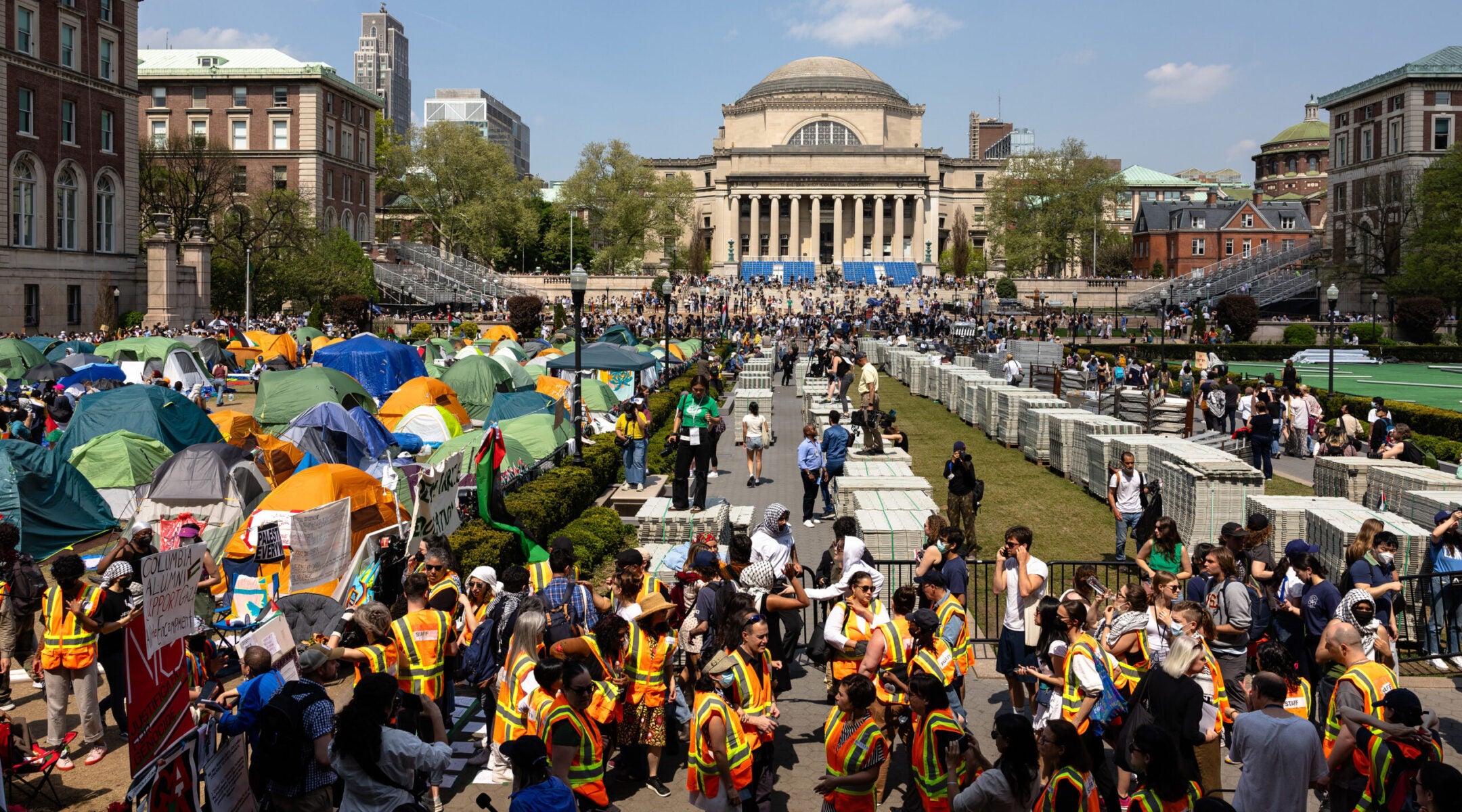
Columbia University faculty members protect students in the Pro-Palestinian “Gaza Solidarity Encampment” on April 29, 2024 in New York City. Photo by Michael M. Santiago/Getty Images
(JTA) — Students at Columbia University have little access to academic expertise on the Middle East that does not come from an “explicitly anti-Zionist” perspective, the school’s antisemitism task force found.
The Ivy League university “should work quickly and energetically” to add expertise on Jewish and Israeli topics that do not come from an anti-Israel stance, Columbia’s Task Force on Antisemitism urges in its fourth report since forming amid the fallout over the school’s pro-Palestinian protests in 2024.
Previous reports have focused on rules for demonstrations, experiences of antisemitism among students and the broader campus climate, all of which found that many Jewish students felt excluded and hurt by incidents on their campus. The latest report, issued Tuesday, focuses on the classroom experience — and finds that anti-Israel sentiment reared its head not just in protests but during courses and in personal encounters with professors, including those who do not teach anything related to the Middle East.
“A student told us in a class on feminism, the professor opened the first session by announcing it had been 100 days since Israel began waging war on Gaza,” the report says. “We heard similar reports, where harsh condemnations of Israel were made a central element of classes in ways that blindsided Jewish and Israeli students, in a class on photography, a class on architecture, a class on nonprofit management, a class on film, a music humanities class, and a Spanish class.”
The report is the first to be released after Columbia agreed to pay the Trump administration $221 million to settle antisemitism investigations that emanated from the school’s pro-Palestinian encampment, which some faculty members joined, defended and even chose as a site for office hours.
The report emphasizes that professors must be permitted to explore ideas, even those that may be offensive to others, in an academic context, and that there should not be any ideological constraints placed on the readings they assign. But it says faculty members should ideally assign readings representing an array of perspectives and create climates in which students “feel free to express other views.”
It also calls for faculty to alert students in advance if their courses will promote particular perspectives on sensitive topics, so students are not surprised by the content of their courses, and for the university to ensure that required courses, as opposed to electives that are a student’s choice to take, “do not turn into exercises in anti-Israel activism and advocacy.”
The most actionable recommendation is for the school to create a new high-level faculty roles in Middle East history, politics, political economic and policy, to introduce perspectives beyond the anti-Zionist stance that most faculty in the field promote.
“We heard from many students that an academic perspective that treats Zionism as legitimate is underrepresented in Columbia’s course offerings, compared to a perspective that treats it as illegitimate,” the report says. “The University should work quickly to add more intellectual diversity to these offerings.”
Columbia did not immediately commit to acting on the recommendation. But Acting President Claire Shipman issued a statement thanking the antisemitism task force for its work, which has now concluded, and saying that the school would continue to advance its broad suggestions as it
“Thank you for your time, your engagement, your insights, and your care,” Shipman said, addressing the task force’s chairs directly. “And thank you for helping us make sure that our University is a place that protects free expression and our academic mission while ensuring that all of the members of our community feel safe, heard, and welcome.”
This is a moment of great uncertainty. Here’s what you can do about it.
We hope you appreciated this article. Before you go, we’d like to ask you to please support the Forward’s independent Jewish news. All donations are still being matched by the Forward Board - up to $100,000 until April 24.
This is a moment of great uncertainty for the news media, for the Jewish people, and for our sacred democracy. It is a time of confusion and declining trust in public institutions. An era in which we need humans to report facts, conduct investigations that hold power to account, tell stories that matter and share honest discourse on all that divides us.
With no paywall or subscriptions, the Forward is entirely supported by readers like you. Every dollar you give is invested in the future of the Forward — and telling the American Jewish story fully and fairly.
The Forward doesn’t rely on funding from institutions like governments or your local Jewish federation. There are thousands of readers like you who give us $18 or $36 or $100 each month or year.

Support our mission to tell the Jewish story fully and fairly.