Brown University students light first Hanukkah candle in the shadow of mass shooting
Police have not identified a suspect in the shooting, which took place in a Jewish professor’s class
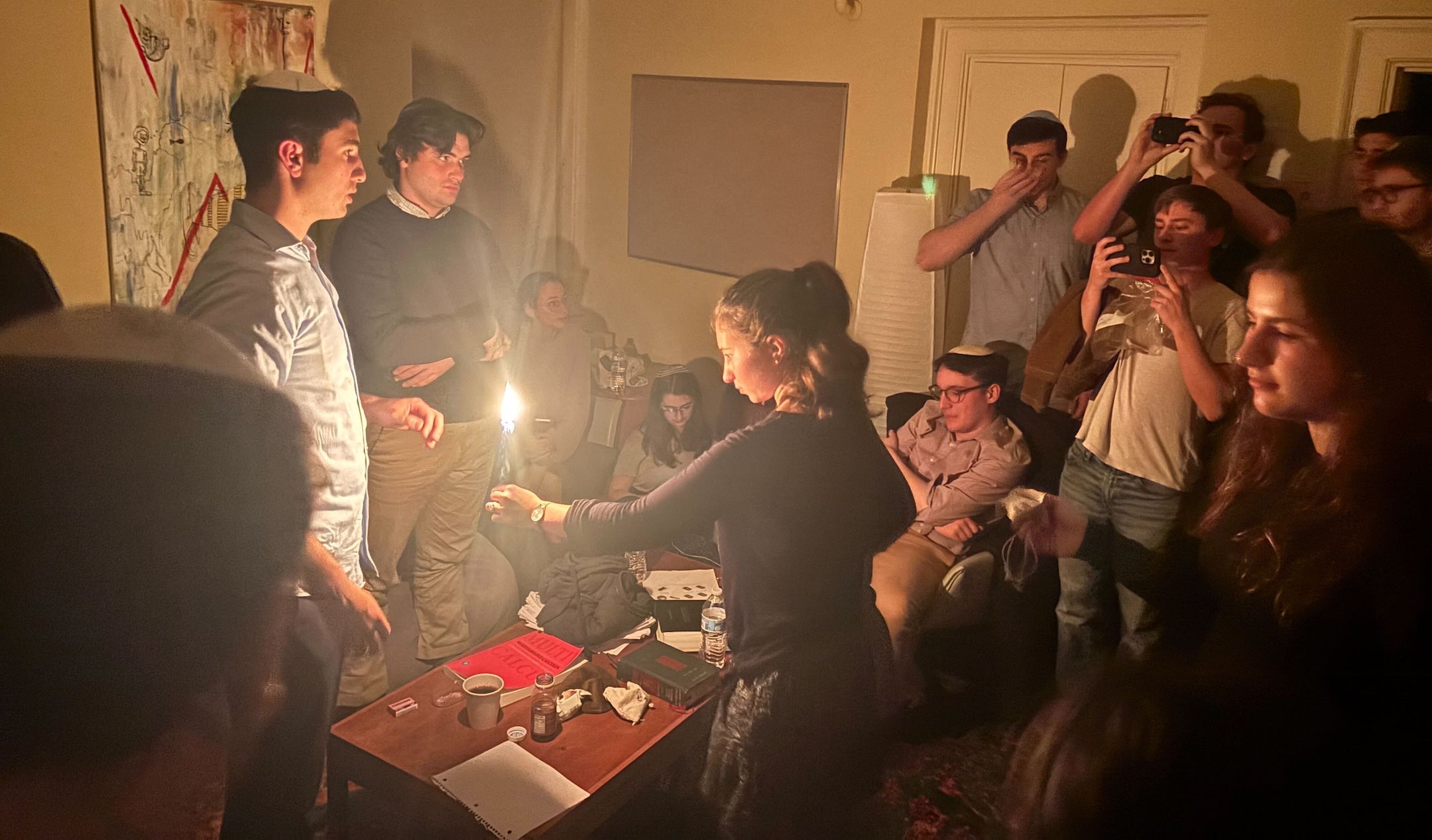
Jewish students at Brown University mark havdalah during a lockdown caused by a shooting in an engineering class, Dec. 13, 2025. Courtesy of Josh Bolton
(JTA) — PROVIDENCE, Rhode Island — Dozens of Brown University students shielded their candles at a menorah lighting that doubled as a vigil on Sunday night as the Hanukkah arrived under a sheet of snow and a thick blanket of trauma, following a mass shooting in an economics class.
On Saturday, a gunman opened fire on a room where students had gathered to review for their final exam in Principles of Economics, Brown’s most popular class that is dominated by freshmen. He killed two students and injured nine others at the Barus and Holley engineering and physics building in Providence, Rhode Island.
The school went into lockdown for 12 hours and subsequently canceled all academic exercises for the rest of the semester. On Sunday night, Providence Mayor Brett Smiley said a police investigation was ongoing and a person of interest detained earlier in the day was being released.
Yael Ranel Filus, a sophomore engineering student from Israel, goes daily to Barus and Holley and was at a nearby building when shots rang out. She said she had been in touch with fellow Israeli students, who like her were in disbelief.
“We were talking in the group channel, like, ‘Oh, we thought we left that at home. We thought we left those tragedies at home,’” Filus said. “I don’t think any of us thought we would encounter something like this here.”
Another tragedy loomed over the menorah lighting led by two rabbis, Josh Bolton and Mendel Laufer, the respective heads of Brown’s Hillel and Chabad, located on adjacent blocks at the heart of the school’s urban campus. Across the world on Sunday, at least 15 people were killed and dozens injured in a shooting attack on Jews who gathered to celebrate Hanukkah in Sydney.
Bolton said both shootings were on his mind during a speech to the crowd of students, professors and Hillel staff.
“The message of Hanukkah here is that we should increase the light,” he said. “Even in the midst of this very dark and difficult moment, together as a community, we come together and we give each other a little bit of light.”
Brown recently struck a $50 million settlement with the Trump administration over allegations of antisemitism tied to pro-Palestinian protests during the war in Gaza. It drew particular criticism for allowing students to present a proposal to divest from Israel to the school’s board of overseers, who rejected it.
The school has a Jewish president, Christina Paxson, and the highest proportion of Jewish students in the Ivy League, with particular growth in recent years among its Orthodox student population. It recently hosted a major gathering to celebrate 130 years of Jewish life that attracted alumni from around the world as well as prominent figures including Robert Kraft, founder of the Foundation to Combat Antisemitism.
The economics class that was attacked is taught by Rachel Friedberg, a Jewish faculty member who researches the intersection of economics and Jewish studies and who has worked extensively in Israel, though she was not in the classroom at the time. Police have not indicated any antisemitic motive behind the shooting. But they also have not identified the shooter, igniting unease on campus and speculation online, particularly in the wake of the Sydney attack.
Bolton said regardless of the motive, Brown was being forced to contend with a nationwide plague.
“Whether or not the shooter was antisemitic or anti-Muslim or anti-LGBTQ or whatever, the burden of our culture is lonely, disturbed, usually young men with guns, and you can add whatever other layers of ideological hatred to it,” he said.
The Brown community was ravaged by gun violence only two years ago, when a Brown student, Hisham Awartani, was among three Palestinian students were shot over Thanksgiving break in Burlington, Vermont. Awartani was hit in the spine and paralyzed from the waist down.
The shock that ripped through Brown this weekend was familiar to Zoe Weissman, a sophomore who has lived through two school shootings in her 20 years. As a 12 year-old in Parkland, Florida, she was outside her middle school when she heard gunshots and screams from the adjacent Marjory Stoneman Douglas High School, where 17 people were killed in 2018. She said the shooting left her with post-traumatic stress disorder.
“I’m an example of how prevalent gun violence is becoming,” said Weissman. “If you look at the statistics of mass shootings, it should be physically impossible for this to have happened to me twice. And that’s a fact I used to use to comfort myself.”
Another Brown student, junior Mia Tretta, was shot in the abdomen during a 2019 attack on Saugus High School in California.
Weissman left Brown before the communal Hanukkah lighting, but she lit the first candle with a few friends at a house off-campus.
“It’s a tradition I’ve grown up with, so it’s something that makes me feel really comfortable,” she said. “It wasn’t something that I wanted to skip for the first time ever because of this.”
The shooting began in the last hour of Shabbat, when over 30 students were gathered at Hillel, many without their phones. They were ordered to shelter on the third floor with the lights off.
Bolton arrived about an hour later with water and food for the night. He wanted the group to mark havdalah, the ritual to note the end of Shabbat traditionally performed once three stars can be spotted in the sky. Bolton and the students did havdalah in a windowless room, whispering over candles in the dark.
Aaron Perrotta, a junior who was there, said that some jokes mixed in with the panic. “It was nice to have a little sense of normalcy and be able to close out Shabbat like that,” he said.
“I think a lot of us bonded and got closer together, just being in such a tight space upstairs,” said Max Zimmer, a sophomore.
Filus was blocks away from Barus and Holley at the Nelson Center for Entrepreneurship on Saturday night. She and nine other students rotated sleeping shifts, as Brown’s Department of Public Safety advised having one person alert until the lockdown ended.
Filus went to the candle lighting on Olive Street after sitting with friends at the neighboring Hillel building.
“It’s a safe space,” she said. “I don’t really want to be alone right now. I don’t want to be in my room.”