Columbia professor Mahmood Mamdani, father of NYC Mayor-elect Zohran Mamdani, criticizes university over antisemitism and protests
The longtime Columbia professor said that students feel targeted and ‘terrorized’
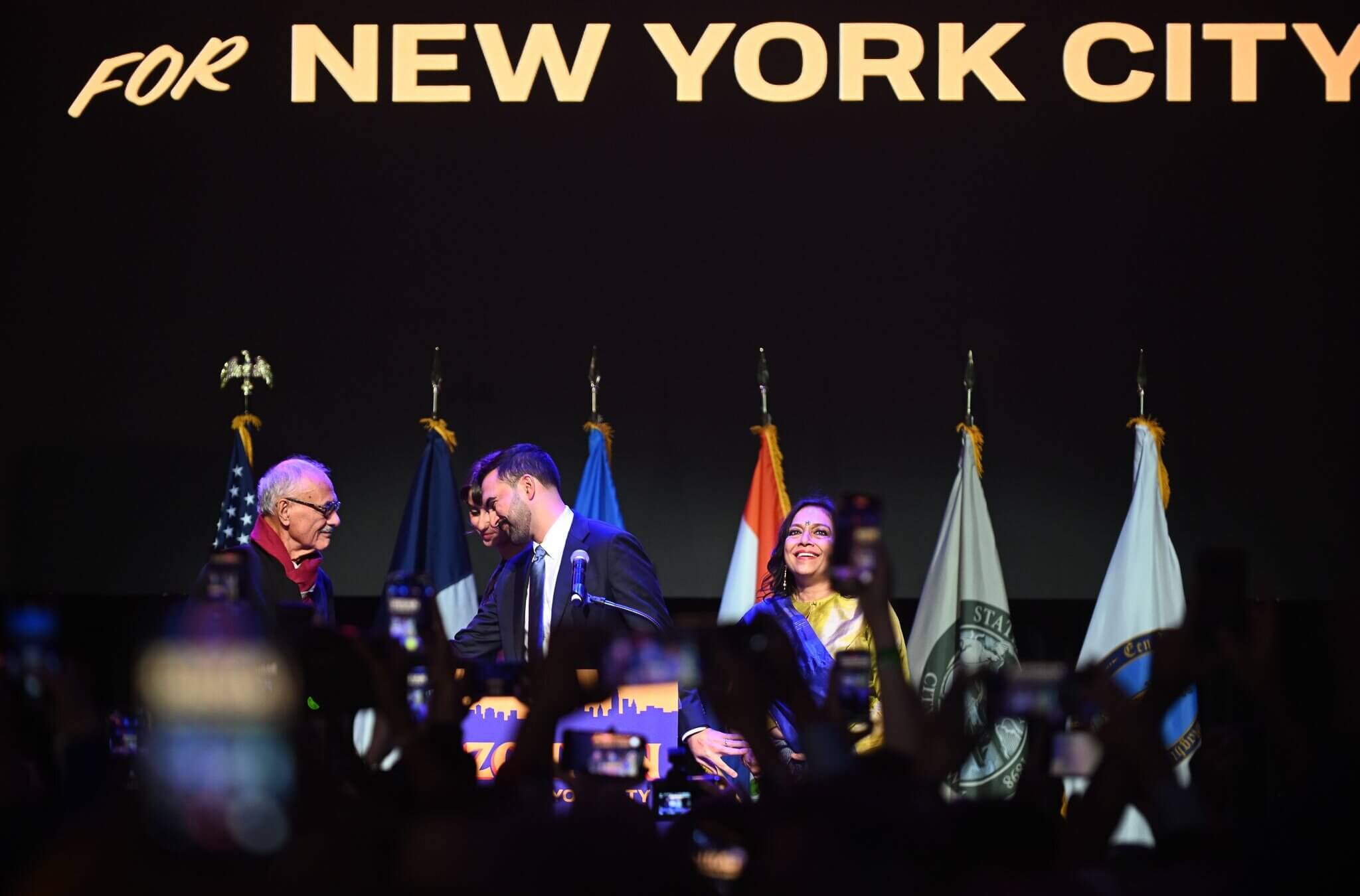
Columbia professor Mahmood Mamdani greets his son New York City Mayor-elect Zohran Mamdani at his election night victory party on Nov. 4. Photo by Gili Getz

By Jacob Kornbluh December 15, 2025
Mahmood Mamdani, a longtime Columbia University professor and father of New York City Mayor-elect Zohran Mamdani, sharply criticized the school’s leadership and its creation of a task force to address allegations of antisemitism in a recent interview with progressive writer Peter Beinart.
Students who hold pro-Palestinian views are “terrified” and “terrorized,” Mamdani said in a Zoom call for Beinart’s Substack on Friday. “The smallest move they make, they are targeted, they are expelled, they are suspended and they are warned. Which means we have less and less of an idea of what they think and how they might respond to their situation.” Beinart is editor-at-large of Jewish Currents, which co-hosted the webinar.
Mamdani, who has been on medical leave since September, refused to discuss his son’s views or how his son was raised, a condition for participating in the conversation, he said. Though he briefly acknowledged the election’s broader significance as an immigrant was elected to the city’s highest office.
Mamdani, who has been critical of Israel and teaches about the Middle East, South Asia and Africa, said the school’s leadership is in a “vindictive mood” since it entered a settlement with the Trump administration and created a task force to address complaints of harassment and allegations of antisemitism by Jews on campus.
Pro-Palestinian protests intensified in April 2024 after a House hearing highlighted antisemitism at Columbia and the school’s police crackdown on students.
Mamdani, a faculty senator at Columbia, said he was planning to suggest at a Senate meeting convened on Friday a “healing process” through an alternative, broad-based commission on discrimination, rather than separate initiatives for specific groups to address concerns about Islamophobia or other forms of discrimination.
“Can’t you resist turning anti-discrimination into a device to set up one group of students against another group of students, like a divide and rule policy under British colonialism that I grew up under,” he said about the university’s approach.
“I think these people have lost a sense of what it means to govern,” Mamdani said, pointing to the Board of Trustees’ struggle to find a new president.
Mamdani said that Minouche Shafik, a former World Bank official who resigned in summer 2024 after being accused of exacerbating the turmoil on campus, was ill-equipped to handle the student encampments that erupted shortly after she took on the top post. “To her credit, when she realized that, she resigned,” Mamdani said.
Columbia has struggled to install permanent leadership since Shafik’s departure. Katrina Armstrong, a medical school executive, stepped down from her interim post in March after the university agreed to a list of demands from the White House. Claire Shipman is the current acting president. The Columbia Spectator, the student newspaper, reported that this is the longest the university has gone without a permanent president since 1948.
Mamdani on the US-Israel relationship
In Friday’s interview, Mamdani also spoke about comparative scholarship on settler colonialism, including his work on the Israeli-Palestinian conflict and South Africa. He said that U.S. policy toward Israel differs fundamentally from its past approach to apartheid South Africa because Israel is an “internal issue” in American politics. “To face up to Israel will require some significant changes inside the U.S.,” Mamdani said.
The mayor-elect is a supporter of the Boycott, Divestment and Sanctions movement against Israel, and faced fierce backlash for refusing to outright condemn the use of the slogan “globalize the intifada” at some of the protests for Palestinian rights and against the war in Gaza. His victory in the Democratic primary was attributed to a surge among young and new voters who agreed with his views. In the general election, Mamdani swept progressive Jewish neighborhoods in Brooklyn and Manhattan on his way to a citywide win. He recently met with Jewish leaders to discuss his positions.
Mamdani did talk about his son’s election and stance on Israel in an interview with Democracy Now. “His refusal to budge, to soften his critique of the state of Israel, even in the face of millions of dollars being pumped against him, even in the face of big personalities, including the president of the United States, coming out against him, his refusal to change his stand, convinced the electorate that this was a man of principle,” Mamdani said.
In the webinar with Beinart, the senior Mamdani said that meaningful political change will come from younger Jews and Palestinians in the diaspora rather than from within Israel itself. “Jewish children in New York City have become increasingly skeptical of the direction in which Israel has been moving,” he said, “and increasingly disillusioned with both the moral and the political efficacy of that route and are increasingly open to exploring an alternative.”
This week, Mamdani released his 12th book, Slow Poison, a political history of Uganda under the dictators Idi Amin and Yoweri Museveni. His next book is about the Israeli-Palestinian conflict.
This is a moment of great uncertainty. Here’s what you can do about it.
We hope you appreciated this article. Before you go, we’d like to ask you to please support the Forward’s independent Jewish news this Passover. All donations are being matched by the Forward Board - up to $100,000.
This is a moment of great uncertainty for the news media, for the Jewish people, and for our sacred democracy. It is a time of confusion and declining trust in public institutions. An era in which we need humans to report facts, conduct investigations that hold power to account, tell stories that matter and share honest discourse on all that divides us.
With no paywall or subscriptions, the Forward is entirely supported by readers like you. Every dollar you give this Passover is invested in the future of the Forward — and telling the American Jewish story fully and fairly.
The Forward doesn’t rely on funding from institutions like governments or your local Jewish federation. There are thousands of readers like you who give us $18 or $36 or $100 each month or year.
Support our mission to tell the Jewish story fully and fairly.