Norman Podhoretz, Commentary editor and archetypal Jewish neoconservative, dies at 95
Podhoretz’s pro-Israel, pro-democracy outlook made him an intellectual forebear of the neocon movement
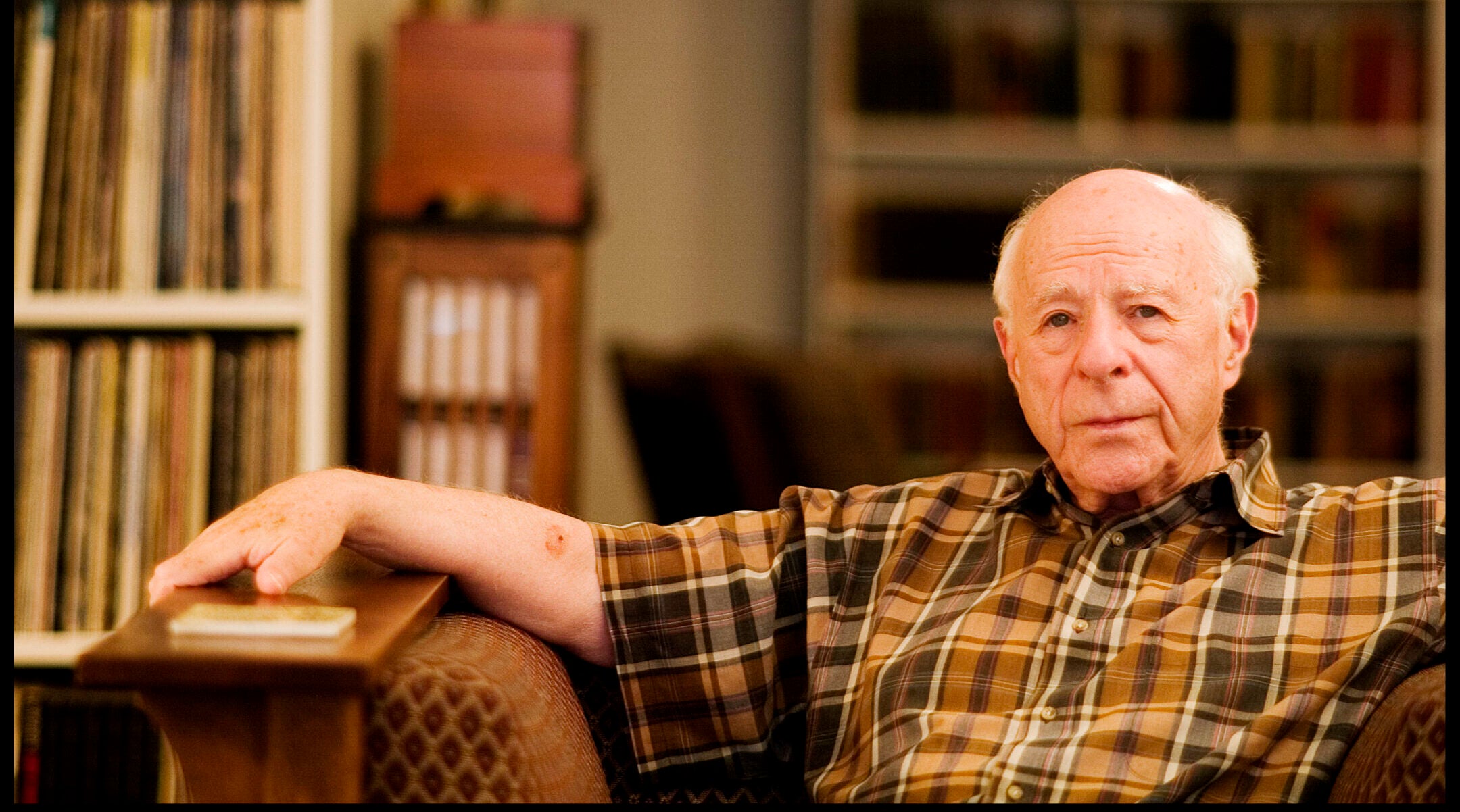
American neoconservative theorist and writer Norman Podhoretz at home in New York City in 2008. Photo by David Howells/Corbis via Getty Images
(JTA) — Norman Podhoretz, the journalist and public intellectual who charted a path from Jewish liberal to pro-Israel neoconservative that would become well worn, has died at 95.
Podhoretz was the influential editor of Commentary magazine for 35 years, after being appointed to run the American Jewish Committee’s thought journal at 30 in 1960.
He initially continued in the magazine’s liberal tradition. But over the course of the 1960s, he became disillusioned by the left. He lamented the radicalism that became prevalent in campus antiwar activism. He also objected to a mounting critique of Israel and its occupation of Palestinian territories within the New Left following the Six-Day War in 1967.
By the decade’s end, Podhoretz had openly refashioned himself as what would become known as a neoconservative — someone his friend and intellectual ally Irving Kristol would describe as “a liberal who has been mugged by reality.”
Many of the most prominent neocon intellectuals were Jewish and, like Podhoretz, from New York City. Commentary became a central platform for their outlook on civil rights, the threat of communism and especially foreign policy, where Podhoretz was known as a particular expert. He argued strenuously against the Soviet Union and expressed steep concern about the U.S. detente with Russia as communism collapsed. He also advocated an interventionist U.S. foreign policy in support of promoting democracy abroad, causing him to support foreign wars that many liberals opposed.
Israel was a focus for Podhoretz, an observant Jew who was a longtime member of Manhattan’s Congregation Or Zarua. He believed that Israel was essential for both Jewish safety and U.S. interests and argued in support of its military pursuits. He soured early on the prospects for a peaceful resolution of the Israeli-Palestinian conflict. He also warned early — and seemingly presciently — that Jews could not rely on left-wing values to keep them or their homeland safe.
Podhoretz made waves in 2016 for endorsing Donald Trump in his first run for president, at a time when many traditional Republicans could not countenance him. He argued that Hillary Clinton would continue Barack Obama’s policies including the Iran nuclear deal that Obama struck, which Podhoretz called “one of the most catastrophic actions that any American president has ever taken.”
By the time he retired as Commentary’s editor in 1995, Podhoretz had embraced mainstream conservative views on a range of social issues, too, opposing abortion and gay rights. He also rejected his early liberal views on immigration, saying in 2019 that contemporary immigrants did not want to assimilate the way his parents’ generation had sought to.
“I was always pro-immigration because I’m the child of immigrants,” he told the Claremont Review, a leading journal of contemporary conservatism. “And I thought it was unseemly of me to oppose what not only had saved my life, but had given me the best life I think I could possibly have had.”
Born in 1930 in Brooklyn to parents who immigrated from Galicia, now Poland, Podhoretz attended public schools but also got a rich Jewish education at the urging of his father, a Yiddish-speaking immigrant who worked as a milkman. In addition to learning Hebrew, Podhoretz worked at Camp Ramah and took classes at the Jewish Theological Seminary while attending Columbia University, from which he graduated in 1950.
The final of his dozens of books, published in 2009, attempted to explain why most U.S. Jews are liberals — and why they should not be.
“He was a man of great wit and a man of deep wisdom and he lived an astonishing and uniquely American life,” his son John Podhoretz, who succeeded him as Commentary’s editor, wrote in a remembrance for the magazine announcing his father’s death. “And he bound himself fast to his people, his heritage, and his history. His knowledge extended beyond literature to Jewish history, Jewish thinking, Jewish faith, and the Hebrew Bible, with all of which he was intimately familiar and ever fascinated.”
Norman Podhoretz is survived by four children, 13 grandchildren and 16 great-grandchildren, according to the remembrance. His wife, the social commentator and critic of feminism Midge Decter Podhoretz, died in 2022.