As Australian Jews call for action on antisemitism, prime minister unveils moves to curb hate speech
“More could have been done, and I accept my responsibility,” Anthony Albanese said in a speech following the Bondi Beach Hanukkah attack
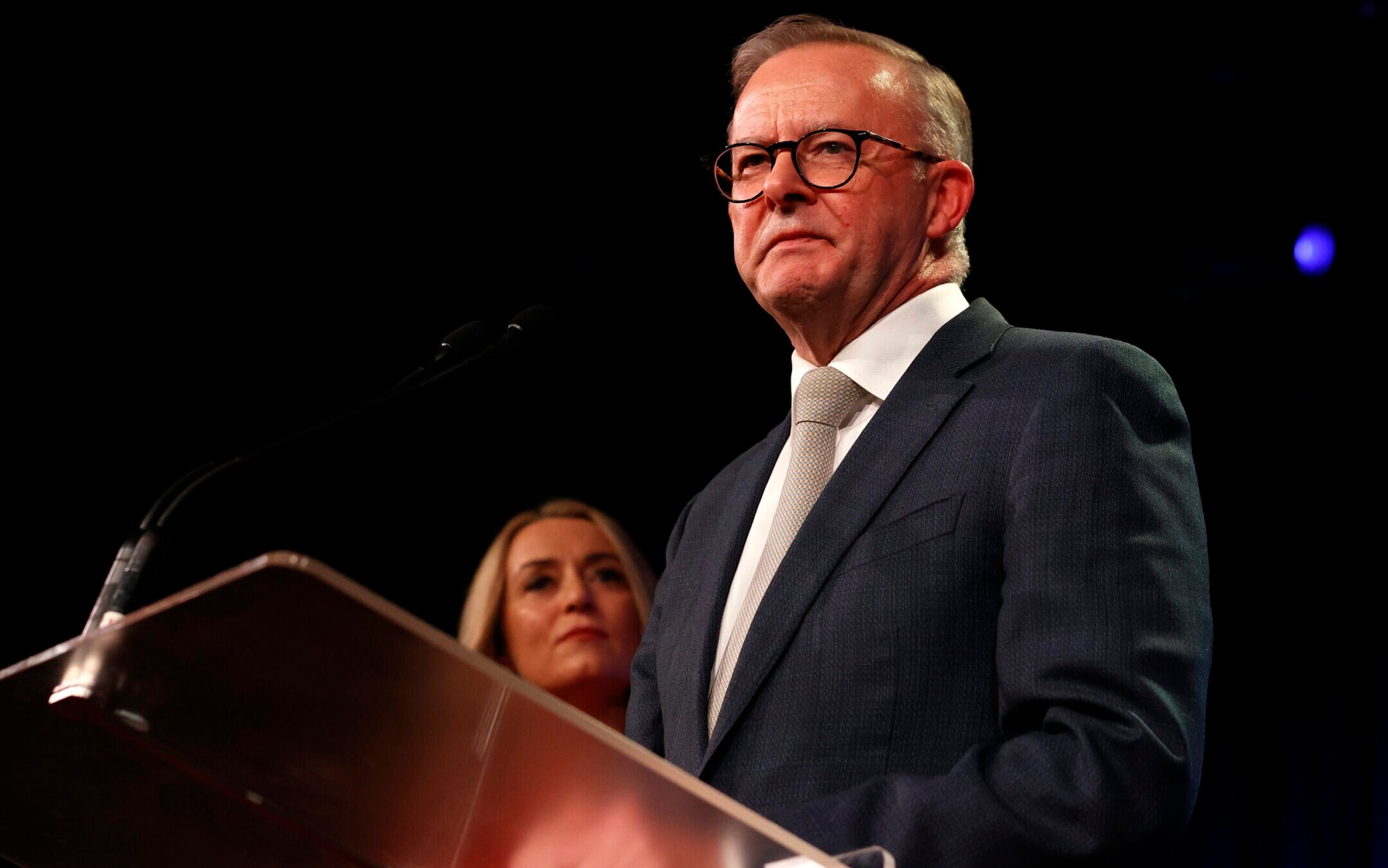
Australia’s prime minister, Anthony Albanese, delivers his victory speech during the Labor Party election night event in Sydney, May 21, 2022 in Sydney, Australia
(JTA) — Australian Prime Minister Anthony Albanese has announced a slew of changes meant to curb antisemitism, including a crackdown on hate speech by extremist clerics.
The announcement comes four days after two gunmen killed 15 people at a Hanukkah celebration on Bondi Beach in Sydney. Many Australian Jews said they had feared such an attack after years of surging antisemitism and what they said had been an inadequate government response.
Albanese acknowledged the criticism during an address in Canberra, Australia’s capital.
“More could have been done, and I accept my responsibility for the part in that as prime minister of Australia, but what I also do is accept my responsibility to lead the nation, and unite the nation,” he said.
“Anyone in this position would regret not doing more, and any inadequacies which are there,” Albanese added. “But what we need to do is to move forward.”
The new policies would heighten penalties for speech that incites violence, including online; increase the government’s latitude to block or rescind visas for those who spread hate; and penalize organizations whose leaders engage in hate speech.
As is the case in England, where two of the largest police forces announced on Wednesday that they would begin arresting people who use protest slogans seen by many as antisemitic, Australian authorities said they aimed to tip the scales against the kinds of speech that had long been treated as just shy of criminal.
“There have been organizations which any Australian would look at and say their behavior, their philosophy and what they are trying to do is about division and has no place in Australia,” Home Affairs Minister Tony Burke told reporters at Albanese’s press conference. “And yet for a generation, no government has been able to successfully take action against them because they have fallen just below the legal threshold.”
Albanese also pledged to enact a 13-point plan that his antisemitism envoy proposed earlier this year and announced a task force to ensure that Australian schools respond adequately to antisemitism. The moves follow a pledge made in the immediate aftermath of the Bondi Beach attack to tighten access to guns, which one of the alleged attackers had obtained legally.
Albanese’s announcement comes as Sydney is in the midst of days of funerals for the victims, who included rabbis, a Holocaust survivor and a 10-year-old girl. While some local officials have attended the funerals, he has drawn criticism for staying away. Burke was heckled when he visited a vigil at Bondi Beach, with some in attendance shouting, “Blood on your hands!”
Prior to the shooting, Australian Jews were distressed by a string of arson and vandalism attacks on Jewish sites, as well as rhetoric in pro-Palestinian demonstrations seen as stoking antisemitic violence. Officials attributed some of the most searing attacks to criminals working indirectly on behalf of Iran, and Albanese ejected the Iranian ambassador in retaliation earlier this year.
Now, Albanese’s new moves have drawn criticism and concern from some on the left, including a progressive Jewish group, about their implications for free speech. But the main body representing Australian Jews, which on Sunday called for “decisive leadership and action now,” said it wanted more.
The Executive Council of Australian Jewry said in a statement that it would reserve a fuller judgment until after the funerals were over and more information was available but indicated that it was not satisfied. Albanese said it could take months to draft legislation to match his commitments.
“We will need to see the details before making an assessment as to whether the measures are likely to live up to their billing,” the council said. “This suite of measures can only be regarded as a first step, but it is an essential one.”
This is a moment of great uncertainty. Here’s what you can do about it.
We hope you appreciated this article. Before you go, we’d like to ask you to please support the Forward’s independent Jewish news this Passover. All donations are being matched by the Forward Board - up to $100,000.
This is a moment of great uncertainty for the news media, for the Jewish people, and for our sacred democracy. It is a time of confusion and declining trust in public institutions. An era in which we need humans to report facts, conduct investigations that hold power to account, tell stories that matter and share honest discourse on all that divides us.
With no paywall or subscriptions, the Forward is entirely supported by readers like you. Every dollar you give this Passover is invested in the future of the Forward — and telling the American Jewish story fully and fairly.
The Forward doesn’t rely on funding from institutions like governments or your local Jewish federation. There are thousands of readers like you who give us $18 or $36 or $100 each month or year.
Support our mission to tell the Jewish story fully and fairly.