Judaism’s Conservative movement apologizes for decades of discouraging intermarriage, signals new approach
A new report embraces engagement with interfaith families while leaving the ban on clergy officiation in place
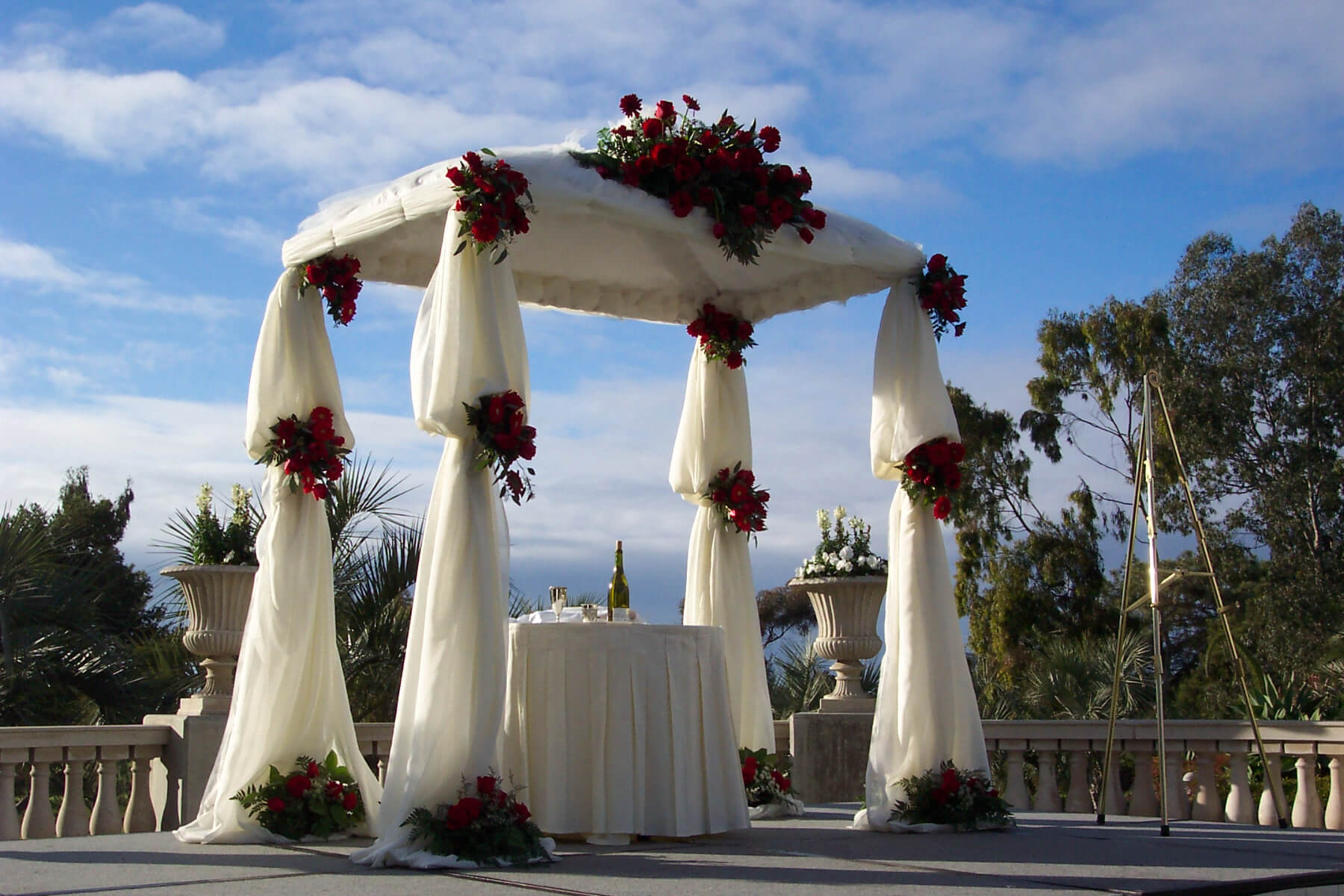
A chuppah, also known as a Jewish wedding canopy. Photo by Joyride/iStock

By Asaf Elia-Shalev December 18, 2025
(JTA) — The Conservative movement, one of the major Jewish denominations, is formally apologizing for decades of discouraging intermarriage and committing itself to a new approach centered on engagement.
The shift marks a significant change in tone for a movement that long treated intermarriage as a threat to Jewish continuity, even as its longstanding ban on clergy officiating at such weddings remains in place.
Leaders of the movement announced the shift in a report released Thursday by a working group representing the denomination’s three main arms: the United Synagogue of Conservative Judaism, the Rabbinical Assembly and the Cantors Assembly.
“For decades, our movement’s approach to families where one partner is Jewish and the other is not was rooted in disapproval and shaped by fears about Jewish continuity,” the leaders wrote in a statement accompanying the report. “But today — as we connect with countless families who want to learn, participate, and belong — we are committed to welcoming people as they are.”
In the report, the movement also accepted responsibility for the consequences of that approach.
“We acknowledge that our movement’s historical stance has resulted in hurt, alienation, and disconnection from our community. We deeply apologize,” the report said.
The report does not itself change binding policy. Instead, it asks the movement’s Committee on Jewish Law and Standards, or CJLS, to revisit how its rules are interpreted, while recommending new educational, pastoral and ritual approaches aimed at intermarried families.
“The idea that we could discourage people from intermarrying through disapproval — all that did was push people away who really should have been part of our communities,” Rabbi Jacob Blumenthal, the CEO of both the Rabbinical Assembly and United Synagogue of Conservative Judaism, said in an interview.
The Conservative movement’s formal ban on officiating at interfaith weddings dates to a 1973 “standard of practice” adopted by the Rabbinical Assembly, which also barred clergy from speaking during such ceremonies. While the rule remains in effect, the report argues that it effectively froze conversation for decades even as intermarriage became widespread across American Jewish life.
“What we stated in 1973 obviously did not deter intermarriage. So moving forward, how do we really embrace these individuals” who are part of intermarried families? asked Shirley Davidoff, a member of the working group and vice president of USCJ’s board.
The ban has long been framed by the movement as a matter of Jewish law, or halacha, which traditionally understands marriage as a covenant between two Jews. While the Conservative movement has historically embraced the idea that halacha evolves over time, leaders have argued that officiating at interfaith weddings raises complex legal and ritual questions that go beyond concerns about continuity.
The report contends, however, that halacha itself contains “expansive, creative” resources for welcoming interfaith families.
“We believe that our halakhic process already contains the necessary ingredients to address the needs of our constituents,” the report said.
The report is the culmination of a nearly two-year process that included responses to a questionnaire from 1,200 people, listening sessions, focus groups and commissioned papers from scholars and rabbis. The 17-member working group included clergy and lay leaders from North America and Israel and operated by consensus rather than formal votes.
The new report builds on a 2024 clergy-led review that maintained the officiation ban but called for greater engagement with interfaith families, expanding that work into a movement-wide process that included lay leaders and focused on repairing trust and widening pathways into Jewish life.
In its section on marriage rituals, the report explicitly notes that there was not unanimity among members, a signal of persistent internal disagreement, particularly over whether and how Conservative clergy should participate in weddings between Jews and non-Jews.
The working group stops short of recommending an immediate end to the officiation ban. Instead, it asks the CJLS to clarify ambiguous terms such as “officiation” and “wedding,” and to consider whether rabbis might offer blessings or other forms of participation before or after a wedding ceremony.
The report arrives amid a broader rethinking of intermarriage in some corners of American Judaism. Reform and Reconstructionist movements have long permitted officiation, and individual Conservative congregations have increasingly tested the boundaries — including a high-profile case last year in Minnesota, where a Conservative synagogue announced it would allow clergy participation short of officiation. In a separate case, a rabbi left the movement rather than face possible expulsion following a complaint to his rabbinical association over his officiation at interfaith weddings.
Blumenthal declined to comment on any internal disciplinary reviews, emphasizing that the report is about setting direction, not enforcing compliance.
“What we hope,” he said, “is that rabbis and congregations will think more deeply about what it means to truly engage people who want to build Jewish lives.”
Rabbi Dan Horwitz of Congregation Beth Yeshurun in Houston is among those opposing a more permissive policy, warning that attitudes in the United States are generally less traditional than elsewhere in the movement.
“Given what I know about the Rabbinical Assembly as a whole, a change in policy would rupture the assembly — particularly among older members and those living in Israel or Latin America,” said Horwitz, who was not involved in the working group and did not have a chance to review its report prior to publication.
But Keren McGinity, who served as director of intermarriage engagement and inclusion at USCJ until her position was eliminated earlier this year, said fears of mass defection have long been overstated.
“I have heard the concern about the fracturing of the movement for years,” McGinity said. “It’s not that no one would leave, but generally speaking, when people make that threat, it’s often hyperbolic.”
While acknowledging deep divisions within the movement, McGinity said she was not convinced that lifting restrictions would fracture Conservative Judaism. Avoiding change, she added, also carries risks, pointing to the 2020 Pew study showing that fewer than half of Jews raised Conservative still identify with the movement. “That,” she said, “is hugely concerning.”
Despite inevitable disagreements over policy and pace, members of the working group said they hope the report itself will be seen as a sign of institutional seriousness and as a unifying moment for the movement.
“I hope people will feel proud that we’re having this conversation,” Davidoff said. “That we’re willing to pull back layers, listen carefully, and include people that want to build a Jewish home.”