Vance says ‘religious liberty is a Christian concept.’ Where does that leave Jews?
The vice president declared America ‘a Christian nation’ at a Turning Point USA convention
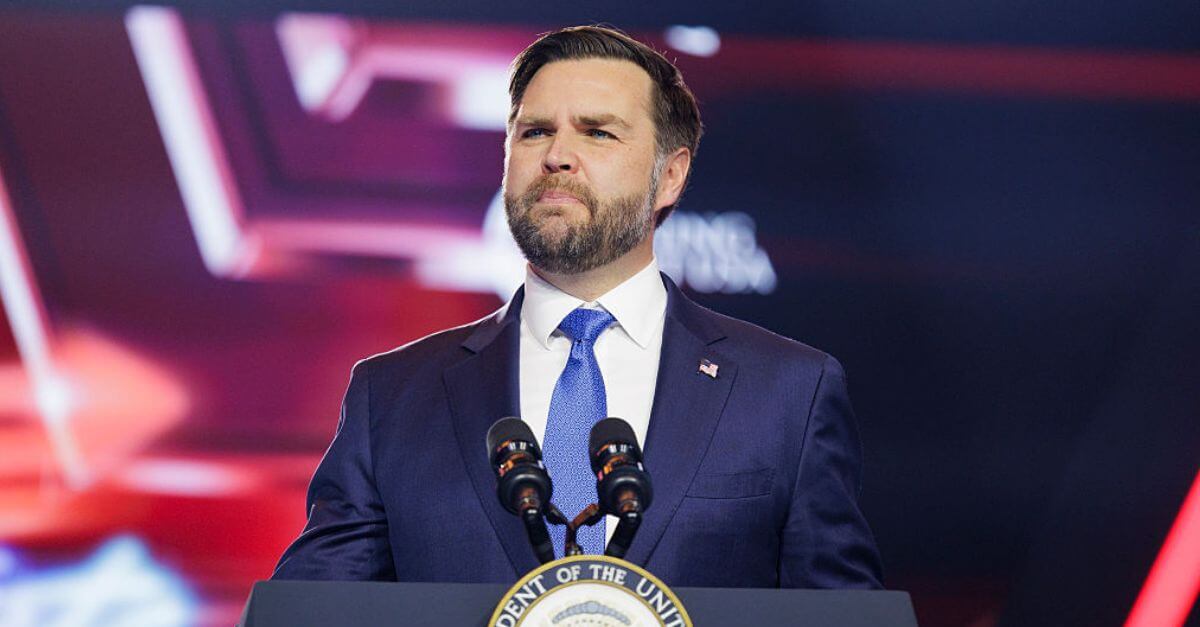
Vice President JD Vance speaks on the final day of Turning Point USA’s annual AmericaFest conference in Phoenix. Photo by Caylo Seals/Getty Images

By Hannah Feuer December 23, 2025
During his speech at Turning Point USA’s annual convention on Sunday, Vice President JD Vance claimed the “famously American idea of religious liberty is a Christian concept.”
Vance has made this argument before. At the International Religious Freedom Summit, held in Washington, D.C., in February, he said it was “a conceit of modern society that religious liberty is a liberal concept,” adding that “religious freedom flows from concepts central to the Christian faith.”
Vance is correct that the philosophical defense of the right to religious liberty has roots in Christian theology. Tertullian, an influential second-century Christian writer, argued that genuine worship must be a matter of free will rather than coercion — and is credited with coining the term “freedom of religion.”
But while Thomas Jefferson owned a copy of Tertullian’s work, the Christian philosopher was not Jefferson’s only inspiration. The Founding Fathers also drew on Enlightenment thinkers such as John Locke and Jean-Jacques Rousseau, who justified religious freedom based on ideas about natural rights and limits on state power.
Nor is religious freedom an exclusively Christian innovation. Religious toleration predates Christianity — centuries earlier, the Roman Empire allowed conquered peoples to maintain their own religious practices, and the Persian Empire embraced religious pluralism.
And Tertullian’s ideas did not exactly translate into a durable Christian political tradition of religious liberty. The Crusades — a series of religious wars launched by Christian rulers — involved massacres, expulsions and forced conversions of Jews and Muslims. During the Spanish Inquisition, Catholic authorities persecuted and expelled Jews and Muslims who refused to convert.
Indeed, the Founding Fathers’ commitment to religious freedom was shaped in part by Europe’s long history of Christian persecution — a record they sought to avoid replicating in the new American republic.
‘A Christian nation’
The First Amendment makes clear that religious freedom applies to all faiths — not just Christians. So why has Vance waded into a niche historical debate?
According to Rachel Laser, president and CEO of Americans United for Separation of Church and State, the telling line comes later in Vance’s speech: “The only thing that has truly served as an anchor of the United States of America is that we have been, and by the grace of God, we always will be, a Christian nation.” He added that he was “not saying you have to be a Christian to be an American,” but argued that “Christianity is America’s creed.”
Vance’s speech was attempting to “co-opt religious freedom and co-opt church-state separation, to make them all into the idea that Christians should have special favor in this country,” Laser, who is Jewish, said in a phone interview. “This is about an effort to redefine terms and distort them.”
Laser noted that this privileging of Christianity is already influencing federal policy, including allowing government employees to proselytize at work and encouraging co-workers to report each other for “anti-Christian bias” — as if Christians were the only potential targets of religious discrimination. At the state level, blurred lines between church and state have led to Bible-infused lessons in public schools and even an effort to make the Old and New Testament law — literally.
Those types of policies might ring alarm bells for Jews, who have long been among the strongest defenders of the separation of church and state, viewing it as a bedrock principle of religious liberty. The 1947 Supreme Court case Everson v. Board of Education of Ewing Township marked the first time Thomas Jefferson’s idea of a “wall of separation between Church and State” was explicitly recognized in law.
Yet some conservative legal scholars, such as Philip Hamburger, question the concept of church-state separation in its entirety, noting that the Constitution never explicitly mentions such a wall. Critics argue that the Supreme Court has, at times, offered not freedom of religion but freedom from religion, effectively privileging secularism and pushing religion out of the public square.
Vance, who converted to Catholicism in adulthood and has said he hopes his Hindu wife, Usha, will eventually convert to Christianity, has been a key proponent of that line of argumentation, explicitly rejecting church-state separation at an October Turning Point USA event.
“What I believe happened is the Supreme Court interpreted ‘Congress shall make no law respecting the establishment of religion’ to effectively throw the church out of every public space at the federal, state and local level,” Vance told the crowd. “I think it was a terrible mistake, and we are still paying for the consequences of it today.”
Laser rejected the characterization that church-state separation advocates are inherently secular, noting that roughly half the plaintiffs in Americans United lawsuits are religious.
“Our opponents try to paint our cause as anti-religion, but it’s actually pro-religion,” Laser said. “Vance would be well served to remember that deeply religious people have been some of the greatest proponents of church-state separation, because they understand that it protects religion from being sullied by the government.”