Coast Guard again retracts policy that would downgrade swastika as hate symbol, clearing path for new leader’s confirmation
The policy, which also applied to imagery of nooses, has now been reversed twice
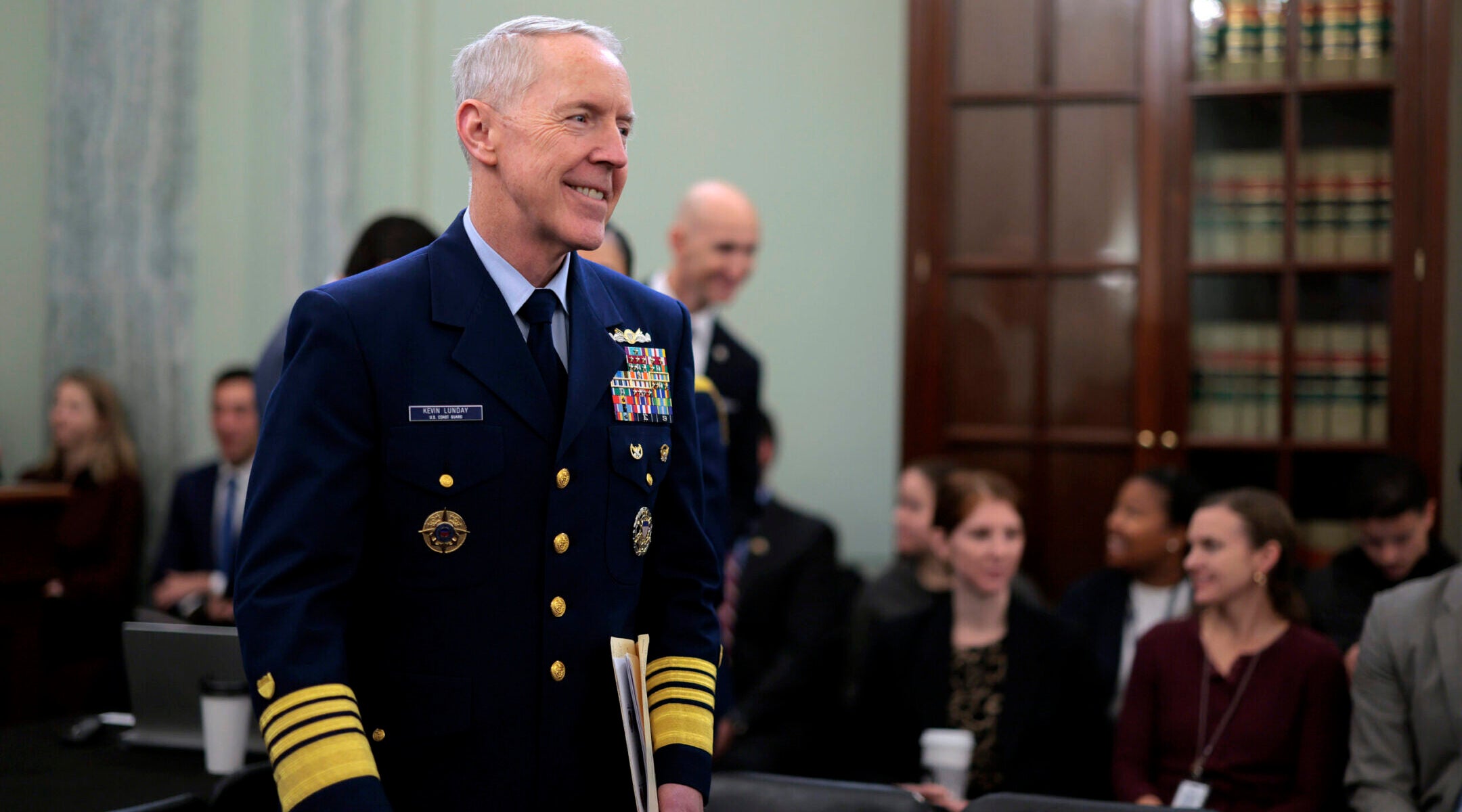
Admiral Kevin Lunday prepares to testify during his confirmation hearing to be the commandant of the U.S. Coast Guard, Nov. 19, 2025, in Washington, D.C. Photo by Heather Diehl/Getty Images
After renewed objections from Jewish groups, the U.S. Coast Guard again removed language referencing a proposed policy that would have stopped classifying swastikas as hate symbols.
The retraction late Thursday, the second such reversal of the Coast Guard’s swastika policy, was enough to prompt Jewish Sen. Jacky Rosen to drop the hold she had placed on Admiral Kevin Lunday’s nomination to permanently lead the organization.
“While I continue to have reservations about the process by which this happened and the confusion created by leadership at the Department of Homeland Security, I am pleased to see that the policy now directly refers to stronger language against swastikas and nooses,” Rosen wrote on the social network X. A Democrat from Nevada, Rosen had placed the hold together with non-Jewish Democrat Tammy Duckworth, a military veteran.
Lunday was swiftly confirmed by voice vote late that evening, prior to the Senate’s adjournment for the holiday season.
Rosen wrote of Lunday, “I appreciate his lifetime of service to our country and look forward to working with him to continue to strengthen anti-harassment policy at the Coast Guard.”
The Coast Guard upset and confused many Jewish groups by issuing and then reversing statements about whether swastikas and nooses would still be considered hate symbols or downgraded to “potentially divisive.”
After The Washington Post reported in November that the downgrade was happening, the Coast Guard denied the reports and Lunday — then the acting head — reassured Jewish leaders the policy would not go through. He issued an explicit directive on the subject.
Yet last week the Post reported that the Coast Guard had gone ahead and made the change in its updated harassment manuals, triggering fierce backlash at a moment when other actions by President Donald Trump’s second administration have raised concerns about antisemitic sentiment.
Jewish leaders, including the heads of the Union for Reform Judaism’s advocacy center and Jewish War Veterans, questioned how such a policy could have gone through despite Lunday’s directive. Some told the Jewish Telegraphic Agency that Lunday should not lead the Coast Guard if he was truly unaware of the policy change.
Yet Rosen appeared to feel differently after Lunday took additional steps Thursday. According to The Washington Post, Lunday issued a new directive to say the revisions involving swastikas and nooses had been “completely removed” from the policy manual. A copy of the manual itself now obscures the language with a large black bar.
In her statement lifting the hold on Lunday, Rosen added that, because she was still not satisfied with how the swastika issue was handled, she would be placing a hold on a different nomination: Sean Plankey, who had sought to lead the Cybersecurity and Infrastructure Security Agency, a component of the Department of Homeland Security.
“I will keep that hold in place until we see that this new policy works to protect our men and women in uniform from racist and antisemitic harassment,” Rosen wrote. Homeland Security also oversees the Coast Guard.
Plankey was not confirmed before the Senate adjourned, and his nomination would have to be renewed by Trump in the new year.
This article originally appeared on JTA.org.