Mikveh unearthed beneath Western Wall plaza shows evidence of Temple’s destruction
The site is located near to where pilgrims once entered the Temple Mount
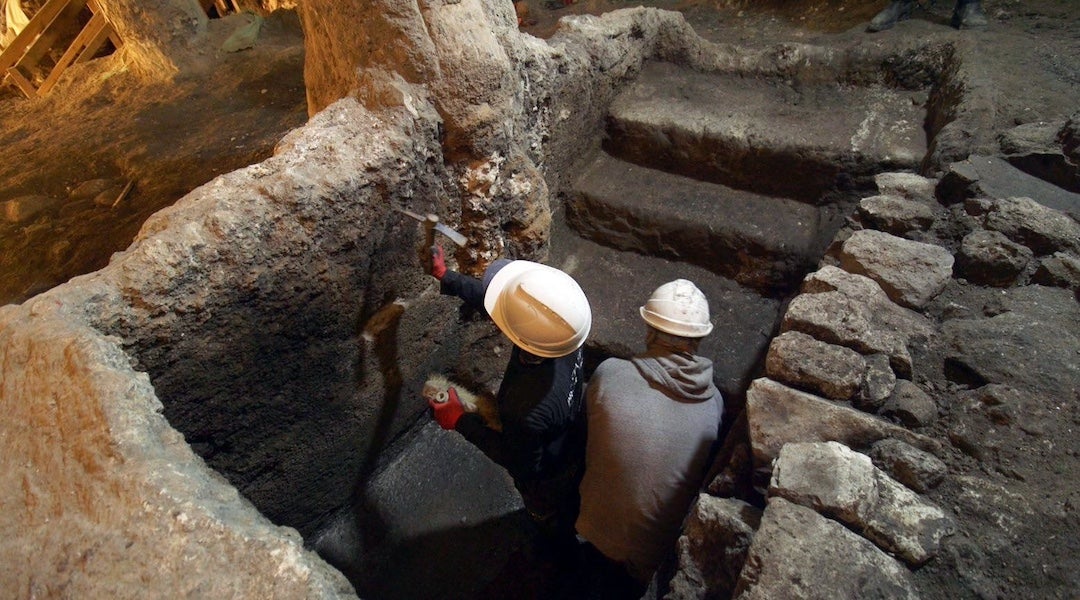
Workers clear debris from the excavation of a Second Temple period ritual bath, or mikveh, in Jerusalem, Dec. 2025. Photo by Emil Eljem, Ari Levi and Yuli Schwartz, Israel Antiquities Authority

By Andrew Silow-Carroll December 29, 2025
Archaeologists have uncovered a 2,000‑year‑old Jewish ritual bath beneath the Western Wall Plaza in Jerusalem that bears ash and destruction debris from the Roman conquest of the city in 70 C.E., officials said.
The find, announced Monday by the Israel Antiquities Authority and the Western Wall Heritage Foundation, lies just west of where pilgrims once entered the Temple Mount, offering a rare physical link to everyday life in late Second Temple Jerusalem.
The mikveh, hewn into the bedrock, measures approximately 10 feet long; 4 feet, 5 inches wide; and 6 feet, 1 inch high, with four steps leading into the bath. It was found sealed beneath a destruction layer dated to the year 70 C.E., filled with ash, pottery shards and stone vessels.
“Jerusalem should be remembered as a Temple city,” Ari Levy, the excavation director for the Israel Antiquities Authority, said in the announcement. “As such, many aspects of daily life were adapted to this reality, and this is reflected especially in the meticulous observance of the laws of ritual impurity and purity by the city’s residents and leaders.” Levy noted that stone vessels, which do not contract ritual impurity under Jewish law, were common in the area.
Heritage Minister Rabbi Amichai Eliyahu said the discovery “strengthens our understanding of how deeply intertwined religious life and daily life were in Jerusalem during the Temple period” and underlined the importance of continuing archaeological research in the city.
Mordechai (Suli) Eliav, director of the Western Wall Heritage Foundation, described the mikveh and its contents as a vivid historical testament: “The exposure of a Second Temple period ritual bath beneath the Western Wall Plaza, with ashes from the destruction at its base, testifies like a thousand witnesses to the ability of the people of Israel to move from impurity to purity, from destruction to renewal.”
Researchers say the mikveh likely served both local residents and the many pilgrims who visited the Temple in the years leading up to the Roman siege.
This article originally appeared on JTA.org.
This is a moment of great uncertainty. Here’s what you can do about it.
We hope you appreciated this article. Before you go, we’d like to ask you to please support the Forward’s independent Jewish news this Passover. All donations are being matched by the Forward Board - up to $100,000.
This is a moment of great uncertainty for the news media, for the Jewish people, and for our sacred democracy. It is a time of confusion and declining trust in public institutions. An era in which we need humans to report facts, conduct investigations that hold power to account, tell stories that matter and share honest discourse on all that divides us.
With no paywall or subscriptions, the Forward is entirely supported by readers like you. Every dollar you give this Passover is invested in the future of the Forward — and telling the American Jewish story fully and fairly.
The Forward doesn’t rely on funding from institutions like governments or your local Jewish federation. There are thousands of readers like you who give us $18 or $36 or $100 each month or year.
Support our mission to tell the Jewish story fully and fairly.