Julius Berman, Orthodox rabbi whose influence spanned secular and observant Jewish institutions, dies at 90
‘People respected him for his intellect and for his selflessness, and he was a real nice guy,’ said one colleague
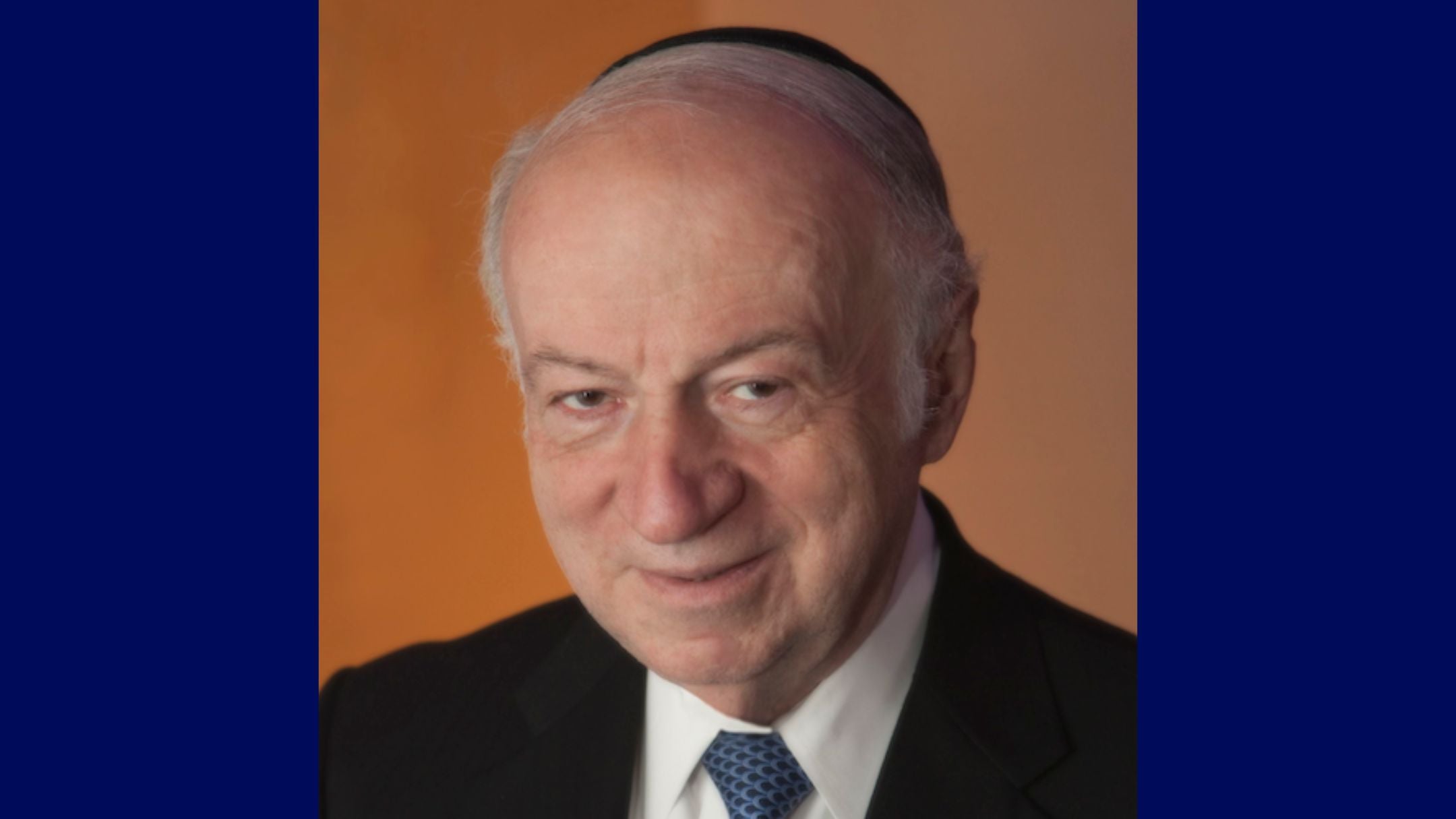
Prominent Jewish communal leader Rabbi Julius Berman dies at 90. Courtesy of Yeshiva University
(JTA) — Rabbi Julius Berman, who led the Orthodox Union and a myriad of other prominent Jewish communal organizations across the Orthodox and secular Jewish world, has died at 90.
Born in Lithuania in 1935 to Rabbi Henoch and Sarah Berman, Berman immigrated with his family to Hartford, Connecticut, in 1940 where he was among the first graduating class of the Yeshiva of Hartford.
Berman received his bachelor’s degree from Yeshiva University in 1956 and his rabbinic ordination from the Rabbi Isaac Elchanan Theological Seminary of Yeshiva University in 1959. In 1960, he graduated first in his class from New York University School of Law.
Berman joined the New York City law firm Kaye Scholer in 1959, where he was a pioneer for observant Jews in the city’s legal world.
But while Berman went on to be an accomplished partner at Kaye Scholer, it was his extensive leadership at some of the largest Jewish communal organizations in the United States that defined his broader legacy.
“Though I am not equipped to psychoanalyze myself, it is very possible that my decision to go into a legal career rather than the Rabbinate had a role to play in my decision to immerse myself into Jewish communal matters,” said Berman in a 2006 interview with the Yeshiva University Commentator. “In any case, I have been heavily involved in communal work my entire adult life.”
Over the span of his career, Berman served in leadership positions at the Orthodox Union, Yeshiva University, the Conference on Jewish Material Claims Against Germany, the Conference of Presidents of Major American Jewish Organizations and over a dozen other Jewish communal organizations.
“I can’t imagine an American Jewish world without the impact and influence of Rabbi Julie Berman,” said Rabbi Josh Joseph, the executive vice president and COO of the Orthodox Union, in a statement. “His contribution as a builder and leader was one of creativity, energy and support to so many institutions. At each stage of my Jewish education and professional career I have seen how his work directly touched me and thousands of others. As we mourn his loss we are left with the gifts that he bestowed upon us.”
Early in his career, Berman became the president of the National Jewish Commission on Law and Public Affairs, or COLPA, a legal group that represents the Orthodox Jewish community.
Dennis Rapps, who was hired as COLPA’s executive director in 1970, described Berman as a personal mentor and a “sought-after participant” in Jewish communal life.
“He was a member and active participant in many of the leading Jewish organizations,” Rapps said. “I think the respect that people had for him cut across a broad swath of the Jewish community, he got along with everybody, and people respected him for his intellect and for his selflessness, and he was a real nice guy.”
Following his work with COLPA, Berman went on to serve as the president of the Orthodox Union from 1978 to 1984, later serving as the longtime chairman of the organization’s Kashrut Commission and OU press. In an obituary for Berman, the Orthodox Union described Berman as “one of the most significant lay leaders of twentieth-century Orthodoxy.”
“He was a gracious, generous person,” Rabbi Menachem Genack, the CEO of the Orthodox Union Kosher Division, told JTA. “Whenever we had a kashrus meeting, or any other kind of meeting, everybody ultimately would defer to Julie Berman.”
Berman was also a longtime devotee of Rabbi Joseph Soloveitchik, the spiritual leader of Modern Orthodoxy in the 20th century and longtime lecturer at Yeshiva University who ordained close to 2,000 rabbis.
“He was a devoted disciple of Rabbi Soloveitchik, and Soloveitchik had a very, very high regard for him,” said Genack. “If he had issues, if he wanted to consult someone, amongst them was always Julie Berman.”
In 1982, Berman also was elected as the chairman of the Conference of Presidents of Major American Jewish Organizations. He also served as chairman of the board at Yeshiva University’s Rabbi Isaac Elchanan Theological Seminary.
“Rabbi Julius Berman stood as a towering leader of the Jewish people and a living embodiment of Yeshiva University’s mission, demonstrating how lives rooted deeply in Torah values can meaningfully and powerfully impact the broader world,” said Rabbi Ari Berman, the president of Yeshiva University and Berman’s nephew, in a statement. “As his nephew, I knew him not only as a visionary shaped by Rabbi Joseph Soloveitchik’s teachings and a trusted steward of Yeshiva University, but as a loving family man whose integrity, wisdom, and devotion to Torah and the Jewish people left an enduring imprint on world Jewry”.
Berman also served as the longtime chairman of the Conference on Jewish Material Claims Against Germany, or Claims Conference, where he was widely credited for expanding restitution for survivors worldwide. His time at the Claims Conference was later shadowed by controversy in 2009 after a $57 million fraud scheme orchestrated by an employee sparked criticism of the organization’s governance.
“Rabbi Julius Berman was a towering moral leader whose life’s work helped shape the global landscape of Holocaust survivor care, restitution, and Jewish communal life,” said Greg Schneider, the executive vice president of the Claims Conference in a statement. “A brilliant legal mind and widely respected Torah scholar, he was typically the smartest person in the room, while his sharp intellect was always matched by profound compassion. Julie led with unwavering integrity, grounding his leadership in the dignity of survivors, an abiding love for the Jewish people and a profound sense of responsibility to future generations. We are deeply grateful for his guidance, and he will be deeply missed by all who had the privilege to know him.”
Berman also formerly served as the president of the Jewish Telegraphic Agency for several years starting in 1989 and remained a member of the board for more than two decades after completing his term.
“I loved and always valued my discussions with Julie Berman, first as a reporter talking (often on background) to a source and later as a CEO seeking sage advice from a former board president,” said Ami Eden, the CEO and executive editor of 70 Faces Media, in a statement. “He was passionate about his beliefs and causes, super sharp and never shy about telling you if and why he disagreed.”
Berman is survived by his wife Dorothy Berman, and his children and their spouses, Zev and Judy Berman, Myra and Simcha Aminsky and Eli and Miriam Berman. His funeral will be held Thursday at Young Israel of Jamaica Estates in Hollis, New York.
Correction: This article has been updated to correct the timing of Berman’s presidency of JTA.
This article originally appeared on JTA.org.