How Mira Nair and Mahmood Mamdani’s politics shaped New York City’s new mayor
Mamdani’s parents and wife’s pro-Palestinian and anti-colonial activism offer a window into the political influences that shaped his path to Gracie Mansion
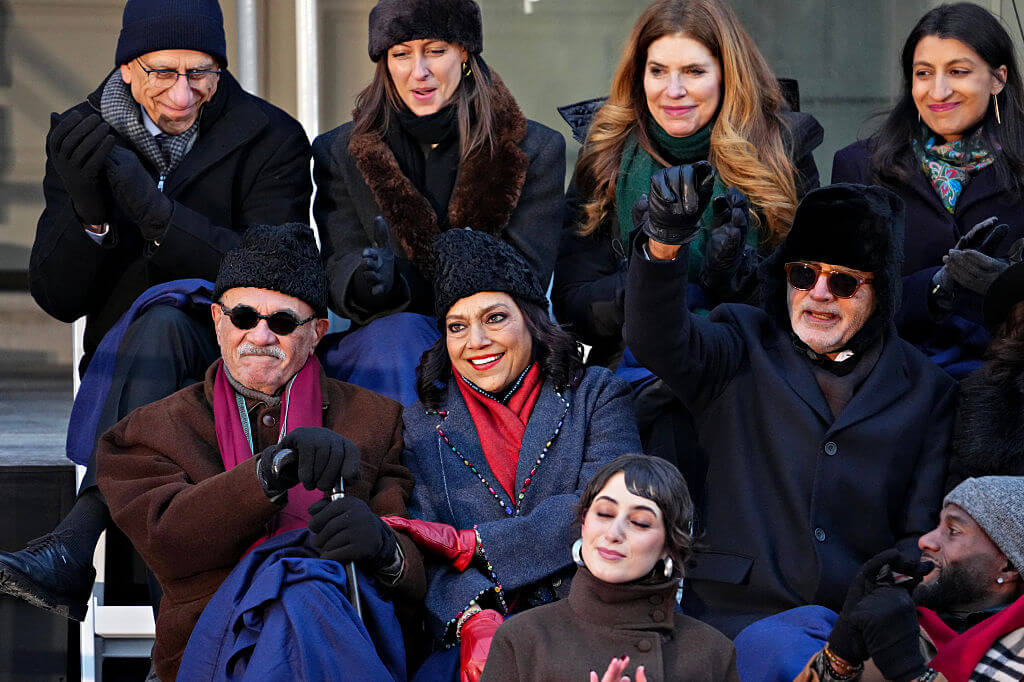
Mahmood Mamdani, left, and Mira Nair, second left, parents of Zohran Mamdani, during an inauguration ceremony at City Hall in New York on Thursday, Jan. 1, 2026. Photo by Adam Gray/Bloomberg via Getty Images
(New York Jewish Week) — When he sat down for an interview in November with the Chronicle of Higher Education, Mahmood Mamdani offered one parameter: “Let’s not talk about the mayor thing.”
It was just two days after the Columbia University professor had taken the stage alongside his wife and daughter-in-law after his son Zohran had been elected mayor of New York City, winning more than 50% of the vote in a three-way race.
Zohran Mamdani, a 34-year-old democratic socialist with a long track record of pro-Palestinian activism, has said he counts his father as one of his political inspirations.
But Mahmood Mamdani preferred to talk about his own record, as a professor of anthropology and international affairs and a longstanding pro-Palestinian activist who was the first faculty member to address the Gaza war encampment on his campus.
His wife, filmmaker Mira Nair, and Zohran’s wife, the artist Rama Duwaji, likewise are respected in their fields and well known for their pro-Palestinian advocacy and adherence to the movement to boycott Israel.
Zohran Mamdani has described the BDS movement as “consistent with the core of my politics,” and in 2023 introduced a bill while serving as an assemblymember that sought to block nonprofits from funding Israeli settlements in the West Bank.
While it is unclear the extent to which Mamdani will pursue BDS policies during his upcoming mayoral term, his politics and those of his parents reflect a shared alignment with pro-Palestinian causes.
“When you’re the kid of two parents who are very involved in social justice, a lot of times what you remember as a playdate was you being at some rally or some march,” Mamdani recalled in an interview with City & State in April 2023.
Now, as Zohran takes the city’s reins, here’s what you need to know about his immediate family.
Mahmood Mamdani, viewing Israel through an anti-colonial lens
Long before his son’s mayoral campaign, Mahmood Mamdani, 79, was known widely as one of the foremost scholars on colonialism and postcolonial politics in Africa. Born in India in 1946, Mamdani was raised in Kampala, Uganda at a time when the country was racially segregated. After receiving his bachelors, masters and doctorate from universities in the United States, Mamdani was expelled from Uganda in 1972 after Ugandan President Idi Amin ordered all Asians to leave the country.
Since 1999, he has been a professor of government at Columbia University, and has published several books and essays on colonialism and political violence including “Citizen and Subject: Contemporary Africa and the Legacy of Late Colonialism” in 1996 and “Good Muslim, Bad Muslim: America, the Cold War, and the Roots of Terror” in 2004.
As a scholar, Mahmood Mamdani is best known for his analysis of colonial rule and how it shapes the identities of both the occupied and occupiers. In his 2020 book, “Neither Settler nor Native: The Making and Unmaking of Permanent Minorities,” he uses case studies that include Nazi Germany, Israelis and Palestinians and post-apartheid South Africa.
Mamdani has spoken directly and repeatedly about how his broader scholarship shapes his thinking on Israel and Palestinians. “The issue is not settlers, but settler colonialism,” he wrote in “Neither Settler nor Native.” In 2021, during an 11-day outbreak of violence between Hamas and Israel that was sparked by tensions in Jerusalem, Mamdani wrote on X, “Palestinians have a right to resist. This is a colonial occupation, not a conflict!”
Three days later, as Hamas and Israel exchanged missiles and airstrikes, Mamdani wrote that the conflict was not between Israel and Hamas, but rather the resurgence of a third intifada.
“The resistance this time began in Jerusalem and spread to Gaza, now the West Bank and Palestinian communities beyond. This is not a conflict between Israel and Hamas,” wrote Mamdani in a post on X. “We are witnessing something far more meaningful, the birth of the Third Intifadah against settler colonialism!”
In 2002, as the second intifada was in full force, Mamdani signed onto a petition calling for Columbia University to divest from companies supplying arms to Israel, saying at the time his support for the petition was to make a “moral statement registering concern over the exercise of power by Israel.”
In the Chronicle of Higher Education interview, Mahmood Mamdani spoke about being the first faculty member to address the pro-Palestinian protesters who set up an encampment at Columbia in 2024. He said his talk focused on “lessons of the divestment movement in South Africa.”
In a 2022 Zoom lecture at the Carter G. Woodson Institute of the University of Virginia, Mahmood Mamdani argued that while there was reason to give “full and enthusiastic support” to the BDS movement, he cautioned against the movement extending its boycotts against the breadth of “Israeli society and not just to its Zionist sectors.”
During his lecture, Mamdani also argued that Israel must learn from the dissolution of the South African apartheid, saying that the only way forward in the region was if there was an “epistemic revolution” in Israel where they realized the “flourishing of Jews and Jewish life does not require a Zionist state.”
“Whites did not need to monopolize political power to have a home in South Africa. It is this lesson that needs to be driven home to Israelis, as many as possible, that Jews do not need to have a Jewish state to have a secure home in Israel-Palestine,” said Mamdani. “Indeed, Jews are more secure in New York City than they are in Israel.”
Asked whether he supports a one-state solution, Mamdani recently told The Chronicle, “I’m sympathetic to only one type of one state, a state which is based on rule of law and guarantees equal rights,” a position his son echoed on the campaign trail. “I’m opposed to any kind of discrimination. I’m opposed to any form of apartheid which I understand to be a legally enforced distinction between two groups in society, where one benefits and the other is penalized.”
In an interview with The Nation in January 2024, Mamdani criticized the public response to the pro-Palestinian protests erupting across the U.S., saying that conflating anti-Zionism with antisemitism was a danger to democracy.
“To conflate the critique of a state with the critique of a people poses a challenge to a democratic culture,” he said. In his recent Chronicle interview, Mamdani pointed favorably to the Jerusalem Declaration definition of antisemitism, signed by over 200 mostly Jewish scholars, which insists that the movement to boycott Israel is not in and of itself antisemitic. The declaration, he said, “makes a very clear distinction between the State of Israel and the people of Israel,” as opposed to the International Holocaust Remembrance Alliance definition.
In a January 2024 letter published in the Columbia Spectator, Mahmood Mamdani criticized the school for dissuading the use of the words “intifada” and “from the river to the sea,” arguing that excluding them would “rule out any meaningful dialogue on Israel and Palestine on this campus.” (He told the Chronicle that the “river to the seas” concept appears in the Likud party manifesto, which declares that “between the [Mediterranean] Sea and the Jordan [River] there will only be Israeli sovereignty.” He also claimed that he had not actually heard “from the river to the sea” chanted in Columbia’s quad, and had only read about it.)
Zohran Mamdani similarly downplayed rhetoric that many Israel supporters consider incendiary. In June he declined to condemn the phrase “globalize the Intifada,” arguing that the phrase symbolized a “desperate desire for equality and equal rights in standing up for Palestinian human rights.” (Mamdani later said he would “discourage” the use of the phrase, which many supporters of Israel, recalling two violent uprisings of Palestinians in 1987 and 2000 that killed hundreds of Israelis, see as a call to violence.)
At an appearance on the encampments, Mamdani described charges of antisemitism as “part of the currency the administration uses to demonize protests like this,” according to the Columbia Spectator.
Critics of the elder Mamdani say he underplays Jewish historical vulnerability and antisemitism, minimizes Palestinian political agency and their internal divisions, and ignores the way Zionism differs from European colonialism. But like his son, he believes even younger Jews are increasingly adopting his critique of Israel and Zionism.
In a December interview with Peter Beinart for Jewish Currents, a leftist magazine, he said he believed the Jewish diasporic community would play an “important role” in discussions over the “Palestinian question” in the future.
“Jewish children in New York City have become increasingly skeptical of the direction in which Israel has been moving, and increasingly disillusioned with both the moral and the political efficacy of that route and increasingly open to explore an alternative,” said Mamdani.
Mira Nair, a supporter of cultural boycotts
Nair is an award-winning Indian-American filmmaker whose debut 1988 film, “Salaam Bombay!,” earned her an Academy Award nomination for Best Foreign Language Film. She also directed several acclaimed films including “Mississippi Masala” in 1991, “Monsoon Wedding” in 2001 and “The Namesake” in 2006.
Born in India, she met Mahmood Mamdani in Uganda in 1989, and they married two years later. Nair was also married to the Jewish photographer Mitch Epstein from 1981 to sometime before 1989; he has declined JTA’s requests for an interview.
Nair has also been an outspoken critic of Israel and a supporter of petitions backing the Boycott, Divest and Sanctions movement.
In 2013, Nair declined an invitation to the Haifa International Film Festival. “I will not be going to Israel at this time. I will go to Israel when the walls come down. I will go to Israel when occupation is gone,” she tweeted at the time. In a subsequent post, she added that she stood with the BDS movement.
In March of this year, Nair signed onto a petition calling for the Academy Awards to remove Israeli actress Gal Gadot from its ceremony, accusing her of showing “support for Israel’s military actions against Palestinians,” according to an Instagram post by the group.
Following the election of her son, Nair has also declined to discuss Mamdani’s attitudes towards Jews and Israel in an interview with The Hollywood Reporter.
“What I love so much about Zohran is that he embraces the multiplicity of our lives in the most natural way — this mosaic that is our city but that no one has seen until this young man came along,” Nair told The Hollywood Reporter of her son.
Rama Duwaji, an artist with a political vision
Mamdani’s wife, Rama Duwaji, whom he married this year, has also made pro-Palestinian advocacy a focal point of her work in ceramics, animation and illustrations.
While Duwaji has largely refused interviews with the press and did not appear at campaign events or fundraisers, last month she sat for her first interview post election with The Cut.
“Speaking out about Palestine, Syria, Sudan — all these things are really important to me,” Duwaji told The Cut. “I’m always keeping up to date with what’s going on, not just here but elsewhere. It feels fake to talk about anything else when that’s all that’s on my mind, all I want to put down on paper.”
“Everything is political; it’s the thing that I talk about with [Zohran] and my friends, the thing that I’m up to date with every morning, which is probably not great for my mental health. It’s what I talk about when I check on my family back home,” continued Duwaji.
During the interview Duwaji also discussed the meaning behind part of her election night outfit —- a black top designed by Zeid Hijazi, a London-based Palestinian-Jordanian label.
“It’s nice to have a little bit of analysis on the clothes because, for instance, during the general-election night, it was nice to send a message about Palestinians by wearing a Palestinian designer,” said Duwaji.
Duwaji, 28, who is ethnically Syrian and grew up in Texas and Dubai, also frequently posts illustrations that advocate for pro-Palestinian causes on her Instagram account. Her art has been featured in The New Yorker, The Washington Post, the BBC, and VICE, according to her website.
https://www.instagram.com/p/DNQ85ehpSo6/?hl=en
In August, she posted an animation of the Palestinian flag along with the words “end the genocide,” and posted another last month depicting the Global Sumud Flotilla.
In March, she posted an illustration of Mahmoud Khalil, a pro-Palestinian student activist at Columbia University, calling for his release after he was detained by the Trump administration amid its campaign to purportedly combat campus antisemitism.
“This is an attack on freedom of speech, and sets a scary f—king precedent for anyone who speaks up for what’s right. Resist,” wrote Duwaji.
“He’s his own person”
In an interview with the New York Times in June, Mahmood Mamdani spurned suggestions that his politics had an outsized impact on his son’s political views.
“He’s his own person,” Mamdani said. “Now, of course what we do as his parents is part of the environment in which he grew up, and he couldn’t help but engage with it. That doesn’t mean anything is reflected back on us.”
But Nair was quick to disagree, telling the Times that her son had “very much absorbed” his parents’ politics, which largely center on anti-colonialism.
“I don’t agree!” Ms. Nair said. “Of course the world we live in, and what we write and film and think about, is the world that Zohran has very much absorbed.”
This is a moment of great uncertainty. Here’s what you can do about it.
We hope you appreciated this article. Before you go, we’d like to ask you to please support the Forward’s independent Jewish news this Passover. All donations are being matched by the Forward Board - up to $100,000.
This is a moment of great uncertainty for the news media, for the Jewish people, and for our sacred democracy. It is a time of confusion and declining trust in public institutions. An era in which we need humans to report facts, conduct investigations that hold power to account, tell stories that matter and share honest discourse on all that divides us.
With no paywall or subscriptions, the Forward is entirely supported by readers like you. Every dollar you give this Passover is invested in the future of the Forward — and telling the American Jewish story fully and fairly.
The Forward doesn’t rely on funding from institutions like governments or your local Jewish federation. There are thousands of readers like you who give us $18 or $36 or $100 each month or year.
Support our mission to tell the Jewish story fully and fairly.