Michele Weiss and Justin Brasch mark milestones as first Orthodox Jewish mayors in their cities
The two took office in towns in Ohio and New York
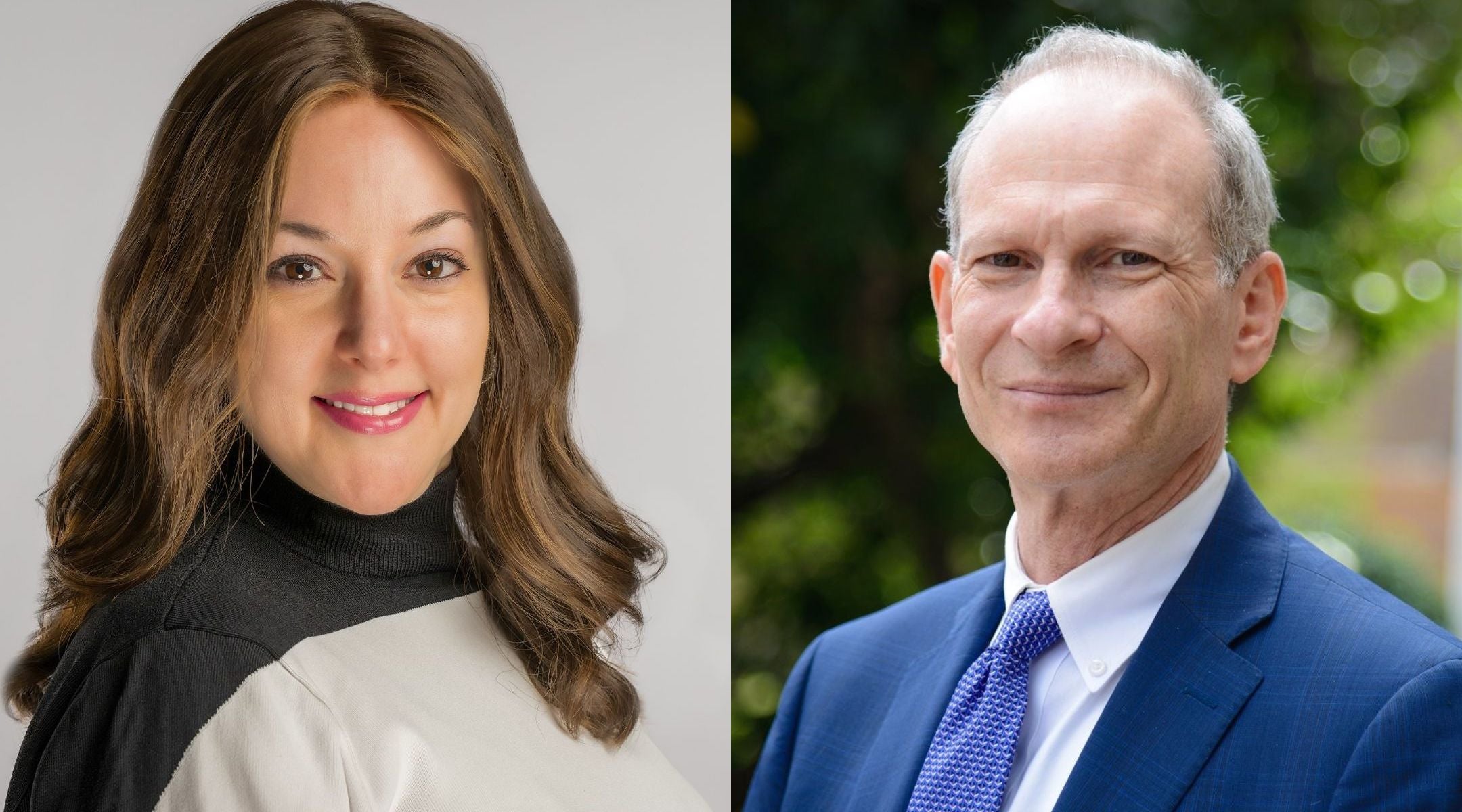
Michele Weiss, the mayor of University Heights, Ohio, (L) and Justin Brasch, the mayor of White Plains, New York (R). Courtesy of Michele Weiss and Justin Brasch
(JTA) — This week, as New York City inaugurated its first Muslim mayor, two cities in the United States also made history with the swearing-in of their first Orthodox Jewish mayors.
While Orthodox mayors have been elected in cities and suburbs across the county, including New Jersey, New York State and Florida, the inaugurations of Michele Weiss in University Heights, Ohio, and Justin Brasch in White Plains, New York, this week marked a milestone for Orthodox representation in local politics.
In November, Bal Harbour, Florida, also swore in an Orthodox Jewish mayor, Seth Salver, making him the third Orthodox mayor currently serving in a municipality of Miami Dade.
Here is what you need to know about the United State’s newest Orthodox mayors:
Michele Weiss, first female Orthodox Jewish mayor in the United States
Michele Weiss was sworn in on Wednesday as mayor of University Heights, Ohio, a suburb of Cleveland, making her one of the first Orthodox Jewish women to lead a city in the United States.
(Meyera Oberndorf, who served as mayor of Virginia Beach, Virginia from 1988-2008, was described as having an Orthodox Jewish upbringing.)
“I want to make a kiddush hashem,” Weiss told the Jewish Telegraphic Agency, using a Hebrew term that can mean a positive Jewish role model. “I want to make sure that the Jewish community is seen in a good light, and that’s what I want to portray as a Jewish woman, as an Orthodox Jewish woman, and just make sure that that permeates.”
Weiss said that the Jewish community in University Heights had grown “a tremendous amount” in recent years, driven in part by the low cost of living compared to Cleveland and the fact that the city offers non-public school vouchers.
“It is the largest Orthodox contingency of residents in the state of Ohio, at this point it’s about 20-25%” said Weiss. “They definitely need to be represented, but of course, I represent everyone in the city, not just the Jewish residents.”
Growing up in a Conservative home in another suburb of Cleveland, Richmond Heights, Weiss said that she first became more observant in high school while participating in NCSY, the youth division of the Orthodox Union.
Weiss moved to University Heights in 1997, and worked as the controller and later the CFO of the Hebrew Academy of Cleveland, the largest Jewish day school in Ohio. She is married to her husband, Marcelo, and has three children and multiple grandchildren.
In 2013, Weiss said a coworker inspired her to volunteer as an observer for the League of Women Voters.
“I always was doing quiet good deeds,” said Weiss. “I was at the point, though, where I kept thinking, well, what could I do more for the community? So I had a colleague that said, ‘you know, why don’t you get involved with the city?’”
In 2016, Weiss won a seat on the University Heights city council, and was later appointed by the council as the city’s vice mayor for six years. Weiss said that she felt inspired to run for city council as a voice for the city’s Orthodox.
“I really feel that we’re put on this world to make a difference, and I felt that there needed to be a voice for a lot of reasons,” said Weiss. “I can relate to the secular world and the Jewish world and the Orthodox world, so I can fill that void and that spectrum knowing how to speak to certain people appropriately. I don’t think every religious leader can do that, so I have that ability, and I thought that I would be able to bridge that gap effectively.”
The same year, Weiss also founded the AMATZ initiative, a nonprofit that trains Jewish educators and principals on how to better serve their female students. Weiss also holds board positions on YACHAD, a Jewish disability nonprofit, and the Community Relations Committee at the Jewish Federation of Cleveland.
During her tenure on the city council, Weiss often struggled to work with the city’s former mayor, Michael Dylan Brennan, who was censured twice by the council for “inappropriate language.”
During her campaign, Weiss said that she ran on unifying the city, building new municipal facilities and sharing resources with neighboring communities. While Weiss said the mayoral election in University Heights is nonpartisan, she is a Republican. She won the mayoral election with 56% of the vote.
To help bring together the city’s communities following the discord of Brennan’s tenure, Weiss said she planned on hosting programs and educational forums to “show the diversity of our residents.”
“I’m not focusing just on the Orthodox community, I have to focus on everybody, because we want to be a cohesive unit,” said Weiss. “But one of the things is, I think we need to do some healing and unify the community.”
While Weiss said her religious identity had not been a big factor on the campaign trail, during one debate she was asked about her Sabbath observance. Weiss said she had consulted her rabbi and the police chief to develop a plan for situations that would need her attention during Shabbat or Jewish holidays.
Looking ahead to her mayoral tenure, Weiss said she felt a responsibility to serve as a role model amid rising antisemitism.
“There’s hope for the Jewish community going forward in America, and because it’s scary times with with antisemitism right now, I want to be an example, not just to the religious community, but to women and girls that are Jewish that maybe don’t see themselves in that type of leadership position,” said Weiss.
Justin Brasch, first Orthodox mayor of White Plains
Justin Brasch, a career public servant and lawyer, was inaugurated Friday as the first Orthodox mayor of White Plains, a city just north of New York City in Westchester County and a hub of Jewish life.
Brasch, a Democrat, won the mayor’s seat in November with 72% of the vote against Republican opponent Lenny Lolis, becoming the city’s first new mayor since 2011.
Speaking with the Jewish Telegraphic Agency about his upcoming mayoral tenure, Brasch said that he looked forward to setting an example as the county’s only Orthodox mayor, a distinction he said he had earned by building bridges across the city’s diverse communities.
“I love what I do, and everybody knows that I care, and of course I have to set an example, I have no choice, and I like that,” said Brasch. “I have to be accessible to everybody, help everybody, and I do. I go into all the communities, I go to Iftar and break the fast at the mosque, regularly attend the black churches, you name it. I’m there trying to be helpful and build bridges and make things better for people.”
Brasch, now 60, was just 17 when he made his first foray into politics, serving as an intern for then-congressman Ted Weiss on the Upper West Side of Manhattan. There, Brasch said he first “saw how much good government could do.”
“He and his office were in there helping people with housing insecurity and food insecurity and problems with Medicare and Medicaid, and supporting immigrants and helping immigrants get their proper paperwork, etc.,” said Brasch. “I was very inspired by that. I loved how much the people in that office and Congressman Weiss cared and how much good they could do through government.”
As a student at Williams College in Williamstown, Massachusetts, Brasch founded the school’s Young Democrats chapter. After moving back to the Upper West Side, he served on the political committee of the New York City Sierra Club and the board of the Mid-Manhattan NAACP.
Brasch said that he had grown up “confusidox,” with Orthodox grandparents on one side and Reform grandparents on the other.
For several years after graduating college, Brasch lived with his Orthodox grandfather on the Upper West Side, an experience he said helped set him on a path for public service and toward becoming an Orthodox Jew.
“He had a real love for people, and felt that Jews need to be helping the Jewish community and the broader community, and he was always very inspiring to me, very down to earth,” said Brasch.
Brasch moved to White Plains with his wife, Juli Smith, in 2003 in search of more space, drawn by the city’s diversity, “down-to-earth” spirit and, at the time, small Jewish community. He is a member of the Modern Orthodox synagogues Young Israel of White Plains and Hebrew Institute of White Plains. Brasch and his wife, who is a commissioner in the White Plains Housing Authority, have three children.
“I joke that I have made a lot of mistakes in life, moving to White Plains was not one of them,” said Brasch. “It’s a very diverse place. People get along. People help one another. People are very supportive. We don’t have any of that hate and intolerance and anger that exist in other places.”
Since moving to White Plains, Brasch said that he had seen the local Jewish community grow at a steady pace. According to the UJA-Federation of New York’s 2023 population study, Westchester County is home to approximately 89,000 Jewish adults and 16,000 Jewish children.
“Our community is growing. People know that this is a great place to raise a family,” said Brasch. “We’re a very safe city and a great place. We have five synagogues, as I said, they all get along, everybody works together, and there’s a lot of harmony in our community.”
Beyond his work at his small legal firm in New York City, Brasch has served in myriad leadership roles in White Plains’ government, including on its planning board, school board budget advisory committee, youth bureau and a transportation task force.
He also served for 12 years on the county’s budget committee.
“That was an incredible opportunity to help and to review things and discover things, and to make connections, and certainly to show as a Jewish person, that we care and we’re involved,” said Brasch.
Before announcing his campaign for mayor, Brasch said that he believed his involvement in different communities in White Plains demonstrated to the local Democratic Party leadership that he was well suited for the role.
“We’re an extremely diverse city, and everybody sees that I go to all the different communities,” said Brasch. “I show up at the black churches, I go to the mosque, I go to the black community, the Latin community. I’m completely involved, and they felt that I have the leadership skills and abilities to keep our city moving in the right direction.”
Brasch said that his involvement in White Plains’ diverse communities also served another purpose: combatting antisemitism.
“I believe that we need to be more involved in the broader community to fight anti semitism,” said Brasch. “Unfortunately, the propaganda these days is that Jews are a selfish community that only cares about themselves. And actually, when people get to know us, they see that we’re good people, we care, we want to help all communities and help the world.”
Brasch said that he also expected some people to leave New York City for White Plains following the election of Mayor Zohran Mamdani, whose election sparked concern among some of the city’s Jewish residents over his harsh criticism of Israel and avowed socialist politics.
“I do have a different vision from him, except with regard to our desire to help people who have less,” said Brasch of Mamdani. “I do think that there will be somewhat of a migration to White Plains from the city, because we’re a safe city that takes care of our people and builds a nice community.”
During his mayoral campaign, Brasch ran on several key issues, including expanding affordable housing, creating new green spaces and building an intergenerational community center that would put programming for the city’s youth and elderly under one roof.
“I’ve always believed that Judaism is about being the best person you can be helping the world,” said Brasch. “Whether we want to say it’s bringing kedushah or holiness to the world, whether it’s tikkun olam, we are supposed to be a light unto the nation, there’s, quote after quote and teaching after teaching, that we’re supposed to be doing a great job being decent and honest people.”
This article originally appeared on JTA.org.