The judge in Maduro’s case is an Orthodox Jew — and displays a Torah verse in his chambers
Judge Alvin Hellerstein is overseeing the case of ousted Venezuelan President Nicolas Maduro
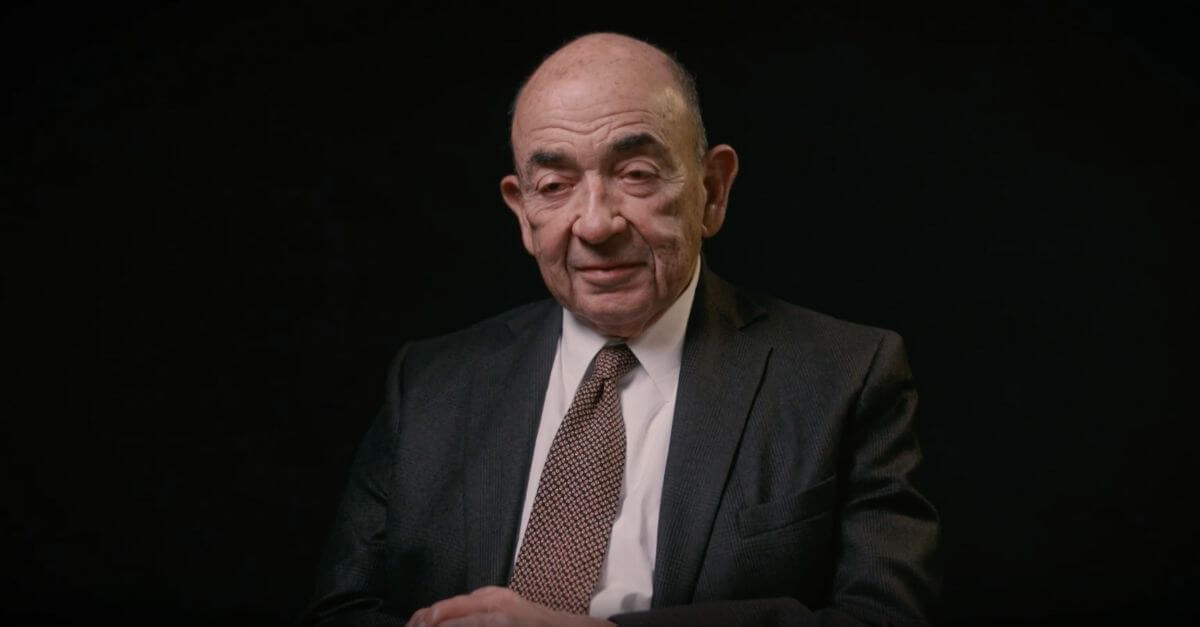
Judge Alvin Kenneth Hellerstein. Screenshot of Blavatnik Archive, Oral History Project

By Hannah Feuer January 5, 2026
Judge Alvin Kenneth Hellerstein, an Orthodox Jew who displays the Torah verse “Tzedek, tzedek tirdof” — “Justice, justice you shall pursue” — on the walls of his chambers, is presiding over the case of ousted Venezuelan President Nicolás Maduro.
Hellerstein oversaw Monday’s arraignment of Maduro and his wife, Cilia Flores, who entered a plea of not guilty to drug trafficking charges. The hearing followed the U.S. military’s extraordinary capture of the Venezuelan leader and first lady in Caracas on Saturday and their subsequent transfer to a federal jail in Brooklyn.
Hellerstein, 92, has spoken extensively about the role his Jewish identity has played in his life and career, including his work advocating for refuseniks in the former USSR, service as president and chairman of the Board of Jewish Education, and weekly tennis matches with three rabbis — the latter the subject of a 2016 feature in The New York Times.
Raised in New York City, Hellerstein attended Bronx Science High School, Columbia College, and Columbia Law School. Upon graduation from law school, he clerked for Judge Edmund Palmieri, served in the U.S. Army Judge Advocate General’s Corps, and worked in private practice for several decades, before being appointed to the federal bench by President Bill Clinton in 1998.
“As a Jewish boy coming to interview [with] law firms, you met up with very strong discrimination — some of it overt, most of it implied,” Hellerstein said in a 2020 interview on the podcast Behind the Bima. “Even joining a Jewish firm caused you to lose status.”
He recalled telling prospective employers that he would not work on Shabbat except in emergencies.
In a 2013 article for the Touro Law Review, titled “The Influence of a Jewish Education and Jewish Values on a Jewish Judge,” Hellerstein reflected on how those values intersected with his judicial work — or were perceived to.
In that article, he cited a 2010 Times piece headlined “Empathetic Judge in 9/11 Suits Seen by Some as Interfering,” which examined his rejection of a proposed settlement between New York City and more than 10,000 rescue and cleanup workers who said their health was harmed on Ground Zero. In the article, one attorney said it was “frustrating” that Hellerstein appeared to be “guided by a concept of fairness that’s not in the law.”
In another case, Hellerstein declined to accept a guilty plea from Alejandro Orozco, a Mexican national who had unknowingly transported drugs hidden in a truck he was hired to drive. Hellerstein helped connect Orozco with an immigration lawyer, and the man later obtained U.S. citizenship.
When Orozco fell to his knees in gratitude, Hellerstein stopped him and quoted the verse from Deuteronomy displayed in his chambers: “Justice, justice shalt thou pursue,” telling Orozco that he should be the one giving thanks.
“I would not want it to be said that I ruled in a certain way because I am an Orthodox Jew, and I would not want to feel that my Jewish upbringing or values cause me to rule in one way and not another,” Hellerstein wrote. “Yet, it cannot be denied that judges are influenced by who they are and how they were brought up — and certainly I would not deny that.”
This is a moment of great uncertainty. Here’s what you can do about it.
We hope you appreciated this article. Before you go, we’d like to ask you to please support the Forward’s independent Jewish news this Passover. All donations are being matched by the Forward Board - up to $100,000.
This is a moment of great uncertainty for the news media, for the Jewish people, and for our sacred democracy. It is a time of confusion and declining trust in public institutions. An era in which we need humans to report facts, conduct investigations that hold power to account, tell stories that matter and share honest discourse on all that divides us.
With no paywall or subscriptions, the Forward is entirely supported by readers like you. Every dollar you give this Passover is invested in the future of the Forward — and telling the American Jewish story fully and fairly.
The Forward doesn’t rely on funding from institutions like governments or your local Jewish federation. There are thousands of readers like you who give us $18 or $36 or $100 each month or year.
Support our mission to tell the Jewish story fully and fairly.