Breads Bakery employees unionize, call for end to Jewish Israeli owners’ ‘support for the genocide in Gaza’
The workers cited a Jewish food festival as an example of a “Zionist project” they will now refuse to cater
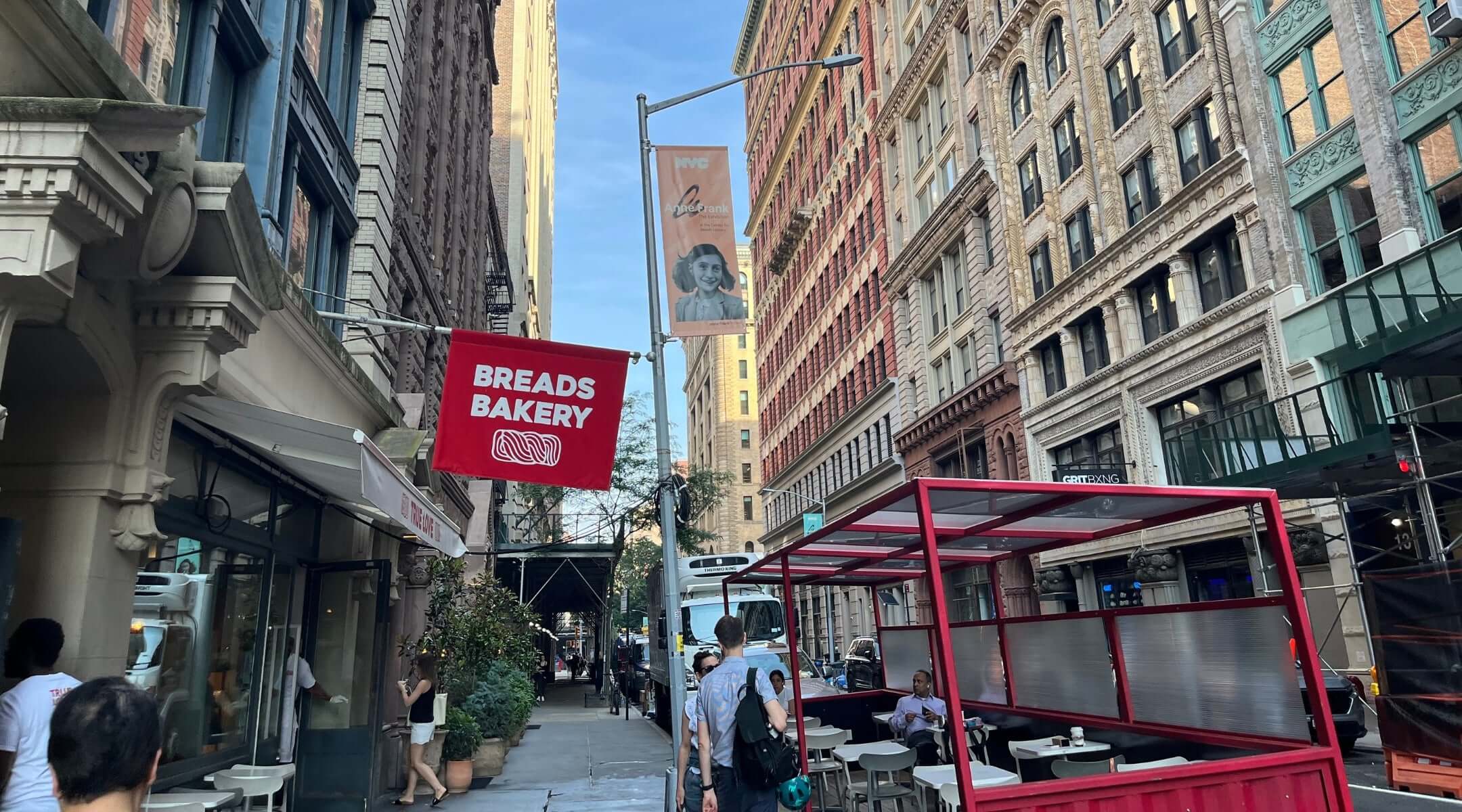
(Philissa Cramer) Photo by Philissa Cramer
(New York Jewish Week) — Employees at New York City’s biggest Israeli bakery chain are seeking to form a union — and one of their top demands is “an end to this company’s support of the genocide happening in Palestine.”
As an example, they cited Breads Bakery’s participation in last year’s Great Nosh, a citywide festival of Jewish food held on Governor’s Island.
“The workers refuse to participate in Zionist projects such as fundraisers that support the ‘Israeli’ occupation of Palestine, baking cookies with the ‘Israeli’ flag, and catering events such as the Great Nosh, which are connected to organizations that donate millions each year to the IDF,” the union, which is calling itself Breaking Breads, said in a statement issued Tuesday.
The employees at Breads, a spinoff of a Tel Aviv bakery with six outposts in New York City, have teamed up with the United Auto Workers to form their union. They are alleging poor working conditions, low and unfair pay and a lack of “respect” from management.
But they also are calling on the bakery’s operators, CEO Yonatan Floman and founder Gadi Peleg, to end Breads’ ties to Israel. Both men are themselves Israeli, and Breads’ menu features items from across the Jewish diaspora that are popular in Israel, such as rugelach, challah, bourekas and its award-winning babka.
“We cannot and will not ignore the implicit and explicit support this bakery has for Israel,” Breaking Breads posted on Instagram on Jan. 1 in a statement that appeared in English, Spanish, Arabic and French. It said it had announced itself to Breads’ management days earlier.
“We see our struggles for fair pay, respect, and safety as connected to struggles against genocide and forces of exploitation around the world,” the statement continued. “There are deep cultural changes that need to happen here, and we need to see accountability from upper management.”
To form a union under federal law, at least 30% of workers must sign on. Now, if the bakery does not agree to voluntarily recognize the union, Breaking Breads can petition the National Labor Relations Board for an election to be legally recognized. It’s rare for unions to announce themselves at the threshold, as Breaking Breads did, more often waiting until at least twice as many workers join in as a show of strength and a safeguard against challenges.
A representative from Breads Bakery did not respond to a request for comment.
Breaking Breads declined to speak further with the Jewish Telegraphic Agency, and referred back to the press release.
Breads is not the first employer to face worker demands related to support for Israel. In November 2023, about a month after the Oct. 7 Hamas attack on Israel, five employees at New York’s Café Aronne quit after learning of the owner’s public support for Israel; volunteers stepped up to help run the café.
In 2024, employees at a Detroit bagel shop either quit or were fired following a dustup with management when their concerns about work conditions merged with their criticism of Israel. Earlier this year, workers at Alamo Drafthouse, a movie theater chain, petitioned their employer not to show the film “September 5,” calling it “Zionist propaganda.”
And in Philadelphia, workers were among those who protested after the celebrity chef Mike Solomonov’s restaurant group, CookNSolo, donated to United Hatzalah, an Israeli rescue service, soon after Oct. 7.
Breads, too, staged an emergency fundraiser to benefit Israel shortly after Oct. 7. The bakery worked with the Israeli food influencer (and now bakery owner himself) Ben Siman-Tov to create heart-shaped challahs that sold for $36 to benefit Magen David Adom, Israel’s national organization responsible for emergency pre-hospital medical care and blood services. The bakery raised more than $20,000 amid a stronger-than-anticipated response.
Peleg and Floman also donated Breads’ signature black-and-white cookies to a bake sale fundraiser that raised $27,000 for Israeli food relief efforts in the wake of Hamas’ attack.
“What happened in Israel was an act of pure evil,” Peleg said at the time. “What we are doing is an act of pure good.”
Such fundraisers would be prohibited if the union succeeds in being recognized and negotiates a contract reflecting its demands. So, too, would the ability of customers to order Israeli flags on custom products, which Breads produces for private events.
Breaking Breads is explicitly positioning itself in the context of Jewish baking labor history. In its statement, it says it is the largest New York City craft bakery union since the 1920s, when Bagel Bakers Local 338 had roughly 300 craftsmen across the city. In the 1960s, Local 338 was nicknamed the “bagel mafia” after it prevented the Italian mob from entering the industry.
Breads Bakery employs 275 workers overall. In its statement announcing itself, Breaking Breads alleges a host of offenses, including deference to violent customers, failure to follow regular schedules for workers, and telling workers that they cannot speak Arabic in the cafes.
For some Jewish Breads fans, the union’s objections to expressions of support for Israel were surprising.
“I think it’s ridiculous to work for a Jewish-slash-Israeli-owned company and then be appalled by their policies and affiliations,” said Morgan Raum, a Jewish food influencer who has promoted Breads in the past.
Raum said the union’s boycott of events like The Great Nosh, for which she sat on the host committee, was especially galling.
The event on Governor’s Island last June drew 2,000 people and had a waitlist of another 2,000. It was not billed as a fundraiser for Israeli organizations, or as an Israeli food event — but some of its supporters and vendors are Israeli, and have fundraised for Israeli causes, such as supporting border communities after Oct. 7, providing trauma care, or providing rehabilitation and civilian reintegration services for injured Israeli soldiers.
Jewish Food Society, the Great Nosh’s lead organizer, did not respond to a request for comment on the Breads unionization effort. UJA-Federation of New York, which gave $500,000 to the event and also raised $800 million for Israel after Oct. 7, also declined to comment.
“I think it’s antisemitic to target the Great Nosh,” Raum said. “Tons of organizations and events are connected to organizations that donate or are affiliated with or support Israel. So it would be extremely hard to navigate anything, any event, any world in which you’re not doing so.”
This is a moment of great uncertainty. Here’s what you can do about it.
We hope you appreciated this article. Before you go, we’d like to ask you to please support the Forward’s independent Jewish news this Passover. All donations are being matched by the Forward Board - up to $100,000.
This is a moment of great uncertainty for the news media, for the Jewish people, and for our sacred democracy. It is a time of confusion and declining trust in public institutions. An era in which we need humans to report facts, conduct investigations that hold power to account, tell stories that matter and share honest discourse on all that divides us.
With no paywall or subscriptions, the Forward is entirely supported by readers like you. Every dollar you give this Passover is invested in the future of the Forward — and telling the American Jewish story fully and fairly.
The Forward doesn’t rely on funding from institutions like governments or your local Jewish federation. There are thousands of readers like you who give us $18 or $36 or $100 each month or year.
Support our mission to tell the Jewish story fully and fairly.