Peter Beinart, Elliot Cosgrove and other Jewish leaders face off over the future of liberal Zionism
At a Manhattan synagogue, rabbis and thinkers lament that young American Jews are losing faith in a model that once linked support for Israel with democratic values
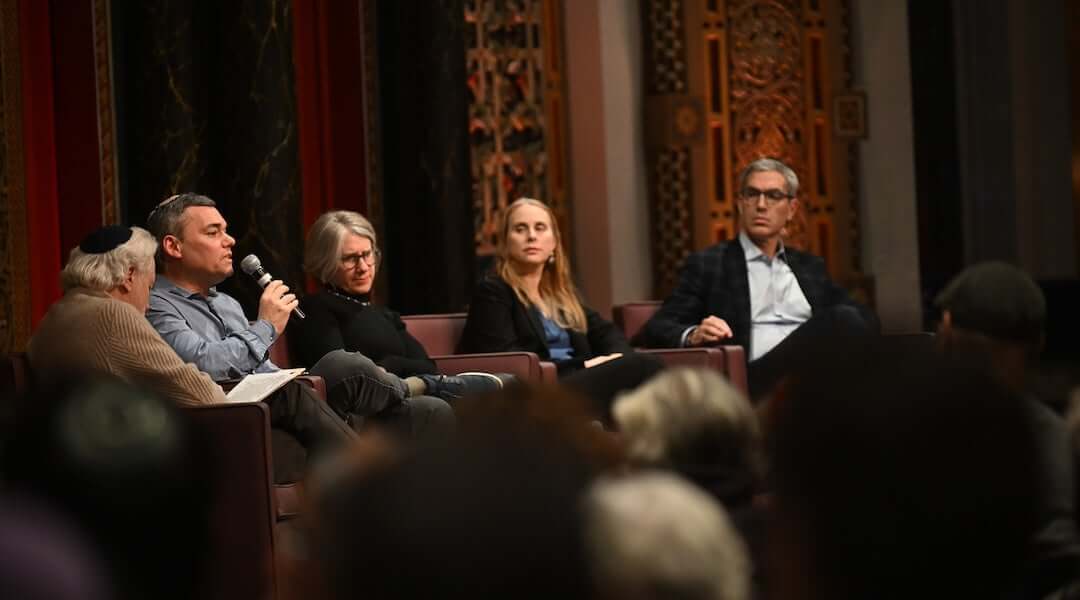
Peter Beinart speaks at a panel on “The Jewish Tent at a Crossroads” in the sanctuary of B’nai Jeshurun in Manhattan, Jan. 6, 2026. Others on the panel were, from left, moderator Rabbi Irwin Kula, Esther Sperber, Rabbi Jill Jacobs and Rabbi Elliot Cosgrove. Photo by Gili Getz/B’nai Jeshurun
By Andrew Silow-Carroll January 7, 2026
(JTA) — For decades, liberal Zionism served the American Jewish majority as the ideological bridge between democratic and Jewish values: Support for Israel was based in, and justified by, a commitment to Jewish self-determination anchored in democracy, and animated by the promise of peace with the Palestinians.
On Tuesday night in Manhattan, a group of prominent rabbis and Jewish thinkers gathered to ask whether that bridge is now collapsing.
The conversation, held at B’nai Jeshurun in the heart of the famously Jewish and historically liberal Upper West Side, centered on what panelists described as a profound crisis in liberal Zionism — accelerated by Hamas’ Oct. 7 attack on Israel and the devastating war in Gaza that followed, but rooted in decades of occupation, the rightward political drift in Israel and growing estrangement between American and Israeli Jews.
The panel brought together figures who have long wrestled publicly with Israel’s moral and political direction, albeit to different degrees: Rabbi Jill Jacobs, CEO of the rabbinic human rights organization T’ruah; Rabbi Elliot Cosgrove of Manhattan’s Park Avenue Synagogue; Peter Beinart, the writer and editor who lately has soured on the idea of a Jewish state in favor of a single, binational state of Arabs and Jews; and Esther Sperber, an Israeli-American architect and Orthodox activist critical of Israel’s shift to the right.
Representatives of the Zionist right were not invited to sit on the panel, said moderator Rabbi Irwin Kula, because “that’s [not] where the crisis is.”
“We are living through the collapse of a paradigm,” said Kula, describing a polarized Jewish community shaken by grief, fear of antisemitism, and, especially for liberal Zionists, despair that their vision of two states for two people will ever come about. Kula, who championed pluralism as the president of the Jewish organization CLAL, said the question was no longer how big the Jewish tent should be, but whether it had already been “shredded.”
Throughout the evening, Kula resisted turning the discussion into a debate over one state versus two states or competing historical narratives. Instead, he pressed panelists to articulate the fears and “nightmares” driving their positions — a strategy meant to surface “vulnerability” rather than certainty. For the most part, the audience — over 400 in the sanctuary, and another 882 who registered online, according to the synagogue — held its applause and jeers, as Kula requested, lending the evening the hushed air of a memorial service.
Cosgrove, who recently referred to himself as a “liberal Zionist disillusioned by the Israeli government,” framed his fears around internal Jewish fracture. Drawing on biblical imagery, he warned that American Jews were increasingly turning one another into enemies, and said that the role of pulpit rabbis like him is to make room in their congregations for disagreement.
“My primary fear, and that is my primary role right now, is that in a moment of time when the Jewish people don’t lack for external enemies, we are making internal enemies,” he said. “And I believe that the role of rabbinic leadership and all of leadership right now must be that we restrain ourselves from this need to call the other a ‘self-hating Jew’ or ‘self-hating Zionist,’ or whatever label you want to put on one side, and a colonial oppressor on the other side.”
Jacobs, whose organization has been outspoken in condemning Israeli policies in Gaza and the West Bank, said liberal Zionism’s credibility has been undermined by institutions that claim its mantle while abandoning their Jewish values.
For years, she said, major Jewish “legacy” organizations instructed American Jews that supporting Israel meant defending its government, ignoring occupation and silencing Palestinian voices. As Israel has moved further away from liberal democracy, that model has alienated young Jews, whose distancing from Israel was front of mind for a panel whose youngest members are in their 50s.
“You have a young generation who’s never known Israel without Netanyahu in the helm, or almost never known the possibility of peace for both Israelis and Palestinians,” Jacobs said.
“Unsurprisingly,” she continued, that generation “looks around and says, ‘Well, if you’re telling me that Zionism means defending occupation and defending illiberal democracy, I want no part of that.’”
Jacobs suggested that most American Jews remain deeply connected to Israel while opposing its current government and supporting a two-state solution — a position she described as underrepresented in communal leadership.
In March, a Pew Research survey found that about 46% of Jewish Americans, or a plurality, said a two‑state solution is the best outcome. Polling by Pew and others also suggests that while a substantial share of young Jews still affirms the importance of Israel and the two‑state idea, they also tend to be less supportive of Israeli policy and more questioning of traditional Zionist approaches than older generations.
Sperber brought the crisis into the realm of family and faith. Speaking as an Israeli with relatives across the political spectrum, she described conversations that have become nearly impossible, even among her siblings in Israel who share religious language and deep attachment to the land.
She said her own activism as a founder of Smol Emuni, or the “faithful left,” grew out of alarm at what she called the celebration of power, vengeance and dehumanization in Israel discourse in her community of Orthodox and otherwise observant Jews. Their uncritical support of the current Israeli government and its hawkish policies is often justified, she said, through distorted readings of Jewish tradition.
“We hear a kind of admiration of power and vengeance and brutality that is using our Jewish tradition as its justification,” said Sperber. “People talking about the Palestinians as Amalek, a kind of mythical nation that is supposed to be destroyed.
“Our Judaism has been leached away from us, and we need to find a way to bring it back into a place that’s morally grounded in our Torah and in our kind of democratic and liberal” values, she continued.
What is needed, she argued, is not only broader inclusion but teshuvah — moral self-examination and repentance — a core Jewish response to catastrophe.
Beinart, a prominent journalist whose call for one state has placed him outside the liberal Zionist camp, described his own position as emerging from years of listening to Palestinians, including people in Gaza. He spoke of specific conversations that left him haunted by the scale of civilian suffering and fearful of being judged by future generations for silence or complicity.
“The most constructive role I could play is to nudge people a little bit to listen to Palestinians,” he said. Such conversations undermine assumptions about Palestinian intentions and force Jews to confront how “ethnonationalism in Israel-Palestine” contradicts their own ideals as Americans. The liberal Zionist promise — that one could affirm Jewish safety, democracy and equality simultaneously — has failed under the weight of reality, he suggested.
At the same time, Beinart — recently criticized by Zionists and supporters of the Israel boycott after his appearance at Tel Aviv University — acknowledged the cost of rejecting the Zionist idea of exclusive Jewish sovereignty: estrangement from the observant Jewish communities he once felt at home in, and anxiety about what that alienation means for his children.
“My nightmare is that I will continue to lose those relationships because I can’t find a way to communicate effectively with people who profoundly disagree with the positions that I’ve taken that I do it out of love for our people and then other people,” said Beinart.
Indeed, Cosgrove suggested that Beinart’s views have become so toxic in many parts of the Jewish community that it was a risk for a prominent pulpit rabbi like him to share the stage. “I’m concerned, because this is a public forum, that me sitting here quietly would signal my assent with anything that’s being said here,” Cosgrove said at one point, earning scattered applause.
Cosgrove agreed with the notion that American Jews could learn from Palestinian voices, but also said that critics of Israel should speak with Israeli soldiers and others “risking life and limb to make sure the atrocities of Oct. 7 never happen again.”
Repeatedly, the conversation returned to American Jews’ relationship with Israeli Jews — and to the question of responsibility across distance and disagreement. Even panelists sharply critical of Israeli policy rejected the idea of disengagement.
“We can’t try to create a Jewish community that has nothing to do with half of the [world’s] Jews,” Jacobs said, referring to the young anti-Zionist Jews who are severing their relationship with Israel, home to more than 7 million Jews. At the same time, she urged American Jews to stop using Israel as a proxy for Jewish identity and invest more deeply in Jewish life at home.
By the evening’s end, no roadmap had emerged for saving liberal Zionism — or replacing it. Sperber suggested Jews like her have a responsibility to continue to bring their “moral convictions to your Jewish community and the very broken country that we live in,” even in the absence of political solutions.
“The challenge is on us, those who still believe that Israel is a vital and important place that we care [about] and love,” she said.
Correction: An earlier version of this article included incorrect tallies for he number of audience members at the B’nai Jeshurun event. The sanctuary included almost 400 audience members, not 700; 882 people registered online, not 1000.
This is a moment of great uncertainty. Here’s what you can do about it.
We hope you appreciated this article. Before you go, we’d like to ask you to please support the Forward’s independent Jewish news this Passover. All donations are being matched by the Forward Board - up to $100,000.
This is a moment of great uncertainty for the news media, for the Jewish people, and for our sacred democracy. It is a time of confusion and declining trust in public institutions. An era in which we need humans to report facts, conduct investigations that hold power to account, tell stories that matter and share honest discourse on all that divides us.
With no paywall or subscriptions, the Forward is entirely supported by readers like you. Every dollar you give this Passover is invested in the future of the Forward — and telling the American Jewish story fully and fairly.
The Forward doesn’t rely on funding from institutions like governments or your local Jewish federation. There are thousands of readers like you who give us $18 or $36 or $100 each month or year.
Support our mission to tell the Jewish story fully and fairly.