NYC’s first Jewish City Council leader could govern as a check on Mamdani. Here’s her plan to fight antisemitism
Julie Menin supports the creation of protest-free buffer zones around houses of worship
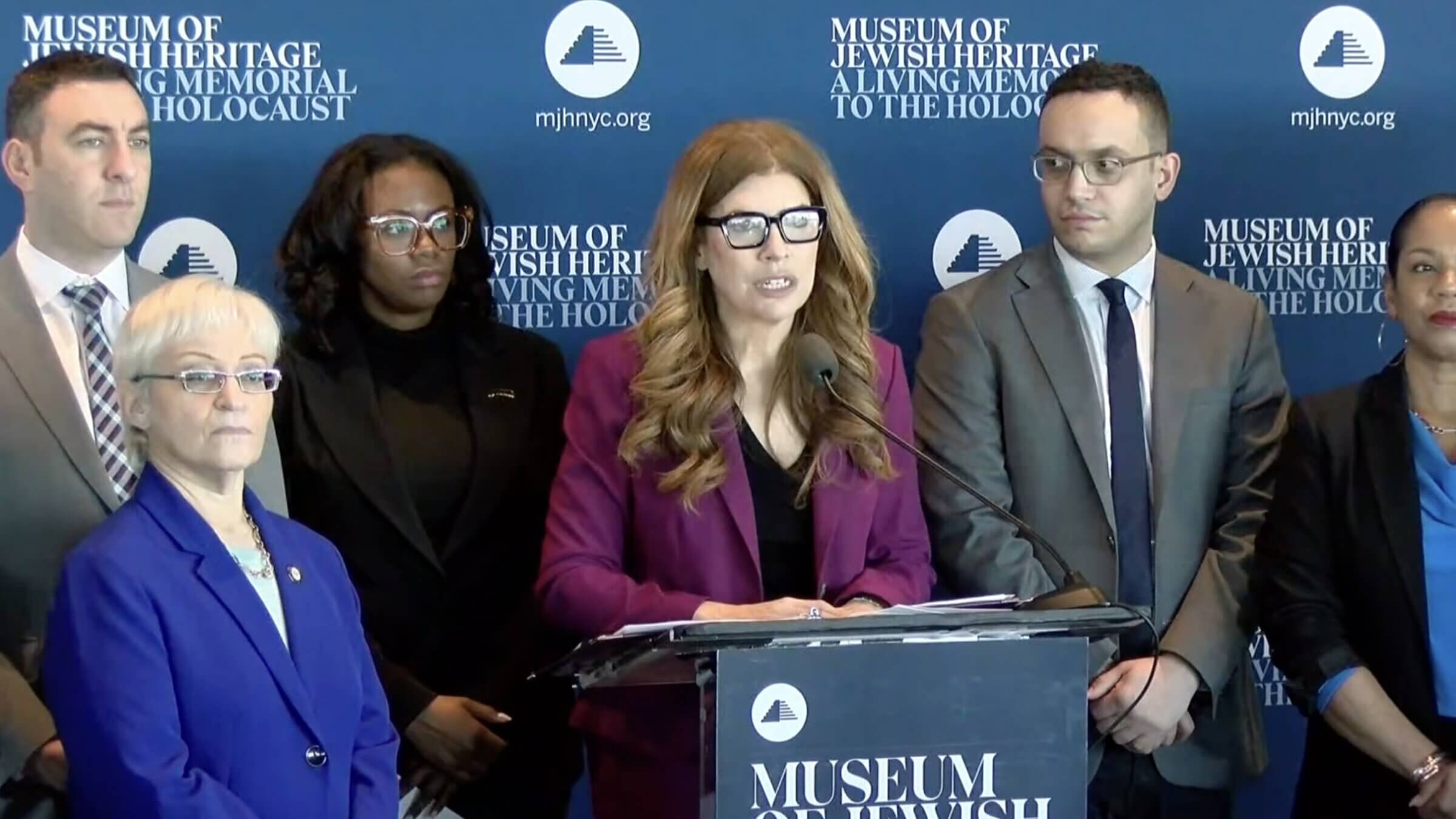
City Council speaker Julie Menin announces a five-point plan to combat antisemitism at the Museum of Jewish Heritage. Photo by Jacob Kornbluh


By Hannah Feuer and Jacob KornbluhJanuary 16, 2026
Julie Menin, New York’s first Jewish speaker of the City Council, has introduced a plan to combat antisemitism in the city, where Jews are divided over Mayor Zohran Mamdani.
Her plan includes introducing a bill that would ban demonstrations around entrances and exits of houses of worship. Mamdani is assessing the proposal. “On the first day of his administration, the Mayor directed the NYPD and Law Department to review the legality of a range of proposals, including those like Speaker Menin’s buffer zones proposal, and he will wait for the outcome of that review,” Dora Pekec, a Mamdani spokesperson, said in a statement.
Mamdani has also said he is reviewing the legality of similar legislation proposed by Gov. Kathy Hochul, which would create a 25-foot buffer zone around houses of worship across New York state. Menin’s bill would “probably” extend that to 100 feet, she told The New York Times.
On his first day in office, Mamdani revoked an executive order issued by former Mayor Eric Adams in December that called on Police Commissioner Jessica Tisch to evaluate proposals for establishing a buffer zone of at least 15 feet outside houses of worship. Tisch, who is Jewish, has remained commissioner under Mamdani.
Menin’s proposal also includes $1.25 million in funding to the Museum of Jewish Heritage and establishes a hotline to report incidents of antisemitism, housed within the New York City Commission on Human Rights.
Antisemitic incidents accounted for 57% of reported hate crimes in 2025, according to the NYPD, while Jewish New Yorkers make up 10% of the city’s residents.
“As the first Jewish speaker of the New York City Council, I must emphasize, no one is in a position too high or too low to fight hate,” Menin said at a press conference Friday hosted at the Museum of Jewish Heritage in Manhattan.
Menin’s proposal follows a series of protests at synagogues after which Mamdani drew scrutiny for what some Jewish New Yorkers saw as slow or equivocal responses. After chants of “we support Hamas here” outside a Queens synagogue event promoting real estate development in Israel earlier this month, Mamdani said the rhetoric and displays at the protest were “wrong and have no place in our city.” He took about a day to issue a statement, as other city leaders immediately issued condemnations.
The response echoed an earlier incident, when demonstrators outside Park East Synagogue chanted “globalize the intifada” and “death to the IDF” while protesting an event promoting immigration to Israel. Mamdani condemned the protesters’ rhetoric but also said “sacred spaces should not be used to promote activities in violation of international law.”
“I think the most important thing for New Yorkers is to know that they have a mayor who is firmly committed to rooting out the scourge of antisemitism across this city,” Mamdani told the Forward on Monday, adding that he would fulfill that commitment “not only through my words, but through my actions.”
On day one in office, Mamdani revoked executive orders issued by Adams prohibiting city employees from boycotting Israel and implementing the International Holocaust Remembrance Alliance (IHRA) definition of antisemitism, which classifies most anti-Zionism as antisemitic.
Mamdani also announced his intent to keep open the Office to Combat Antisemitism, created by Adams in May. Rabbi Moshe Davis, the current executive director, is a holdover from the Adams administration. On the campaign trail, Mamdani pledged an 800% increase in funding for hate crime prevention and response, but has not since offered other specific policy recommendations.
“Rhetoric is not enough. Policy fights antisemitism,” Councilman Eric Dinowitz, chair of the Jewish Caucus, said at Friday’s press conference. “This government action will help our Jewish community that will go beyond saying ‘I condemn antisemitism,’ because it is not enough.”
The proposal for protest-free buffer zones outside houses of worship could run into legal challenges if passed. The bill has prompted First Amendment concerns, as legal experts note it could be problematic if the bill permits supportive demonstrations but bans critical ones.
A 1994 federal law, the Freedom of Access to Clinic Entrances Act, already makes it illegal to use force, threats, or physical obstruction to block access to reproductive health services or houses of worship.
“We’re not trying to stifle peaceful protests,” Menin said at the press conference. “What we are trying to do is protect congregants for any house of worship, of freely being able to enter and exit without fear of intimidation or harassment.”
This is a moment of great uncertainty. Here’s what you can do about it.
We hope you appreciated this article. Before you go, we’d like to ask you to please support the Forward’s independent Jewish news this Passover. All donations are being matched by the Forward Board - up to $100,000.
This is a moment of great uncertainty for the news media, for the Jewish people, and for our sacred democracy. It is a time of confusion and declining trust in public institutions. An era in which we need humans to report facts, conduct investigations that hold power to account, tell stories that matter and share honest discourse on all that divides us.
With no paywall or subscriptions, the Forward is entirely supported by readers like you. Every dollar you give this Passover is invested in the future of the Forward — and telling the American Jewish story fully and fairly.
The Forward doesn’t rely on funding from institutions like governments or your local Jewish federation. There are thousands of readers like you who give us $18 or $36 or $100 each month or year.
Support our mission to tell the Jewish story fully and fairly.