Prosecutors charge Capital Jewish Museum shooter with terrorism
The new indictment claims that Rodriguez intended to influence government policy and intimidate civilians through ‘coercion’
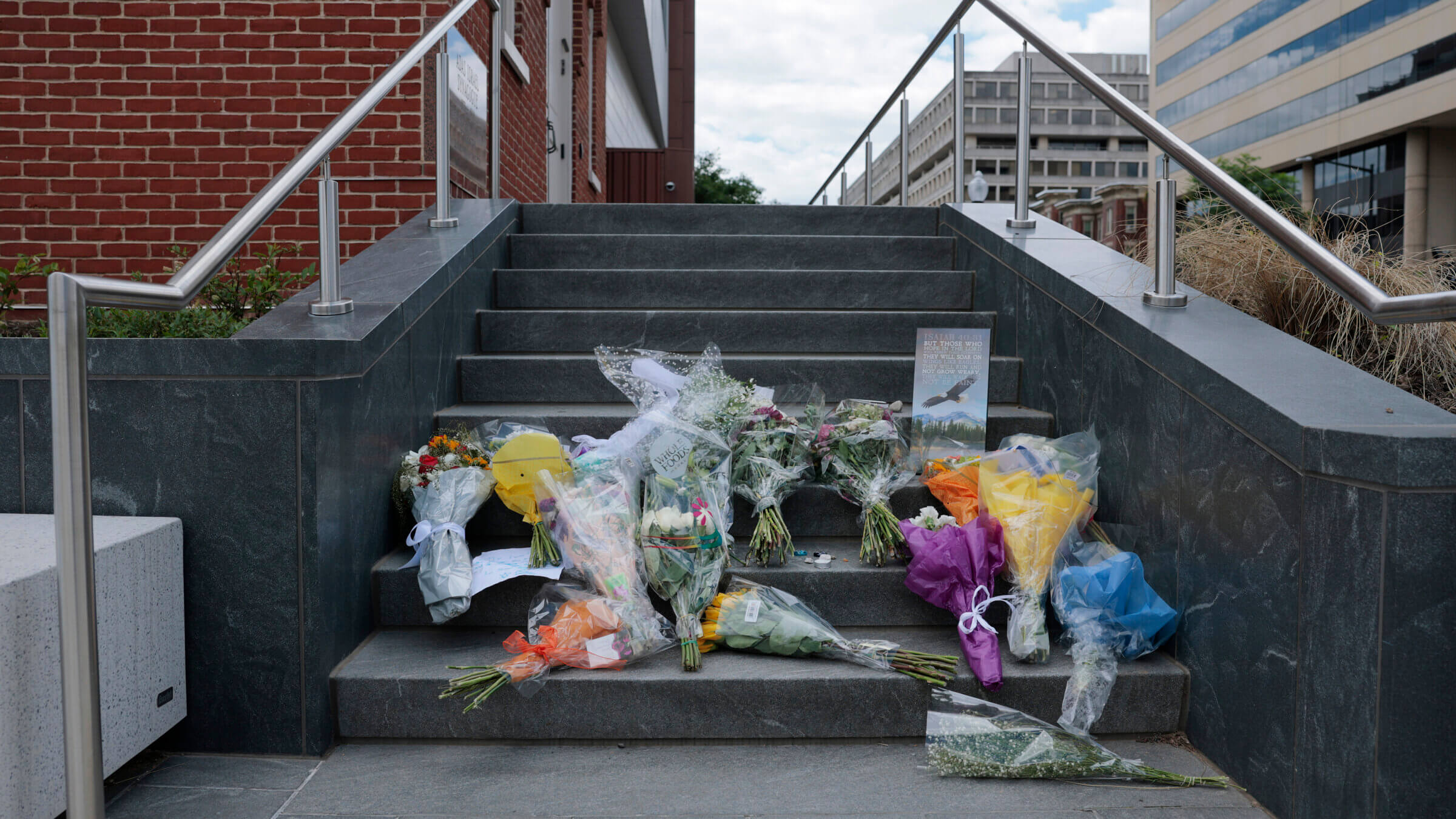
Handwritten notes and flowers are left outside the Lillian and Albert Small Capital Jewish Museum on May 23, 2025 in Washington, DC. Photo by Anna Moneymaker/Getty Images
By Arno Rosenfeld February 5, 2026
Federal prosecutors added two terrorism charges to the indictment against Elias Rodriguez, the Chicago man accused of killing two Israeli embassy employees outside a networking event held at the Capital Jewish Museum last May.
The new indictment, filed on Wednesday, claims that Rodriguez murdered Yaron Lischinsky, 30, and Sarah Milgrim, 26, with the intent to both influence government policy through “intimidation” and that he sought to “coerce a significant portion of the civilian population” of the United States.
“These additional terrorism-related charges carry a mandatory life sentence under D.C. Code, while also reflecting the reality that this act was in fact an act of terror,” U.S. Attorney Jeanine Pirro said in a statement.
Rodriguez, 31, who prosecutors say flew from Chicago to carry out the attack, allegedly shot Lischinsky and Milgrim repeatedly after they left a Jewish young professionals reception at the museum, hosted by the American Jewish Committee.
He then entered the museum and shouted, “I did it for Palestine, I did it for Gaza.”
While prosecutors previously charged Rodriguez with national origin-based hate crimes, they have focused on the political dimension of the attack and the indictment quotes at length from social media posts and a manifesto that law enforcement sources attribute to Rodriguez.
“I am glad that today at least there are many Americans for which the action will be highly legible and, in some funny way, the only sane thing to do,” the manifesto stated. “Free Palestine.”
Lischinsky, a German-born Israeli, worked as a research assistant at the Israeli embassy while Milgrim, who was American, worked in its department of public diplomacy.
It remains unclear whether Rodriguez, who has pleaded not guilty, intentionally targeted the young couple, who were planning to get engaged on an upcoming trip to Israel. Israeli Ambassador Yechiel Leiter initially said that Rodriguez had identified Milgrim and Lischinsky as embassy employees while mingling with attendees at the event and then waited outside for them to leave.
But other accounts say Rodriguez never made it inside the event prior to the shooting, and the Israeli Embassy later said that Leiter was merely floating “a theory that law enforcement officials are investigating.”
Prosecutors said at a September hearing that they had more than 1.5 million pages of evidence against Rodriguez, while one of his defense attorneys described receiving “trillions of gigabytes” of data from the government.
It’s our birthday and we’re still celebrating!
We hope you appreciated this article. Before you go, we’d like to ask you to please support the Forward’s independent Jewish news.
This week we celebrate 129 years of the Forward. We’re proud of our origins as a Yiddish print publication serving Jewish immigrants. And we’re just as proud of what we’ve become today: A trusted source of Jewish news and opinion, available digitally to anyone in the world without paywalls or subscriptions.
We’ve helped five generations of American Jews make sense of the news and the world around them — and we aren’t slowing down any time soon.
As a nonprofit newsroom, reader donations make it possible for us to do this work. Support independent, agenda-free Jewish journalism and our board will match your gift in honor of our birthday!
Support our mission to tell the Jewish story fully and fairly.