At US Commission on Civil Rights hearing, Jewish students warn against politicizing campus antisemitism
The hearing last week was the first in an independent government investigation into campus antisemitism
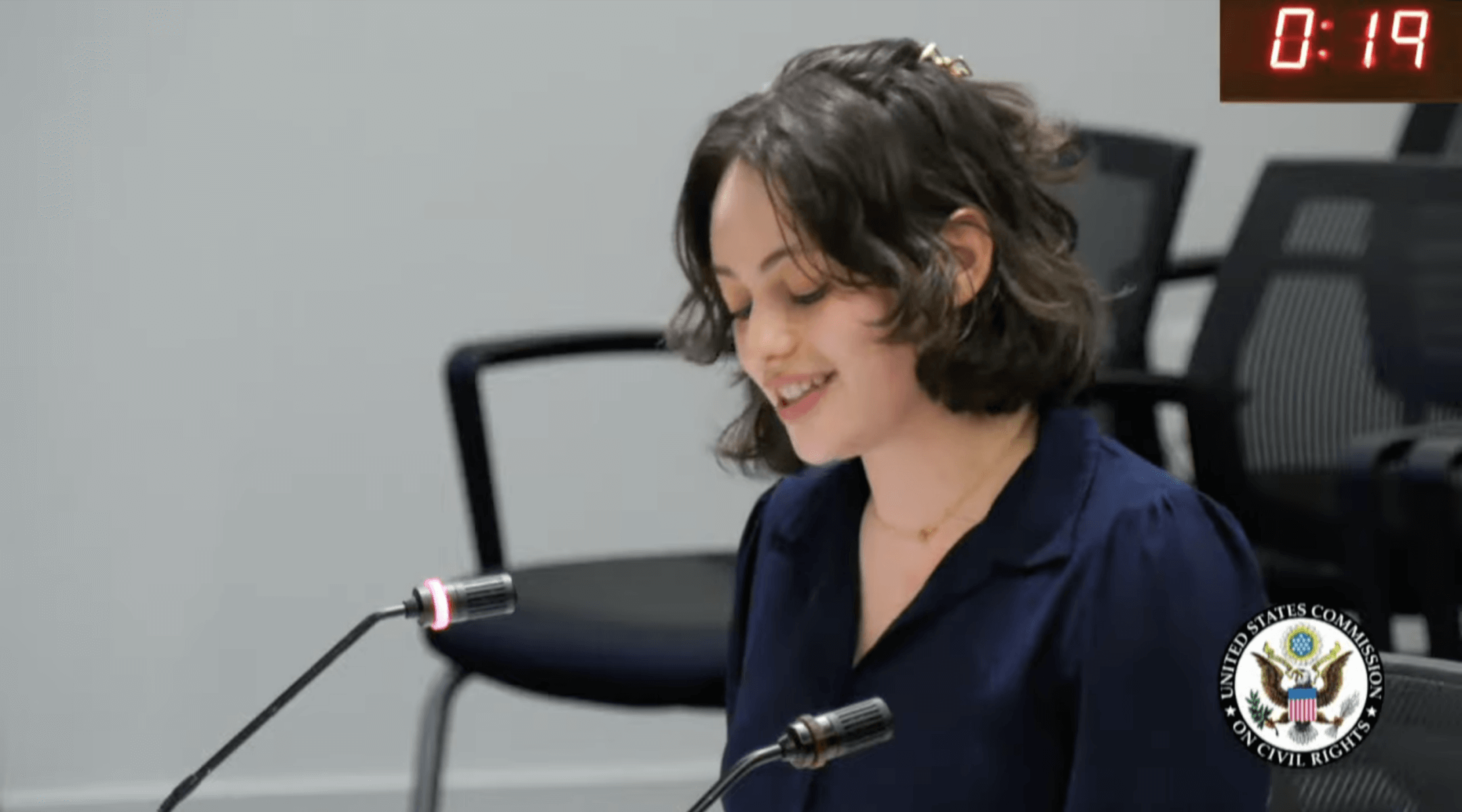
Tova Kaplan, a student at Harvard University, testifies before the U.S. Commission on Civil Rights briefing on antisemitism on college and university campuses on Feb. 19, 2026. (Screenshot via YouTube)
(JTA) — Instead of practicing with her a capella group or preparing to lead Shabbat services, University of Maryland senior Tekoa Sultan-Reisler spent her Friday afternoon testifying about campus antisemitism in front of the United States Commission on Civil Rights.
She shared that she had witnessed antisemitism at her school, and heard about it from other students in J Street U, the college division of the liberal pro-Israel lobby that she leads. But she was also very clear on another point: She did not want Jewish college students’ pain to be used for a political agenda.
“Jewish students do not want to be used as a pretext to justify this divisive and xenophobic action of the administration,” Sultan-Reisler said in her testimony. “Instead, protecting students’ right of free speech and expression would allow all students to feel safe on campus, regardless of faith or ethnicity.”
Sultan-Reisler and other students who testified similarly criticized the Trump administration’s decision to defund universities that did not comply with its terms for addressing antisemitism. They took the stand on Friday on the second day of a two-part hearing called by the civil rights commission in an independent investigation — the first — into how the federal government has responded to campus antisemitism.
The commission, which has the power to issue subpoenas, is appointed by Congress and the president and currently has a narrow Democratic majority. A bipartisan group of representatives requested the antisemitism investigation in 2024.
Friday’s session followed several tense exchanges on Thursday as commission members pressed those testifying — including representatives of antisemitism watchdogs StandWithUs and the Brandeis Center — on whether the Department of Education’s Office of Civil Rights should have its full funding back, and the costs and benefits of different government agencies’ own civil rights offices. They also made partisan jabs, with many accusing either the Biden or Trump administration of failing to protect Jewish students.
Craig Trainor, former acting assistant secretary for civil rights at the U.S. Department of Education, criticized the Biden administration for its slow pace in resolving antisemitism discrimination complaints at universities.
“The Biden Education Department’s Offices for Civil Rights’ policy agenda was deeply unserious and counterproductive and its response to the antisemitic harassment and violence consuming America’s college campuses was weak and ineffective,” Trainor said.
Kevin Rachlin, vice president for government relations and Washington director of the The Nexus Project, meanwhile, lambasted the Trump administration’s attempt to shrink the Office of Civil Rights.
“By closing those offices, by removing those personnel, by reducing those resources you have effectively hobbled the very organization that is dedicated to protecting not just Jewish students but all students,” Rachlin said.
Like her peers who testified over the past two days, Sultan-Reisler recounted specific incidents of antisemitic intimidation. She recalled that in November 2023, the words “Holocaust 2.0” were written in chalk on the campus sidewalk, and during an on-campus demonstration, a student waved the flag of Hezbollah, a designated terrorist organization. But said she didn’t think the Trump administration’s response to allegations of campus antisemitism had made her safer.
Among the other students testifying was Harvard University’s Tova Kaplan, who was one of 10 students to pen an op-ed last year arguing that Trump’s response to antisemitism had harmed research and academic freedom without helping Jewish students.
Others who testified, including many non-students and older adults, said they thought the Biden administration had been too reserved in tackling campus antisemitism and praised the Trump administration’s heavier-handed tactics.
“Despite the elimination of encampments and other results of the threat to withhold federal funding from schools which failed to protect Jewish students, the underlying hatred which gave rise to the encampments is alive and well and could explode again at any time,” said Leonard Gold, a retired attorney and the executive producer of “Blind Spot,” a documentary about campus antisemitism after Oct. 7.
Since 2025, the Trump administration has canceled billions of dollars in HHS research grants for universities like Columbia, Harvard, and Princeton in an effort to coerce universities to comply with demands like making hiring, admissions, and course material changes. Harvard University defended its handling of campus antisemitism and decided to reject those demands.
The commission is accepting written testimonials until March 20. The commission’s report is expected by the end of the 2026 fiscal year.
The final report could feature more information from within federal agencies. In one tense exchange, Mondaire Jones, a Democrat and former congressman from New York who is one of the investigation’s chairs, asked Assistant Attorney General for Civil Rights Greg Dolin why the justice department had not yet handed over documents the commission requested.
“You have a statutory obligation to comply,” Jones said. “That is very clear under federal law.”
This is a moment of great uncertainty. Here’s what you can do about it.
We hope you appreciated this article. Before you go, we’d like to ask you to please support the Forward’s independent Jewish news this Passover. All donations are being matched by the Forward Board - up to $100,000.
This is a moment of great uncertainty for the news media, for the Jewish people, and for our sacred democracy. It is a time of confusion and declining trust in public institutions. An era in which we need humans to report facts, conduct investigations that hold power to account, tell stories that matter and share honest discourse on all that divides us.
With no paywall or subscriptions, the Forward is entirely supported by readers like you. Every dollar you give this Passover is invested in the future of the Forward — and telling the American Jewish story fully and fairly.
The Forward doesn’t rely on funding from institutions like governments or your local Jewish federation. There are thousands of readers like you who give us $18 or $36 or $100 each month or year.
Support our mission to tell the Jewish story fully and fairly.