A new curriculum brings adults with intellectual disabilities into Jewish learning
A program from Melton and Matan adapts Torah, prayer and holiday study for learners long left out of formal adult education
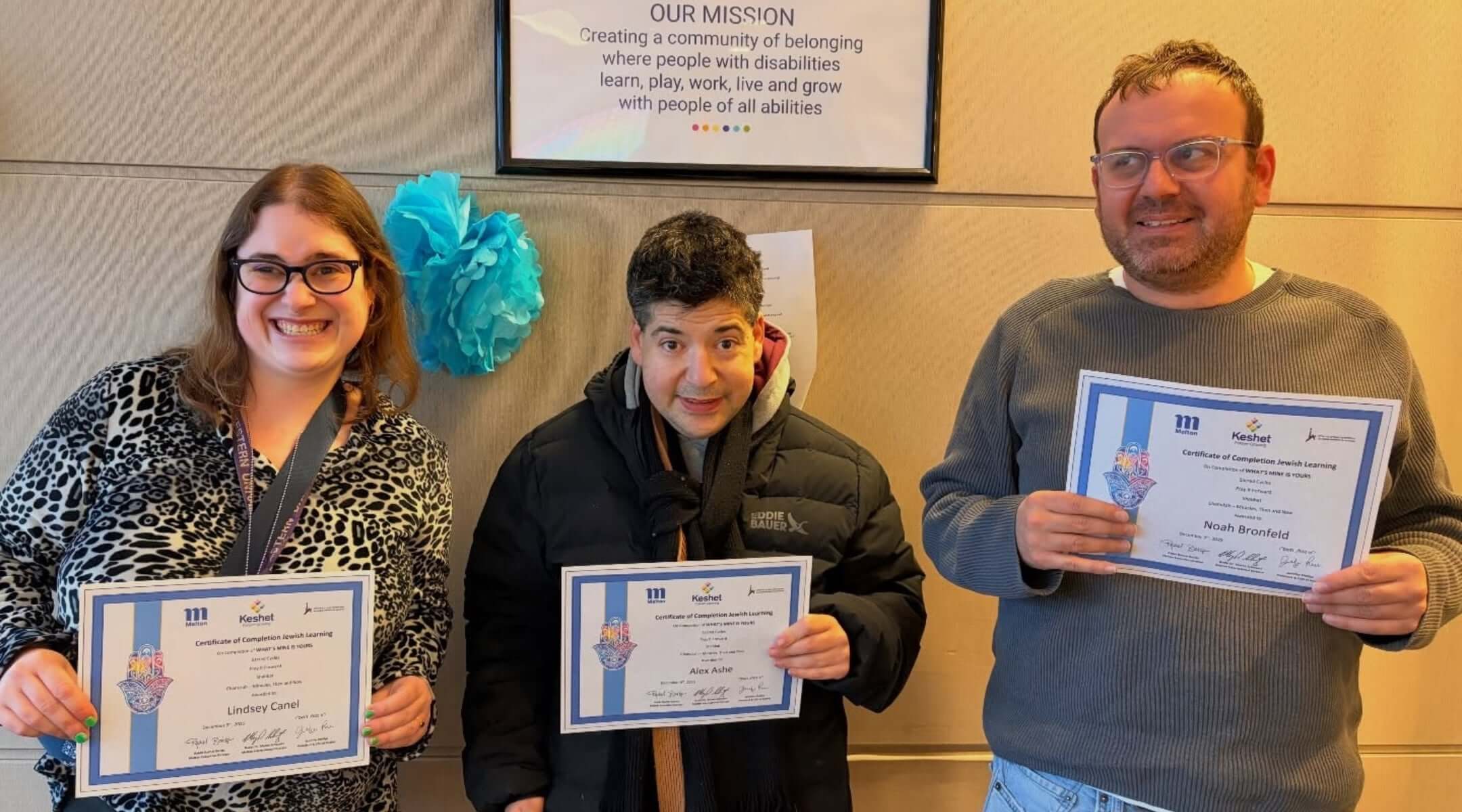
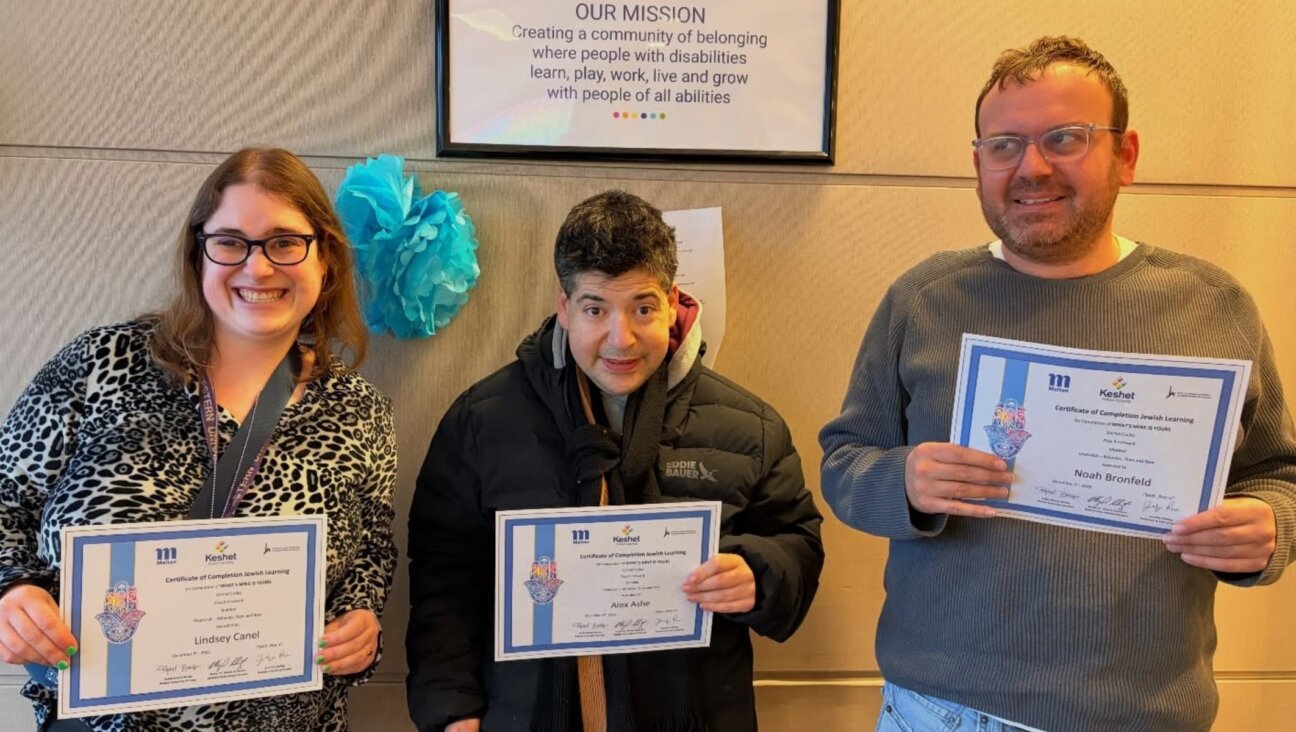
Graduates from a What’s Mine is Yours class at Keshet in Chicago. Courtesy of Melton
(JTA) — When he’s not working at the local dog care and boarding center, 24-year-old Raffi Stein-Klotz is usually playing kickball or tending to the garden at his residential facility in Boca Raton.
But once a week, Stein-Klotz can be found in an adult Jewish learning class series created specifically for people with intellectual and developmental disabilities, like him and his housemates at JARC, the Jewish Association for Residential Care.
“We learn the book of Genesis,” Stein-Klotz, the son of two rabbis, told the Jewish Telegraphic Agency. “And we get to know how everything is in Hebrew and English, and every morning we say ‘boker or,’ ‘boker tov,’” referring to the Hebrew expressions for “good morning.”
Stein-Klotz’s class is possible thanks to a new curriculum from Melton, the adult Jewish education network that offers in-person and online classes. The program, called What’s Mine is Yours, aims to provide Jewish academic resources for adults with disabilities, who advocates say have few if any options for formal Jewish education tailored to their needs.
“There’s really not a lot specifically designed for adults with intellectual and developmental disabilities to have a continued adult learning experience,” said Carol Morris, Jewish disabilities advocates coordinator at Jewish Family Service of Colorado. “That doesn’t mean that there aren’t some educational programs that they could attend or be part of, but not really anything designed specifically for them as adults to do higher-level Jewish learning.”
The curriculum was developed in partnership with Matan, an organization that educates Jewish community leaders on how best to include people with disabilities. After a successful precursor curriculum with Melton took off in Atlanta in 2021, What’s Mine is Yours began piloting the Melton and Matan curriculum in 2023. Four cities are offering the curriculum for the first time this year.
The rollout comes as the Jewish world has otherwise made significant strides in some aspects of disability inclusion in recent years. (February is Jewish Disability Awareness, Acceptance and Inclusion Month, a global Jewish organizational initiative.)
“One of the things that’s so important here is the Jewish world, to a great extent, has embraced the importance of inclusion, the importance of adding ramps where there are stairs to get into the synagogue, to get up to the bimah in the front, they’ve thought about the ways to include people with disabilities,” said Morey Schwartz, international director of Melton.
But, he added, “Inclusion can’t just be about ramps. It has to be about giving them inspiration, education, engaging, thought-provoking materials that can give them also the ability to participate fully to the extent that they can to the enterprise of Jewish learning. It can’t be like some watered-down version of something else. That’s not what we’re doing.”
What’s Mine is Yours includes units about prayer, holidays, Shabbat and rituals that are structured to be accessible for adults with intellectual disabilities without giving up on the core elements of advanced Jewish learning: open-ended questions, engagement with original texts and group discussions. Lesson plans ask students to relate the ideas they encounter to their own lives, and materials include prominent visual markers to enable students who might have trouble accessing text-based materials to follow along.
The pilot class in Atlanta, in 2021, was supported by a local Jewish disability support network. “Then we got feedback: We should take this over, nationalize it, scale it up,” Schwartz said.
The result is a customizable system that can be used wherever Melton classes are held, such as synagogues, JCCs and Jewish federations — or in residential facilities, day programs, specialty organizations, adult camp programs, community centers and educational networks. It’s in use in nine cities, mostly in the United States but also in Cape Town, South Africa.
Each module in the curriculum is three lessons, but can be stretched over more classes if teachers prefer. The first collection of four adapted modules has been completed, and another 12 are still in process.
Subject matter includes the meaning and purpose of prayer; the Exodus story; the miracles of Hanukkah and Purim; symbols in Judaism; and marriage, divorce, and conversion in Judaism.
“There are suggestions made, and everyone can kind of enter at a different point of where their knowledge is,” said Judy Snowbell Diamond, director of curricular development at Melton. “In addition to the course book, there’s a faculty guide, which gives the faculty some suggestions as to how to modify it depending on the learners.”
At JARC in Boca Raton, teacher Harvey Leven’s class recently completed the “Sacred Cycles” module, where students learned about Rosh Hashanah and Yom Kippur. During a recent class, which JTA viewed by Zoom, six students, roughly mid-30s and older, sat around a conference table. (The rest of the class was on a field trip to Orlando.)
In his class, Leven reviewed relevant terms with students like “atonement,” “repentance” and “self-denial.”
Leven also played a three-minute video where a narrator, speaking quickly, recapped the basics of the holiday. Before playing any video, Leven tells his students a few of the things they might see, and a few things to look out for.
“Some people participate a lot, and some never say a word,” said Leven.
Stein-Klotz said he counts himself as one of those quieter students.
“For me, it’s hard, because I have autism, and it takes my brain a little bit to get it,” he said.
Leven has worked in Jewish education for more than 20 years, teaching both children and adults. But teaching the Melton curriculum marks the first time he has adapted his teaching specifically for students with special needs.
“Sometimes, like today, the vocabulary in the material often needs translating for these students,” Leven said. “And so you have to spend some time helping the students to understand what exactly is being said there.”
It can be difficult to measure how much information is getting through to his students, Leven said.
“We don’t do tests,” he said. “Today, one or two barely said anything. So I’m hoping that something sinks in.”
Over the past two years of teaching from the What’s Mine is Yours curriculum, Leven has had a number of returning students. Having worked with them in the past, he is already familiar with their learning styles and with their personalities, which has been helpful in the classroom.
“Every one of those students has particular idiosyncrasies that I had to learn and to be able to work with in order to make this class meaningful and fun for them, enjoyable for them,” Leven said.
But he said he had identified challenges in executing the curriculum. Leven said he avoids the suggested physical activities, for example, because many of his students have limited mobility, and the space and shape of his classroom is not conducive to much movement.
And though the program seeks to be accessible to all, in practice, it doesn’t work for every person’s needs.
Alissa Korn is the mother of two adult daughters, including 27-year-old Jillian, who has intellectual disabilities and mental health challenges. After learning about the success of the adapted curriculum in Atlanta, Korn was inspired to introduce the What’s Mine is Yours curriculum to Jillian’s adult living facility in New Haven, Connecticut.
“My daughter, it wasn’t great for her, because she really learns best in a one-on-one setting,” Korn admitted. “And with adults raising their hands and talking over each other, it was very challenging for her.”
Still, Korn finds value in the program, and her family continues to support it at her daughter’s living facility.
“It doesn’t necessarily need to be the perfect match for my daughter,” Korn said. “It just makes me feel good to be involved in anything in the special needs world, where we can feel like we’re empowering people and making them feel good about themselves.”
Erica Baruch, Jewish disabilities advocates adviser at Jewish Family Service of Colorado, said just offering the program takes the burden off families like Korn’s.
“Oftentimes families don’t ask for things because they make the assumption that it wouldn’t be possible or it would be a burden on the community,” she said. “Learning is such a big piece of Jewish life.”
Stein-Klotz is exactly the kind of student Melton is trying to reach. He fondly recalls marking his bar mitzvah at 13, when his godfather, who is also a rabbi, taught him his Torah portion — the story of Noah and the ark. He recalls having fun, learning about the animals and getting to sing songs.
“It was great, because I had people helping me, and I remembered everything,” he recalled of his bar mitzvah. “Learning it was hard for me, and I didn’t want to do it, but I took my time and learned well, and I still remember it, and I’m still Jewish throughout this day.”
Now, he is able to play a helping role in his Melton course, which he said has been a great way to get to know his neighbors from JARC and from the garden.
“It’s great to see them in the Melton class and learn what their disability is and what their strong skills and what their weaknesses are,” Stein-Klotz said. “So that’s a good thing, so I help them with that, if I can.”
Stein-Klotz said he even helps some of his classmates who are new to Judaism or interested in converting one day.
“They make me feel happy and good and strong,” he added. “Like I’m helping people, or like a good mitzvah.”