What the Epstein files show about Jeffrey Epstein’s Jewish world
The latest release of emails connected to the child sex trafficker gives a fuller picture of his Jewish networking
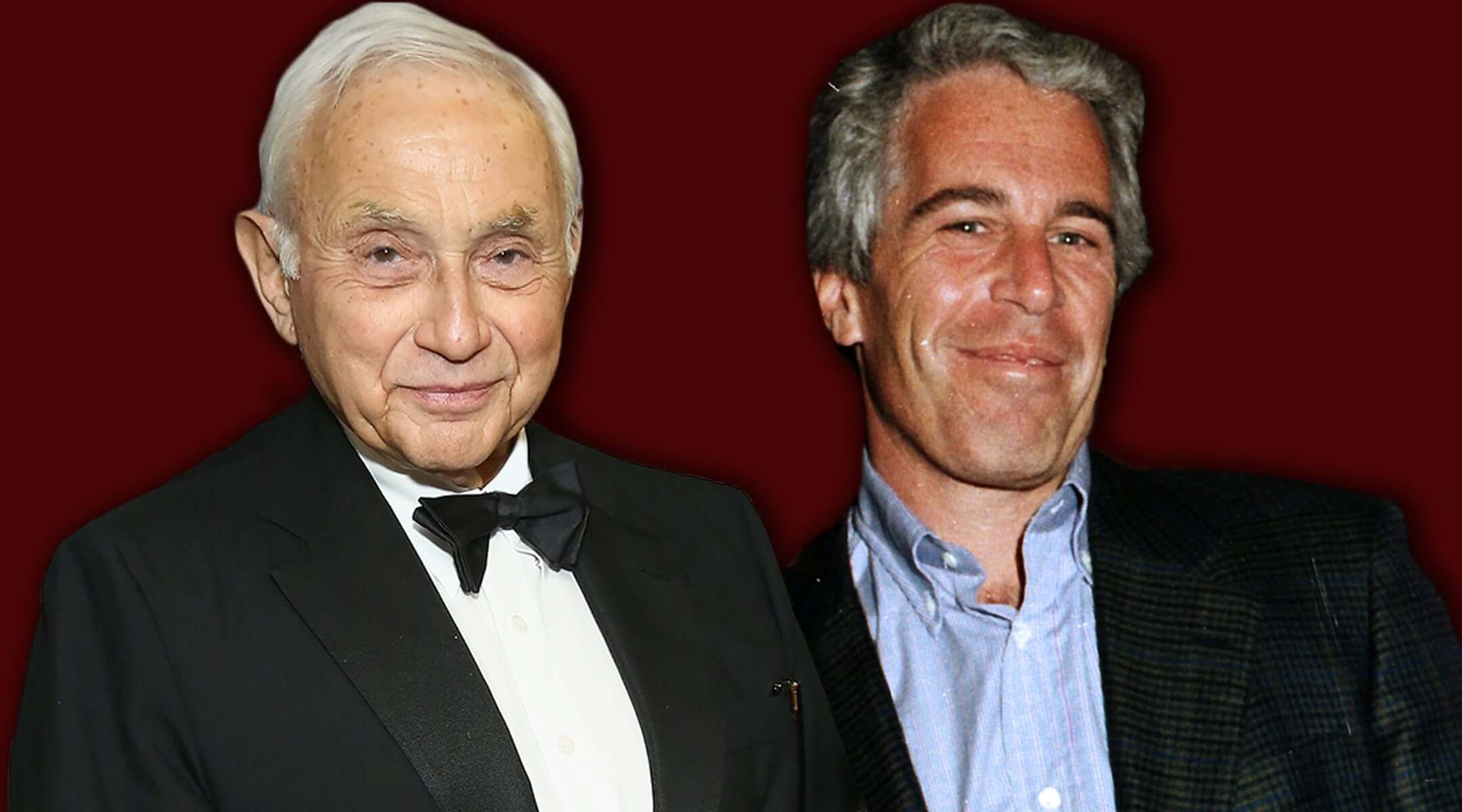
Leslie Wexner, left, and Jeffrey Epstein were close for years. Epstein’s scandal has dogged the billionaire Jewish philanthropist. Photo by Getty Images
(JTA) — Sometime in the early 2010s, Jeffrey Epstein walked into Dr. Steven Kaplan’s office for a root canal.
The procedure took some time and required multiple visits. The two men got to chatting. “He was just another guy, that’s it,” Kaplan recalled to the Jewish Telegraphic Agency. The subject of Judaism came up.
“I wanted to put some yiddishkeit into him,” Kaplan said. “I was telling him, ‘You should meet a Jewish girl, because I think these girls are going to want you for your money.’ He said, ‘I would marry a Jewish girl.’”
Kaplan, who says he was unaware at the time of Epstein’s 2008 conviction and sentencing for sexual solicitation of a minor, sent Epstein several books on Judaism and offered to connect him with his rabbi. That meeting never happened, but when Epstein offered to help Kaplan fix up his office, a different proposal emerged: Kaplan asked his patient to donate to his children’s Jewish school or any Jewish institution.
Epstein agreed, telling Kaplan he would do it in honor of his mother. Soon his accounts wired $25,000 to Yeshiva Tifereth Moshe, in Queens, via the Jewish donation service MATCH. (He had initially promised $50,000, Kaplan said.) On a form for MATCH explaining his donation, included in the latest Justice Department release of files pertaining to his investigation, Epstein (or an assistant of his) wrote, “I AM IMPRESSED WITH THE CHILDREN I HAVE SEEN FROM THE YESHIVA.”
“Maybe that donation is helping him in the next world,” Kaplan told JTA. He added that, by the tenets of Orthodox Judaism that stipulate 10% of one’s earnings should go to tzedakah, or charity, Epstein’s donation was “nothing.” A spokesperson for the yeshiva told JTA they didn’t know anything about the Epstein connection. (JTA could not independently verify Kaplan’s account, but in emails revealed in the Epstein files, Epstein’s assistants relate conversations they had with Kaplan in which he urges the donation.)
Kaplan said he was of two minds today about Epstein’s support of Jewish causes throughout his life. “He still has a Jewish neshama,” Kaplan said, using the Hebrew word for soul, of the man who had orchestrated a wide-ranging network of underaged escorts; maybe giving money to Jewish causes was still a net good, regardless of where that money came from.
Yet Kaplan added that if Epstein were alive today and wanted to give to a yeshiva, knowing what he now knows about his crimes, he would have to ask his rabbi.
“I don’t know the answer to that,” the endodontist said. “I would go to the rabbi and say, ‘Is it a mitzvah for him to give it? Or is it bad for us to take it?’”
Kaplan’s ethical dilemma reflects one theme surfaced in the Epstein files released by Congress last month about the financier and convicted sex offender’s connections to the Jewish world.
Scrutinized for evidence of Epstein’s misdeeds, the files have enabled armchair sleuthing about Epstein’s associates, fueled antisemitic conspiracy theories and caused powerful players implicated in them to face new consequences — as when Harvard University broke ties with its former president, Larry Summers, on Wednesday.
The files also offer a window into Epstein’s workaday, small-scale networking, suggesting an almost obsessive effort to be involved in the affairs of his friends and associates. Jewish groups and individuals made up a significant share.
The files show that Epstein made donations to and connections with Jewish causes with which he had little to no personal relationship. They also show that some Jewish groups benefitted from donations from Epstein even after his 2008 conviction for sexual solicitation of a minor — though it remains unclear whether they knew about it. Some have said specifically that they did not.
Epstein served 13 months in a county jail following that conviction, which was largely swept under the rug thanks to a “sweetheart deal” between Epstein and former U.S. Attorney Alex Acosta. Many in the public had little knowledge of him or his misdeeds until investigative reporting about the deal emerged in 2018 and Epstein was arrested the following year.
Epstein sought to leverage his Jewish largesse as he also sought to improve his public image both before and after his conviction, the latest files show.
One email shows that he was seeking placement on the website eJewishPhilanthropy, then an industry newsletter for Jewish philanthropy insiders, for one of his foundations in 2013.
“The Foundation supports many jewish causes around the world as well as numerous Israli [sic] causes,” an Epstein staffer wrote in a draft letter sent to Epstein for approval. (eJewishPhilanthropy did not publish an article on Epstein at the time, and the outlet said that it cannot find evidence of ever receiving such an email.)
Describing Epstein as “a financier and science philanthropist,” they trumpeted his support of the Jewish National Fund, the National Council of Jewish Women, the Columbia Jewish Foundation, UJA- New York, and Friends of the Israel Defense Forces, along with a few yeshivas that were not Kaplan’s. The bio goes on to note Epstein’s “long partnership with Leslie Wexner.”
Epstein’s only note: “no wexner affiliations please.” Six years later, Wexner, a prominent philanthropist to Jewish causes, would reveal that he had broken ties with Epstein years earlier after a decades-long relationship and forced him to repay $100 million he said Epstein had stolen from him. Epstein had previously served as a director of the Wexner Foundation, which funds fellowships for young people entering a career in Jewish communal service and intensive adult education programs for volunteer board members of Jewish organizations.
Now the latest Epstein files release has turned up the heat on Wexner, who again denied knowledge of Epstein’s alleged crimes in a congressional deposition last week. It has also thrown other major funders of Jewish causes into the spotlight, including some for the first time.
Epstein’s Jewish giving far predated his 2008 conviction, and had no clear ideology. Some of it was already known before the latest files release. He and his partner and co-conspirator, Ghislane Maxwell, cultivated relationships with both FIDF, which raises money for the welfare of Israeli soldiers, and Seeds of Peace, which holds summer camps bringing together Israeli and Palestinian youth. They gave large sums to Hillel International and YIVO, as well as $500,000 to the religious day school Ramaz, and backed an Israeli charity that distributed aid to the needy. (That group, Ziv Tzedakah Fund, received $100,000 from Epstein in 2006 before shuttering less than a year later.)
Other Jewish groups solicited Epstein for donations well after his conviction in 2008. Harvard Hillel, whose building Epstein had helped facilitate Wexner’s funds to build, made personal appeals to him in 2010 and 2011 — stoked in part by a Jewish dean, Henry Rosovsky, who brokered Epstein’s giving to Harvard Hillel and who Maxwell testified had received a “massage” at Epstein’s townhouse. (Rosovsky died in 2022.)
“We regret that anyone associated with our organization contacted Mr. Epstein during the years in question, and in the intervening years Harvard Hillel has revised our ethics standards to prohibit interactions of this nature,” Harvard Hillel’s current director, Jason Rubenstein, told the Harvard Crimson this month about the solicitations. Rubenstein added that the staff who sought the donations haven’t been involved with the organization in over a decade.
In 2015, a senior vice president of Touro College, the private Jewish New York institution, made a personal appeal to Epstein for him to fund a “medical incubator as well as resiliency in higher education.”
“I have read with interest about your prior philanthropic pursuits and the Jeffrey Epstein VI Foundation’s generous contributions to various causes,” wrote the official, Michael Newman. “A donation to Touro College would further your foundation’s goals in both education and medical research.” A Touro spokesperson told JTA that Newman’s letter “was a blind prospecting note to a philanthropist that went unanswered.”
Some of Epstein’s post-conviction Jewish giving was prosaic, the kind of mid-level donations made as favors that rarely trigger nonprofits’ due diligence mechanisms.
UJA-Federation of New York, for example, accepted a $50,000 donation from Epstein in 2017. The occasion: the UJA’s signature Wall Street Dinner, which drew more than 2,000 people and raised $29 million. Epstein made his donation in support of one of the honorees, Howard Lutnick, who was then chair of the financial firm Cantor Fitzgerald and is now President Donald Trump’s commerce secretary. (Trump himself is prominently mentioned in the Epstein files.)
Invited to fill a table at the event, Epstein declined, responding that Lutnick — who was also his next-door neighbor — could fill his. Lutnick recently admitted to a more extensive relationship with Epstein than he had previously publicized, including visiting his island after he had previously said he had cut ties; the White House has said it will stand by him.
A spokesperson for the UJA declined to comment further to JTA on Epstein’s donation.
For his part, Epstein did not appear to be wedded to UJA as a cause. Emailing with Summers in 2019, six months before his arrest, he discouraged the former U.S. Treasury Secretary from donating to the New York federation: “much rather you use you extra funds for your own benefit „ rather than the UJA,” Epstein wrote. “Agree re no UJA,” Summers wrote back. “Po=dering [sic] uses of money.”
The American Jewish Committee, meanwhile, invited Epstein to a gala dinner in 2013 in honor of Matthew Bronfman, a prominent Jewish philanthropist, though it was not clear whether he attended.
“AJC takes seriously this inquiry given Jeffrey Epstein’s reprehensible crimes,” a spokesperson told JTA in a statement. The spokesperson said that the 2013 invitation “is a standard form solicitation used routinely for honoree events and doesn’t reflect any AJC ties or relationship with Jeffrey Epstein.” The group added that it had two donations from Epstein on file, both predating his conviction: $15,000 in 2000 and $25,000 in 2003.
Nonprofit watchdogs are suggesting that groups that accepted Epstein’s money after 2008 should take a harder look at their practices.
“With respect to any donations accepted after the conviction, I find the compartmentalization truly astonishing,” said Laurie Styron, of the watchdog Charity Watch. “Throwing sex trafficking victims under the bus in service to revenue growth that will eventually support the mission of some unrelated charitable effort is not OK. Anyone who tries to justify this really needs to take a hard look in the mirror and ask themselves if they would feel differently about trading justice for money if it were their own daughter or mother or sister who was trafficked.”
Indeed, what should be done about Epstein’s Jewish donations now is another thorny question. Some of the Wexner fellowship’s alumni, responding to his Epstein ties, have begun lobbying for Wexner’s name to be dropped from the program; a few have made public reparations for benefitting from Wexner’s money.
And Za’akah, an advocacy group for Hasidic sexual abuse survivors, has harshly criticized the yeshivas and other Orthodox institutions that accepted funding from Epstein, even the ones that had no knowledge at the time of his conviction or the allegations against him.
“You can’t come into the holiest place in Judaism and say, ‘I’m paying for this with the wages of prostitution,’” Asher Lovy, the group’s founder, said in an Instagram video in which he cited Talmudic teachings.
Lovy added, “By doing that, Epstein was afforded the opportunity to launder his reputation — the reputation he had rightly earned as a sex trafficker.”
At least one yeshiva that received an Epstein donation has sought to distance itself from him. The Texas Torah Institute, a yeshiva in Dallas, recently issued a statement saying it was unaware that Epstein had paid out $28,000 in tuition payments across 2008 and 2009.
“Until the recent release by the Justice Department of over 3 million documents related to the Jeffrey Epstein investigation, Texas Torah Institute was unaware of any potential connection with Epstein,” Rabbi Eliyahu Kaufmann, the school’s dean, told the Houston Chronicle.
Kaufmann added that the school “conducted an internal review” and determined that the checks were not signed by Epstein himself, but instead by his financial advisor Harry Beller — who also facilitated other yeshiva donations over the years, the Epstein files show. (Other Jewish schools that received donations from Epstein did not return JTA requests for comment.)
Beyond the donations, the latest files have renewed scrutiny on Epstein’s Jewish associates — and induced a cascade of consequences for many of those named beyond Summers.
Casey Wasserman, the Jewish entertainment agent, has lost top clients over his relationship with Epstein and is currently facing calls to step down from the Los Angeles Olympics planning committee.
Thomas Pritzker, a cousin of Illinois Gov. JB Pritzker, has stepped down from his role as chair of Hyatt Hotels over his Epstein connections, while Norwegian diplomat Mona Juul, who played a large role in facilitating the Oslo Accords between Israel and the Palestinian Authority, has also resigned from government after emails revealed Epstein had left her children millions in his will.
Financier Leon Black, whose foundation publishes the Jewish Lives series of biographies from Yale University Press; World Jewish Congress president Ronald Lauder; art curator David A. Ross; renowned linguist and pro-Palestinian advocate Noam Chomsky; and former Israeli prime minister Ehud Barak are among the other Jewish names also facing a new round of scrutiny over their Epstein ties. The latest files show that Epstein and an Israeli security delegation had had a New York apartment, in which Barak stayed on multiple occasions, outfitted with hidden cameras.
Bard College, meanwhile, has opened an investigation into its longtime president (and former Jerusalem symphony director) Leon Botstein. Botstein has said his interactions with Epstein — whose dinner invitation his spokesperson said he had turned down in 2013 because of a Rosh Hashanah obligation — were part and parcel of the difficult job of raising funds to keep a struggling liberal arts college in business.
Some of Epstein’s interactions on Jewish topics had more to do with status than money.
The files show that he was invited to a “very private screening for friends and family” of the 2017 drama “Disobedience,” about closeted lesbian Orthodox women. The invitation had come through Peggy Siegal, a publicist who was a key power broker in his affiliations with celebrities — while also, the files show, cracking Jewish-inflected jokes to him about his sexual predilections.
Epstein indicated that he would attend. The screening, held at New York’s Museum of Modern Art, had a guest list packed with celebrities, including the film’s co-stars Rachel Weisz and Alessandro Nivola, as well as showbiz royalty like Daniel Craig, Jennifer Connelly, Steven Soderbergh, Naomi Watts, and Jeffrey Wright. Also on the guest list: Israeli writer-director Oren Moverman and director Mira Nair, the pro-Palestinian advocate and mother of current New York City Mayor Zohran Mamdani.
Other files show that he got involved in 2013 in seeking a conversion to Judaism for one of his female associates.
“Jeffrey says he needs a Rabbi who does conversions for Shiksa’s ….might you know of one!” his assistant wrote to an intermediary, using a Yiddish term for a non-Jewish woman.
The intermediary, who had pitched Epstein to finance a variety of deals over the years, was quick to oblige. “Yes, What level Orthodox, Conservative or Reform,” he responded. “Obviously the Orthodox is the most rigid but accepted by everyone, as you go down the scale the work gets easier but less acceptance. Not a real issue unless one has a child and the question of religious acceptance of that child. Pick a flavor and I will find.”
The emails show that the intermediary then reached out to a prominent Orthodox conversion advocate, Rabbi Adam Mintz, who advised him to approach Rabbi Lisa Rubin at Central Synagogue, a Reform congregation in Manhattan. A connection evidently took place, as Epstein later made a reference to a contact being enrolled in “Jew class.”
Reached for comment, Mintz told JTA he never interacted with Epstein and didn’t know the particular conversion request was connected to him.
Rubin directed questions about Epstein to a spokesperson for the synagogue. “Rabbi Rubin has no awareness of any of her conversion students having had any connection to Epstein. She is not aware of any past contact with him,” the spokesperson said.
The year after the initial introduction, Epstein urged the intermediary to apply pressure to speed the conversion. “lisa rubin the rabbi you gave [redacted], its important that [redacted] gets her conversion asap,” Epstein wrote, a day after receiving an email from someone who said she had “missed a third of the classes” taught by Rubin.
In response, the intermediary offered to find another rabbi. Over the following two years, Epstein would personally authorize reimbursements for classes with a female rabbi. It is unclear if the classes ever led to a conversion.
The would-be convert’s name is redacted in most of the files, indicating that she may have been a potential victim or co-conspirator. Epstein’s reasons for seeking a conversion for her are unknown, though he was known to have arranged sham marriages, including same-sex ones, for some of his victims in order to help them obtain American citizenship.
Epstein appears to have had closer relationships to at least one other rabbi. Between 2010 and 2011 he frequently advised contacts to connect with Rabbi Sam Klagsbrun, a former Jewish Theological Seminary professor, who died in 2023. In the emails Epstein occasionally referred people to Klagsbrun, a practicing psychiatrist, seemingly as patients; other times he authorized payments to him.
Synagogue representatives, including some rabbis, also made direct appeals to Epstein at many points, according to the latest files. In 2014, a co-founder of The Beis, an upstart Orthodox synagogue on the Upper West Side geared toward South African Jews, asked Epstein for help with seed money to purchase a building. He drew on his perception of Epstein’s Jewish background in his appeal.
“I couldn’t help but notice your ‘Israel’ chalkboard in the dining room – and I have a feeling that you grew up like me in the City – more culturally Jewish than religious,” the pitchman, film producer Daniel M. Rosenberg, wrote to Epstein. He later added, “The rabbi told me that we all needed to go out of our comfort zones on this one. So this email certainly qualifies. Want to meet with an amazing, worldly, brilliant (and very connected) rabbi?”
Requests for comment to Rosenberg and to The Beis’ rabbi were not returned.
Additional pleas for Epstein’s cash or other forms of largesse came from a Naples, Florida, Reform synagogue president, now deceased, as well as two synagogues located on the U.S. Virgin Islands where Epstein frequented — one Reform, one Chabad.
While it was unclear whether Epstein ever donated to the synagogues, the files showed that Orthodox schools beyond Kaplan’s received his money.
Some donations appear to have come in the form of tuition reimbursements for specific students — such as one redacted attendee of Bais Yaakov of Ramapo, a Jewish girls’ school in New York. A bill for $22,600 in tuition to the school in 2015 was included in Epstein’s files.
Beller, Epstein’s assistant, facilitated multiple donations from Epstein to yeshivas, sometimes specifically for tuition. He signed a check for $15,000 from Epstein’s holdings to Yeshiva Aderes Hatorah in Jerusalem in 2010. The next year Beller signed a check for $1,000 to Chabad Neshama Hebrew School in Brooklyn, and sent another $6,000 of Epstein’s money to American Yedidim, an Israeli aid group based in Florida. In 2014 Beller signed another $18,610 cash withdrawal to Yeshiva Mercaz Hatorah, a Jerusalem school catering to English-speaking Orthodox boys.
Another Epstein associate, Darren Indyke, signed a $24,500 check from Epstein’s office to Yeshiva Gedola Ohr Yisrael, in Brooklyn. The check is dated 2016. Indyke, a co-executor of Epstein’s estate, last week settled a class-action lawsuit Epstein’s victims filed against him for up to $35 million. The suit had claimed that Indyke and fellow co-executor Richard Kahn used financial maneuvers to aid Epstein’s abuses and pay victims and recruiters.
Indyke has also been subpoenaed by Congress in connection with the Epstein investigation. Attempts to reach Beller and Indyke were unsuccessful.
This is a moment of great uncertainty. Here’s what you can do about it.
We hope you appreciated this article. Before you go, we’d like to ask you to please support the Forward’s independent Jewish news this Passover. All donations are being matched by the Forward Board - up to $100,000.
This is a moment of great uncertainty for the news media, for the Jewish people, and for our sacred democracy. It is a time of confusion and declining trust in public institutions. An era in which we need humans to report facts, conduct investigations that hold power to account, tell stories that matter and share honest discourse on all that divides us.
With no paywall or subscriptions, the Forward is entirely supported by readers like you. Every dollar you give this Passover is invested in the future of the Forward — and telling the American Jewish story fully and fairly.
The Forward doesn’t rely on funding from institutions like governments or your local Jewish federation. There are thousands of readers like you who give us $18 or $36 or $100 each month or year.
Support our mission to tell the Jewish story fully and fairly.