This Jewish family’s toy company challenged Trump’s tariffs. The Supreme Court agreed.
‘We felt like we wanted to stand up for what we thought was right,’ said Stephen Woldenberg of Learning Resources
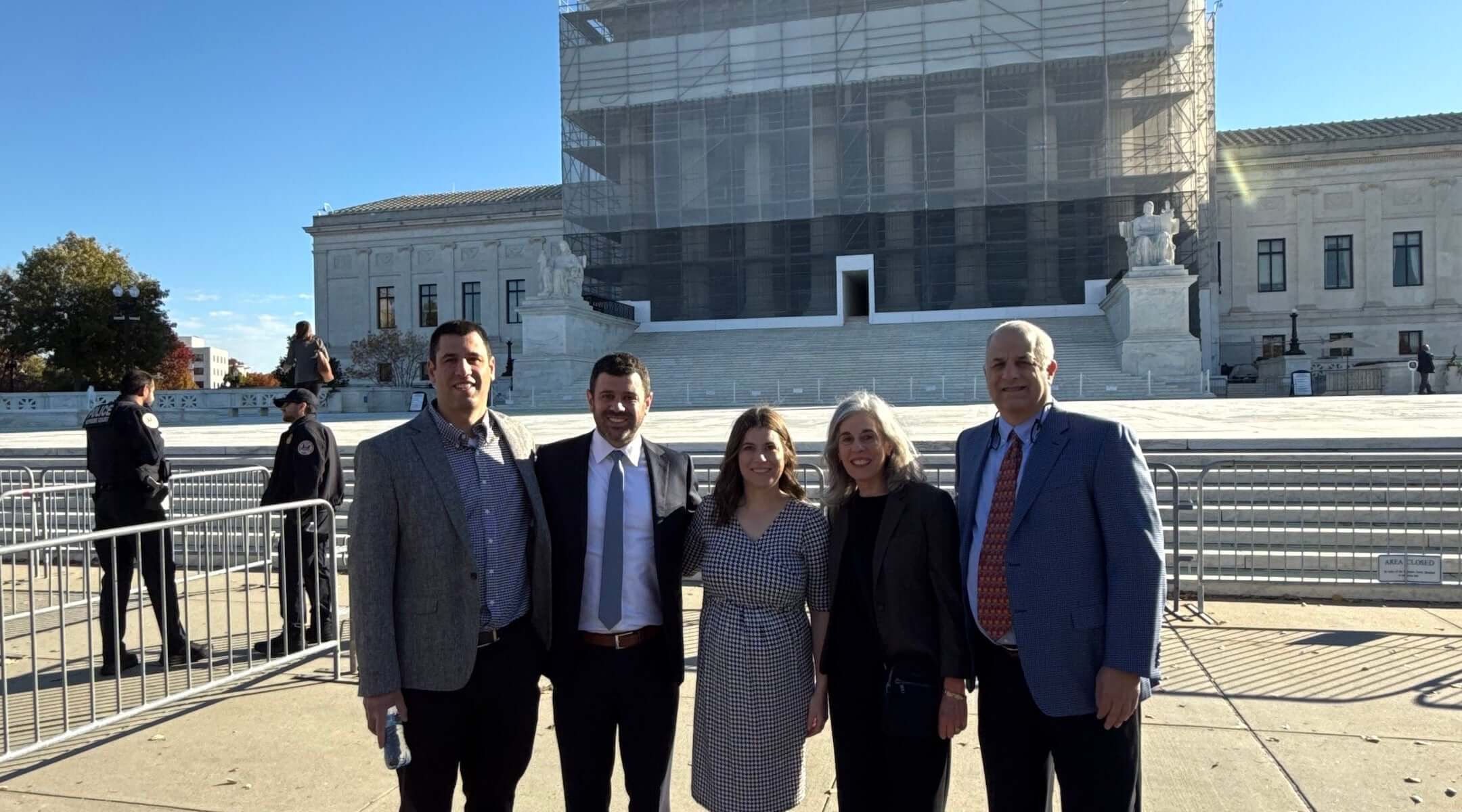
From left, Ben Woldenberg, Stephen Woldenberg, Elana Woldenberg Ruffman, Nadine Woldenberg and Rick Woldenberg pose in front of the Supreme Court building in Washington, D.C. Courtesy of Stephen Woldenberg
(JTA) — Stephen Woldenberg was in a meeting with his father last Friday, refreshing the Supreme Court’s website, when the news finally came through: Their company had prevailed in its legal challenge to the Trump administration’s tariffs.
“It’s all a bit surreal, I’ll be honest,” said Woldenberg. “It’s very gratifying, though, to see that our case has had an impact and that the Supreme Court ruled and agreed with our position.”
For Woldenberg, who is the third generation to lead his family’s Illinois-based educational toy company Learning Resources, the decision to challenge President Donald Trump’s sweeping tariffs was rooted in a moral obligation shaped by his family’s Jewish values.
“I think that for us, being Jewish, we felt like we wanted to stand up for what we thought was right, and, you know, not being afraid to take a stand,” said Woldenberg. “I think that that’s part of our identity, and I think that’s a core part of what this case was about. It’s a civil legal challenge, it isn’t political, but we felt like we weren’t going to stand by idly, and I think that’s part of our Jewish identity.”
Learning Resources was founded by Stephen’s grandmother Jane as a spinoff of a company run by her husband Harry Woldenberg. Jane’s son Rick is CEO, while Stephen, his brother and his sister all have high-level executive roles.
The family, longtime members of a Conservative synagogue in the suburbs of Chicago, has a record of Jewish philanthropy. Rick and his wife have donated to local Jewish organizations as well as to the Center for Jewish Life at Princeton University, his alma mater. Elana, who also graduated from Princeton, founded a Jewish philanthropy fellowship there. And Max Woldenberg’s brother Malcolm was a prominent New Orleans philanthropist for whom the Institute of Southern Jewish Life is named.
It was not philanthropy but Learning Resources’ bottom line that got the family fired up by Trump’s tariffs, which raised import costs for businesses that rely on overseas manufacturing. Trump authorized the tariffs using the International Emergency Economic Powers Act, rather than by seeking approval from Congress.
Like many American companies, Learning Resources relies on Chinese factories and workers to make its products, of which perhaps the most widely recognizable are plastic bears used for counting practice that are staples of many preschool classrooms.
Stephen Woldenberg said that in 2025, after the tariffs were imposed, Learning Resources paid over $10 million in tariff-related taxes, compared to $2 million the year before.
“After ‘liberation day,’ tariff rates spiked up to 145%, which effectively was like an embargo on Chinese goods,” said Woldenberg. “We decided to take action. We aren’t really a company that likes to stand by idly. We weren’t willing to let a single politician sink the ship.”
Learning Resources’ legal battle culminated in a decisive Supreme Court victory, and a notable loss for Trump, who heavily criticized the decision during his State of the Union speech Tuesday night.
In his decision, Chief Justice John Roberts wrote that the “IEEPA does not authorize the President to impose tariffs.” The Supreme Court agreed 6-3 that the tariffs exceeded the law.
“The president asserts the extraordinary power to unilaterally impose tariffs of unlimited amount, duration, and scope,” Roberts wrote in his opinion. “In light of the breadth, history, and constitutional context of that asserted authority, he must identify clear congressional authorization to exercise it.”
Among the estimated 1,000 lawsuits filed against the tariffs, which ultimately collected over $130 billion for the United States, were others filed by Jewish-owned companies.
Rebecca Melsky, a former a Jewish day school teacher, was among the first to legally challenge the emergency tariffs last April through her children’s apparel brand Princess Awesome, which she co-founded to defy “gender stereotypes” in kids clothing.
In 2025, Melsky said Princess Awesome had paid over $30,000 in additional tariffs, a cost she said had hit her small business hard.
“We’re a very small company — that money came out of our paychecks,” said Melsky. “We pulled back on our production. We did not make as much stuff last year as we normally do, which we are feeling this year, as we start the year with less inventory.”
After Melsky and her co-founder, Eva St. Clair, took to Facebook to explain the costs of Trump’s tariffs to their customers last April, the pair were approached by the Pacific Legal Foundation, which represented them in federal court. (Princess Awesome’s lawsuit was put on hold pending the Learning Resources decision.)
For Melsky, the choice to take on Trump’s tariffs in court was also inspired in part by her own Jewish values.
“Even if something feels scary, even if you don’t necessarily know if it’s going to do something, standing up for what is right, is, like, we have a moral and ethical obligation to do that, even if that means taking a risk,” said Melsky. “And thankfully, my business partner, her Catholic faith brought her to the same place, too.”
Following the Supreme Court’s ruling last Friday, Melsky and St. Clair took to Facebook again, posting a video shouting “we won!”
But the battle is not over for Melsky, Woldenberg or any of the other businesses that have sued the government over Trump’s tariffs. Following the ruling, Trump swiftly vowed to impose more tariffs, including a temporary 10% global import duty.
While the Trump administration said during the Supreme Court battle that suing parties would “assuredly receive payment” if they lost, the court did not stipulate in its decision what would happen to the tariffs that had already been collected.
As companies seek refunds following the decision, they are likely to be met by a lengthy legal process, with Trump already dismissing calls for refunds as a process that would take “years.”
“The government, the administration, did not have a hard time taking the money, they found that to be quite easy, and so they should be able to turn around and send it right back to us,” said Woldenberg. “They know what everybody paid, and they know how to get the money.”
Melsky said that she felt her company was now in “limbo,” awaiting the Trump administration’s next move.
“It feels a little bit less chaotic, but we don’t know exactly what’s going to happen, and certainly we have no idea what will happen with refunds and if they are approved, when that money would come,” said Melsky.
Despite the uncertainty, Woldenberg said he hoped his family’s victory would “inspire” others that they too can make a difference.
“It doesn’t matter the size of the company or the notoriety of the individual,” said Woldenberg. “The American system is set up in a way where anyone can make a difference, anybody can have an impact.”
This is a moment of great uncertainty. Here’s what you can do about it.
We hope you appreciated this article. Before you go, we’d like to ask you to please support the Forward’s independent Jewish news this Passover. All donations are being matched by the Forward Board - up to $100,000.
This is a moment of great uncertainty for the news media, for the Jewish people, and for our sacred democracy. It is a time of confusion and declining trust in public institutions. An era in which we need humans to report facts, conduct investigations that hold power to account, tell stories that matter and share honest discourse on all that divides us.
With no paywall or subscriptions, the Forward is entirely supported by readers like you. Every dollar you give this Passover is invested in the future of the Forward — and telling the American Jewish story fully and fairly.
The Forward doesn’t rely on funding from institutions like governments or your local Jewish federation. There are thousands of readers like you who give us $18 or $36 or $100 each month or year.
Support our mission to tell the Jewish story fully and fairly.