Khamenei long obstructed peace for Israel. But his influence was waning before his assassination.
Iran’s supreme leader’s anti-Israel tweets reflected an ideology that preceded him — and could outlast him
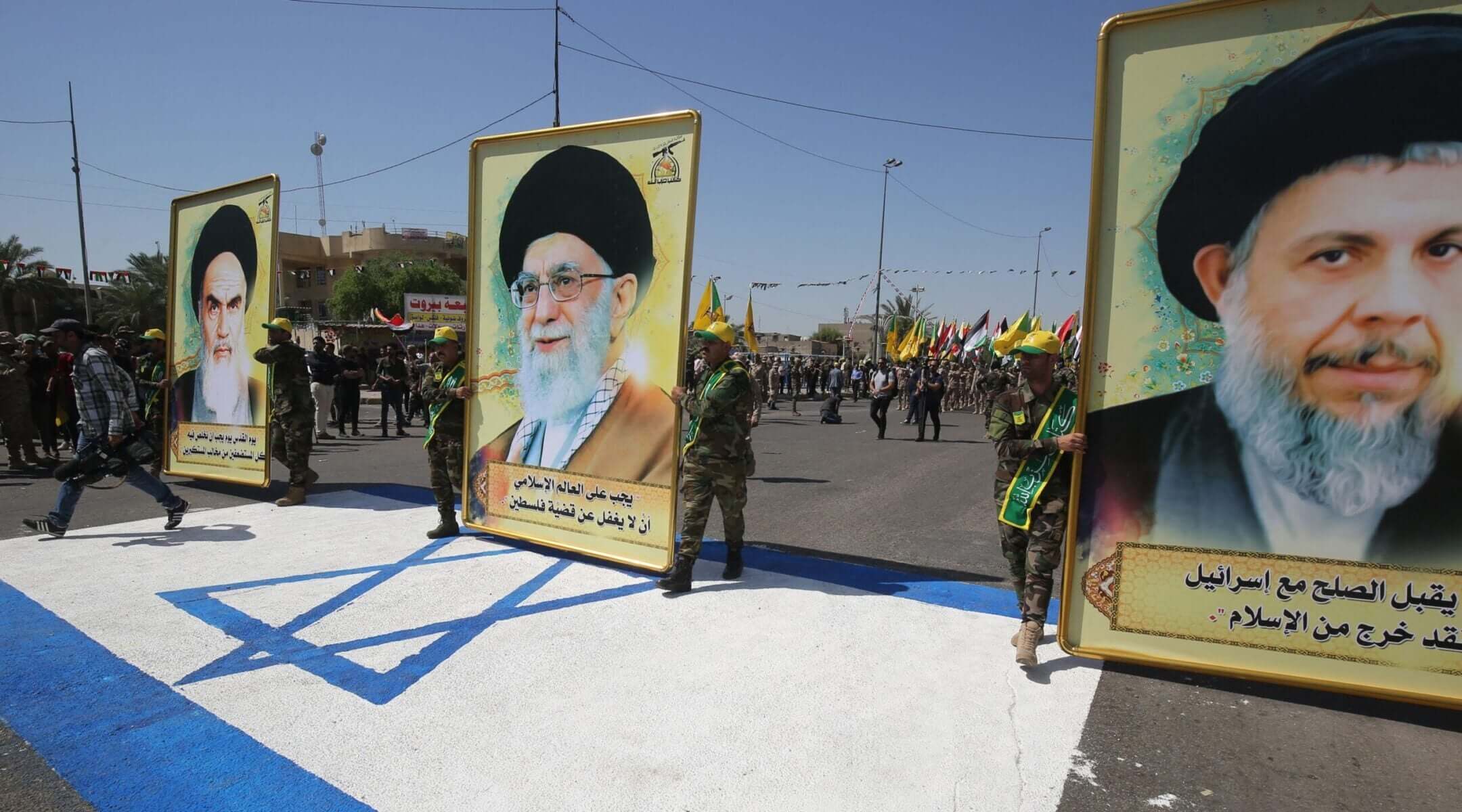
Portraits of Iran’s Supreme Leader Ali Khamenei (center), his predecessor and Islamic Revolution founder Ayatollah Ruhollah (left) and late Iraqi Shiite cleric Mohammed Baqer al-Sadr with a slogan reading in Arabic : “He who accepts peace with Israel, is no more a Muslim,” are pictured during a military parade marking Al-Quds (Jerusalem) International Day in Baghdad, on May 31, 2019. Photo by Ahmad Al-Rubaye/AFP via Getty Images

By Ron Kampeas March 2, 2026
(JTA) — Six days after Ayatollah Ruhollah Khomeini seized power in Iran on Feb. 11, 1979, he hosted his first foreign dignitary: the chairman of the Palestine Liberation Organization, Yasser Arafat.
Arafat, seen then by the Americans and the Israelis as a terrorist, was an ardent opponent of the emerging Israel-Egypt peace deal. Khomeini expelled Israeli diplomats and handed the embassy building over to the PLO.
Arafat relayed the message he got from Khomeini: After the new Islamic regime consolidated its hold over Iran it would turn to “victory of Israel.”
“Today Iran, tomorrow Palestine,” Arafat told reporters.
The symbolism was not lost on the Egyptian, Israeli and American negotiators hammering out the peace deal in Camp David: According to reports at the time, they redoubled their efforts to get to a peace deal before the new Islamist regime in Iran could scuttle it.
Keeping Iran from getting in the way of peace has been a preoccupation of Israeli and U.S. governments from then until the Israeli strike Sunday that killed Khomeini’s successor as Iran’s supreme leader, Ali Khamenei, a key aim of the latest U.S.-Israel war against the country.
The regime’s hopes of stymying peace scored successes at time, particularly in the 1990s, when the terrorist group it backed, Hamas, undermined the peace process with repeated and massive terrorist attacks on Israeli targets. More recently it spectacularly backfired, when Sunni Muslim states fearful of Shia Iran’s adventurism in the region shed years of resistance to peace with Israel and forged ties under the Abraham Accords.
Iran, with its massive military capabilities, its oil wealth, its appetite for regional hegemony and its obdurate Islamism may have been the foremost obstacle to Israel’s integration into the region since 1979.
“Iran was a continually negative actor trying to prevent any normalization of Israel in the Middle East,” Joel Rubin, a former deputy assistant secretary of state during the Obama administration, said in an interview.
Khomeini had since the early 1960s cast Israel as an enemy of Islam and deplored the young Jewish state’s relationship with Iran and the monarchy he cast aside in 1979. In a landmark 1980 speech he listed four “world devourers” as the United States, communism, Israel and Zionism.
Khomeini lost little time in making good on his pledge to Arafat to seek Israel’s defeat. In 1982, after Israel invaded Lebanon, Iranian agents cultivated ties among fellow Shia who resented Israel’s presence. Within a year, Hezbollah was established, becoming one of Israel’s most implacable enemies.
Working with Iran, Hezbollah delivered some of the bloodiest attacks on Israelis and on Jews in the subsequent decades, among them the bombing of Israel’s embassy in Buenos Aires in March 1992, killing 29, and then the bombing of the AMIA Jewish community center in the same city in 1994, killing 85 people, the deadliest attack in Argentine history.
“May this news bring relief to the families and contribute to the acknowledgment of responsibility and to the fight against terrorism and impunity,” the pro-Israel Argentine government said Sunday after Khamenei’s assassination was confirmed.
The timing of the Argentina attacks was not coincidental: The George H.W. Bush administration had in 1991 convened talks in Madrid, bringing around the table for the first time Israel and most of the Arab states in the region. Two years later, Israel and the Palestinians, under the aegis of the Clinton administration, launched the Oslo peace talks.
Arafat by then had done a famous 180-degree turn, embracing peace with Israel and appearing with Israeli Prime Minister Yitzhak Rabin on the White House lawn. Iran, wary of Arafat since he first expressed openness to peace talks in 1988, had begun to cultivate ties with Hamas, the Islamist group that rejected any accommodation with Israel.
By 1994, Iran’s support for Hamas, according to officials of Arafat’s Palestinian Authority, was in the tens of millions of dollars. The money funded terrorist attacks that undermined Israeli confidence in the peace process, propelling Oslo skeptic Benjamin Netanyahu to the prime ministership in 1996. The attacks included suicide missions — a method that Hamas operatives had learned from Hezbollah trainers in Lebanon.
Oslo petered out in the late 1990s and then exploded into the Second Intifada in late 2000. In 2006, when it appeared that the second Bush administration was making strides in getting the Israelis and the Palestinians back to the table, Hezbollah, backed by Iran, launched a war against Israel.
Khamenei, who succeeded Khomeini in 1989, only intensified the country’s focus on confronting Israel, spending billions of dollars on terrorist proxies including Hezbollah, Hamas and the Houthi militias and investing in his own Islamic Revolutionary Guard Forces and its Quds Force, which both trains proxies and conducts its own operations abroad.
Khamenei periodically posted on social media his “plan for the elimination of Israel.” When Arafat died in 2004, Khamenei reviled him as “a traitor and a fool.”
Khamenei’s hostility to Israel was ideological: He would periodically deride Arab and Palestinian leaders who said the conflict should be left primarily to the Palestinians to resolve. Palestine was an “issue for the Islamic world,” he said.
“Khamenei was critical” to obstructing peace with Israel, said Trita Parsi, an Iranian-born analyst who is the executive vice president of the Quincy Institute for Responsible Statecraft. “There were others in the system that were more amenable to the idea of adopting a more flexible position on Israel in order to resolve their problems with the United States.”
Confronting Israel was also a means of stemming U.S. influence in the region. A key rationale for U.S. and Israeli peacemaking in the 1990s was to placate other conflicts and focus on Iran.
“The view was that Iran was the bigger threat, and so for Israel’s peace camp it was, ‘Let’s get over the Palestinian issue, to consolidate support in the Arab world, to enable us to deal with that bigger Iranian threat,’” Rubin said.
Matt Duss, the executive vice president at the Center for International Policy and a former foreign policy adviser to Vermont Sen. Bernie Sanders, the progressive leader, said Iran was able to exploit resentment against American and Israeli influence in the region because at times the influence was itself toxic.
“Iran supported terrorist groups that supported violence against civilians, horrific violence, both against its own people and people in the region and elsewhere,” he said. “Iran clearly exploited anger at both Israel and the United States for its own political ends. It did not invent that opposition. It did not invent those grievances. It successfully exploited and weaponized them.”
Parsi, too, noted that Iran did not operate in a vacuum: It at times exploited existing tensions stoked by Israeli actions.
“If there wasn’t a problem at the outset, there’s no way for an outside power to be able to take advantage of it and be able to push for it, and we’ve seen that as long as the situation on the ground between Israel and Palestine remains what it is, and you have more settlements being built and disregard for international law,” he said.
Iran was influential but not instrumental in inhibiting peace, said Aaron David Miller, a senior fellow at the Carnegie Endowment for International Peace, and a top Middle East peace negotiator in Republican and Democratic administrations.
Iran looked askance at Israeli talks with Iran’s ally, Syria, in the 1990s, but ultimately it was Syrian President Hafez Assad’s obduracy that scuttled those talks, Miller said.
“The major determinant was the inability, in my judgment, of Assad to understand that if he wanted more than Sadat got, he would have to give at least as much as Sadat got,” Miller said, referring to Anwar Sadat, the Egyptian president assassinated in 1981 for making peace with Israel.
“Assad was not willing to do nearly as much on the issue of personal diplomacy, public diplomacy, as what Sadat did,” Miller continued. So, no, Iran was not the major constraint or the major reason why we don’t have an Israeli-Syrian agreement.”
Iranian backing, training and funding for terrorist attacks inhibited popular support for peace, said Shira Efron, the Pentagon-aligned RAND Institute’s Israel policy chair.
“It was tangible in the sense that you see Iran’s different ways of altering the security situation” with terrorist attacks. Iran’s hand and this was always their plan,” she said. “Khamenei was talking about it, this idea of creating the ‘ring of fire’ around Israel — it originated in Tehran.”
The “ring of fire” — the threat to Israel composed of militias in Gaza, Lebanon, Syria and as far afield as Yemen and Iraq — was the construct that Hamas hoped would trigger a massive multi-front war when its terrorists raided Israel on Oct. 7, launching the conflict that culminated this weekend with the U.S.-Israel attacks on Iran.
Khamenei hoped that the ring of fire would prevail in a looming conflict with the United States, tweeting just weeks before his death, “The Americans should know if they start a war, this time it will be a regional war.”
But Israel and the United States launched the current war without fear of igniting the region, in part because of the Abraham Accords, the normalization agreements with Arab countries near Iran. Those accords came about in part because those countries saw working with Israel and the United States as the most effective means of stemming Iran’s hostile adventurism.
Some of those countries are now reaping consequences of allying with Israel, taking blows from Iranian missiles and drones. Some are emphasizing that they reserve the right to join the fight against Iran.
“Look at the proximity between the Islamic Republic of Iran and key Gulf states which have either made peace with Israel or want to,” Miller said. “How could anybody in their right mind argue that Iran has been the major constraint, or even a constraint?”
Iran’s regime, Rubin said, was ultimately the author of its own diminishment. “Imagine Iran had said, ‘We’re going to back peace. We’re going to respect the Palestinians whatever they decide. We’re not going to undermine their politics. We’re not going to support Hamas in the case that they blow up Israelis and kill Palestinians who talk to the Israelis. We’re going to actually be a constructive player.’”
With Khamenei assassinated, the question is whether Iran’s future leadership might take more of that approach. That’s the hope of the United States and Israel, which have urged the Iranian people to take hold of their destinies following the war. But the Islamic Republic swears that it is strong and has said it would name a successor to Khamenei imminently. According to reports that emerged after his death, the CIA has assessed that it is likely that a hardliner, perhaps with ties to the IRGC and certainly with opposition to Israel, is the most likely to take his place.
This is a moment of great uncertainty. Here’s what you can do about it.
We hope you appreciated this article. Before you go, we’d like to ask you to please support the Forward’s independent Jewish news this Passover. All donations are being matched by the Forward Board - up to $100,000.
This is a moment of great uncertainty for the news media, for the Jewish people, and for our sacred democracy. It is a time of confusion and declining trust in public institutions. An era in which we need humans to report facts, conduct investigations that hold power to account, tell stories that matter and share honest discourse on all that divides us.
With no paywall or subscriptions, the Forward is entirely supported by readers like you. Every dollar you give this Passover is invested in the future of the Forward — and telling the American Jewish story fully and fairly.
The Forward doesn’t rely on funding from institutions like governments or your local Jewish federation. There are thousands of readers like you who give us $18 or $36 or $100 each month or year.
Support our mission to tell the Jewish story fully and fairly.