House defeats Iran war powers resolution as Democrats wrestle with Israel
The failed vote to limit Trump’s power exposed growing tension between Democrats aligned with Israel and an anti-war base

Smoke rising after a strike on the Iranian capital of Tehran on March 5. Photo by Atta Kenare / AFP

By Jacob Kornbluh March 5, 2026
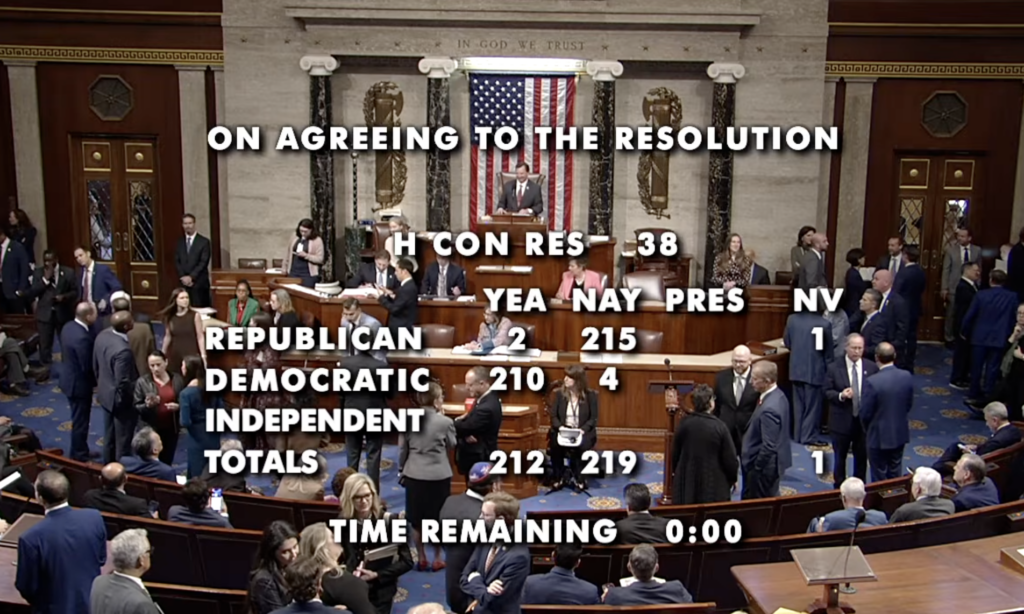
The House of Representatives on Thursday rejected a Democratic-led effort to limit President Donald Trump’s authority to expand U.S. military operations against Iran, voting largely along party lines with some defections on both sides.
The 212-to–219 vote exposed deep divisions within the Democratic Party, including among Jewish members who support confronting Tehran but say it should be up to Congress to authorize any broader war, as the constitution requires. Four Democrats joined Republicans, giving the GOP’s slim and fractured majority enough votes to defeat the measure.
The War Powers Act resolution, which would have required the administration to halt U.S. strikes against Iran, was introduced by Republican Rep. Thomas Massie of Kentucky, a libertarian and open critic of Israel, and co-sponsored by 94 Democrats.
The Senate rejected a similar effort to curb the president’s authority, largely along party lines.
Some members of the House offered a more moderate alternative that would order Trump to end the military campaign within 30 days unless Congress authorizes a formal declaration of war. That measure did not come up for a vote.
Rep. Greg Landsman of Ohio was the only Jewish Democrat to oppose the resolution. Reps. Josh Gottheimer of New Jersey and Jared Moskowitz of Florida, two Democrats who have at times crossed party lines in support of Israel and offered forceful support for U.S. military action against the Iranian regime, ultimately voted with most of their party to invoke the War Powers Act after initially opposing the measure.
Even if a resolution restraining Trump did clear Congress, Trump could veto it, necessitating a two-thirds vote in both chambers to override it — a threshold unlikely to be reached.
Trump said on Wednesday that the joint U.S.-Israeli air campaign against Iranian military and nuclear infrastructure, which he said was intended to create the conditions for regime change, was proceeding beyond expectations. He added that he rated Operation Epic Fury “about a 15” on “a scale of 10.” U.S. officials signaled strikes will intensify in the coming days.
At least six U.S. servicemembers have been killed in Iranian missile strikes. Operations in the region include at least 200 fighter jets, two aircraft carriers and about 50,000 troops stationed there.
The House also approved a separate resolution introduced by Rep. Brian Mast, a Republican from Florida, reaffirming the U.S. position that Iran remains the world’s largest state sponsor of terrorism. The measure passed with bipartisan support, 372 voting in favor and 53 — all Democrats — voting against.
Growing criticism of Israel and opposition to the war
The debate over the war exposed a growing divide between mainstream Democrats, who are largely supportive of Israel and back efforts to weaken Iran’s military and nuclear capabilities, and a party base that remains strongly opposed to U.S. military action. Those lawmakers say they support Israel’s right to defend itself and believe U.S. action against Iran’s missile and nuclear infrastructure may be justified, but they criticized the lack of congressional approval and the absence of a clear endgame that could lead to an endless and deadly conflict.
The position puts the centrist Democrats between progressives in their party who are demanding the strikes stop immediately and Republicans who overwhelmingly back Trump’s strategy — efforts by some on the far right to turn the party against the war notwithstanding. Some Democrats pointed to remarks by Secretary of State Marco Rubio that suggested that an Israeli decision to strike Iran forced Trump to act first.
The vote sends signals ahead of midterm primary elections for House seats. A CNN poll since the war began found that 82% of Democrats overwhelmingly disapprove of the U.S. action against Iran. Almost the same share of Israelis support the war.
Politicians are mindful that they can pay a price for supporting Israel in many districts: In an internal review of the 2024 presidential election, Democratic leaders acknowledged that the Biden administration’s support for Israel during the war in Gaza was a “net negative” politically and cost then-Vice President Kamala Harris crucial support among younger and progressive voters. Several progressive organizations have threatened to back primary challengers to Democrats who vote against limiting the war.
House Democratic Leader Hakeem Jeffries of Brooklyn, who has cultivated close ties with Jewish leaders since his election in 2012 and has visited Israel nine times, said in a House floor speech ahead of the vote that Trump has failed to make the case “to justify plunging America into another war that will cost more American lives and billions, if not trillions, in taxpayer resources.”
Speaking to reporters before that, Jeffries refused to say whether he’d back the alternative measure to give Congress a say on the war. “We will cross that bridge when we get to it,” he said.
This is a moment of great uncertainty. Here’s what you can do about it.
We hope you appreciated this article. Before you go, we’d like to ask you to please support the Forward’s independent Jewish news this Passover. All donations are being matched by the Forward Board - up to $100,000.
This is a moment of great uncertainty for the news media, for the Jewish people, and for our sacred democracy. It is a time of confusion and declining trust in public institutions. An era in which we need humans to report facts, conduct investigations that hold power to account, tell stories that matter and share honest discourse on all that divides us.
With no paywall or subscriptions, the Forward is entirely supported by readers like you. Every dollar you give this Passover is invested in the future of the Forward — and telling the American Jewish story fully and fairly.
The Forward doesn’t rely on funding from institutions like governments or your local Jewish federation. There are thousands of readers like you who give us $18 or $36 or $100 each month or year.
Support our mission to tell the Jewish story fully and fairly.