In Israel’s missile war, some families run to shelters. Others have nowhere to go.
Recent government data showed that only .3% of public shelters were in Arab communities
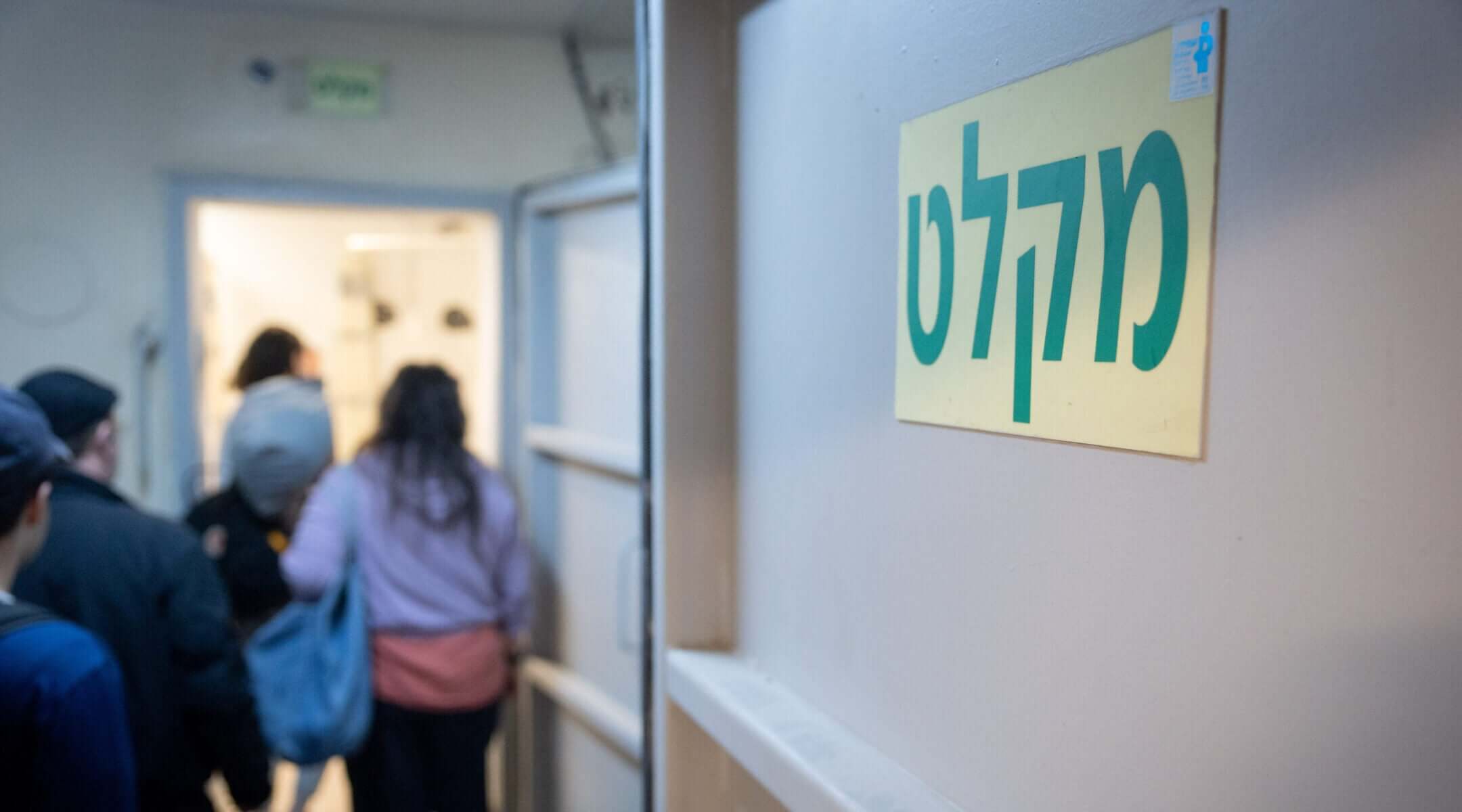
Israelis take cover in Tel Aviv as a siren sounds warning of incoming ballistic missiles fired from Iran toward Israel, March 1, 2026. Photo by Chaim Goldberg/Flash90
(JTA) — JERUSALEM — Walking with her children in Pisgat Zeev, a leafy neighborhood in Jerusalem, on Monday afternoon, Rivka recalled the missile that flew nearby the day before.
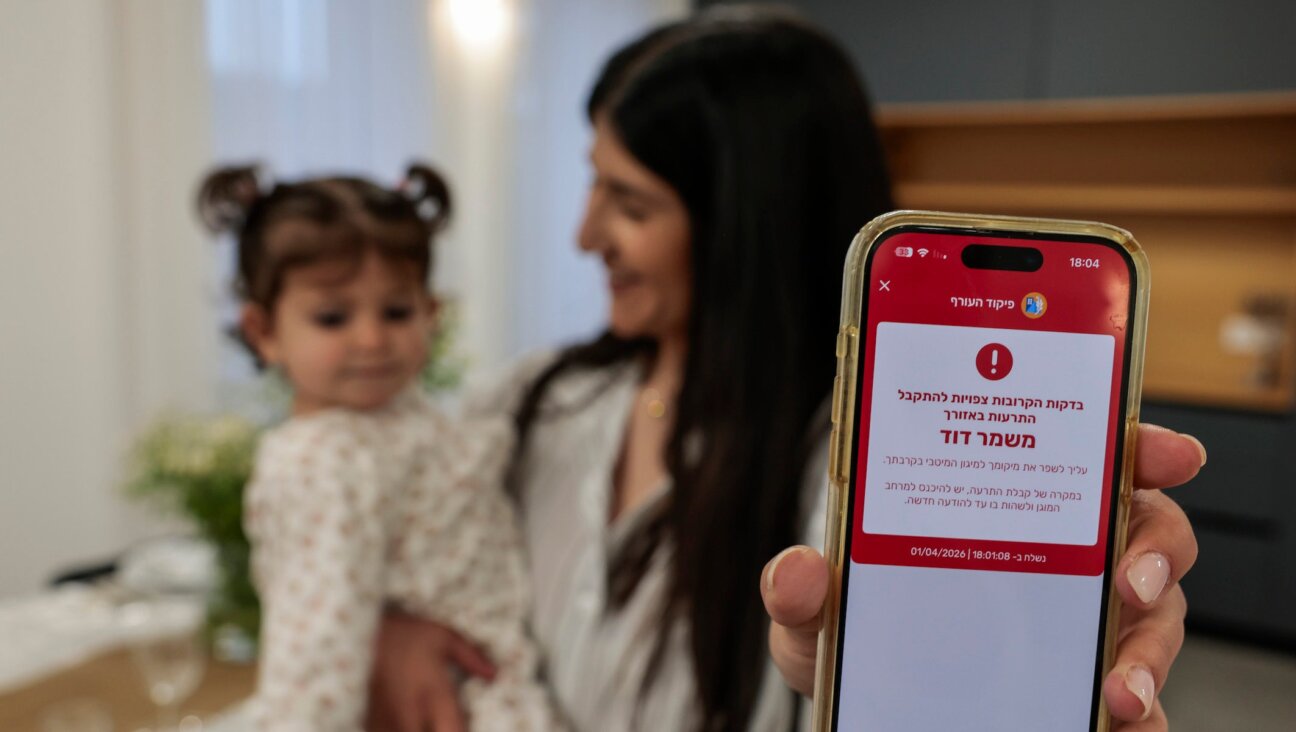
An impact could be felt as the family hunkered in their private “mamad” or safe room, required in all new homes in the Jewish neighborhood. Those who live in older homes or were far from their residence found their nearest public shelter.
When her children started to cry, Rivka said, she reassured them that the walls of the shelter are strong enough to withstand anything Iran could send toward Israel. “We feel safe in our shelters,” she said.
Just a few miles south, in the east Jerusalem neighborhood of Sheikh Jarrah, father of three Abed Abu Sharif recalled how he was driving his taxi on Sunday when he heard the unmistakable sound of an air raid alert.
Israeli authorities advise anyone driving when a warning siren sounds to exit their vehicle and look for the nearest public shelter. Abu Sharif knew he would not find one.
“Where am I to go? What am I to do? There is no shelter for me near here,” he said. “I continue driving because I have to provide for my family.”
The disparate experiences point to longstanding gaps in shelter access that are being thrown into stark relief once again by war.
The access gaps exist both geographically — with residents of the country’s dense center more protected — and between Jewish and Arab Israelis.
A Knesset hearing on Monday took aim at the significant number of Israelis who do not have ready access to shelters near their home, with lawmakers expressing frustration over the lack of support for shelter construction despite the constant threat of war since Oct. 7, 2023.
“In my view, this situation is abandonment of human life. Nothing less,” Oded Forer of the Yisrael Beiteinu party said during the hearing. “And it is happening right now, as people try to run to safe rooms, but they don’t have them.”
The hearing only briefly discussed disparities between Jewish and Arab Israeli communities in shelter access, citing statistics from the Israel Defense Forces’ Home Front Command. The statistics — revealed publicly last week — show that only 37 of 11,775 public shelters in Israel, or roughly 0.3%, are located in Arab municipalities, even though Arabs make up about 15% of Israel’s population.
That information dates to January 2025, before last year’s war with Iran. While both the Home Front Command and Israel’s comptroller told the Jewish Telegraphic Agency that a newer accounting was not available, Ori Narov, who leads the legal department of the Israel Religious Action Center, said he had received government data showing that roughly a third of the 1,500 shelters installed last year in Israel’s north went to Arab municipalities — a development that he cited as a rare sign of progress in Jewish-Arab equity.
Still, there is only one public bomb shelter in east Jerusalem, according to Bimkom-Planners for Planning Rights, a group advocating for equitable built environments in Israel.
“This is an issue of equity,” said Bimkom’s Dafna Saporta. “We’re talking about the Arab population. They don’t have equality, and they don’t have justice in Israel. The state is taking care of the Jewish population but neglecting the Arabs. It’s not new. It’s a political decision.”
National civil defense standards are set by the Home Front Command, while planning approval rests with local planning authorities, and cities are typically responsible for maintaining public shelters.
“As per the Civil Defense Law, public shelter construction is the responsibility of local authorities, whereas personal protection is an individual responsibility,” Home Front Command said in a statement responding to a request for comment on disparities in shelter access between Arab and Jewish communities in Israel.
It added, “The Home Front Command also takes measures to provide individual protection and to renovate public shelters, based on guidance from the political echelon and government decisions.”
Oct. 7, the subsequent conflict with Hezbollah and last year’s 12-day war with Iran drew stark attention to disparities that had deepened over time. A missile landed in Rahat, an Arab city in the south, killing multiple residents, and another strike in Tamra, in the north, killed several members of the same family.
Some efforts are underway to close the gap. A government initiative called Northern Shield worked to install shelters last year in homes and schools within a buffer zone of the Lebanese border, where rockets from Hezbollah are again flying now.
Nonprofit groups have also stepped into the gap. The International Fellowship of Christians and Jews, meanwhile, says it has worked with the government to install 700 shelters since Oct. 7, including several this week and some in a Druze village and in Haifa, a mixed city with large populations of both Jews and Arabs.
And the Israeli organization Standing Together, which advocates coexistence between Arabs and Jewish Israelis, has launched a campaign to crowdfund shelters for vulnerable Arab communities in the Negev.
But advocates say the efforts are far outmatched by the need. “While these initiatives are well-intentioned and deeply appreciated, the scale of the need in the unrecognized villages far exceeds the capacity of civil society,” Huda Abu Obaid, CEO of the Negev Coexistence Forum, said about the crowdfunding campaigns.
The Negev Coexistence Forum joined a lawsuit filed by the Reform movement-affiliated IRAC at the Supreme Court of Israel in 2024, alleging that Israel’s failure to build public shelters in Arab communities was a violation of their civil rights.
The government’s defense rested on high rates of illegal construction in Arab municipalities, which, in their view, absolved them of responsibility to ensure that mamads are installed in new homes. (Retrofitting mamads into older buildings is difficult and costly and not within the budget of any municipality, Arab or Jewish.)
The court sided with the government, ruling that the responsibility for building protective spaces rests with private homeowners and that the state is not obligated to build public shelters.
For Narov, the situation in the Negev is particularly galling because the extant planning process does not account for many Bedouin Arabs living there.
“They are not municipalities recognized by the government, so they can’t even build the shelters if they wanted to,” Narov said. He added, “This is the first responsibility of any state to its citizens: security to keep them safe from attacks, from the inside and definitely from the outside, as we’re experiencing right now.”
“If the law requires a protected room in every new building, but thousands of citizens are prevented from building legally or live in areas excluded from state planning frameworks, then the legal standard itself produces inequality,” Abu Obaid said. “Protection should not depend on municipal status, planning recognition or economic ability. It should be universal.”
The mandate that all new construction include a safe room in each unit or a basement shelter, first enacted in the 1990s, shifted Israel’s safeguards away from public shelters. That includes in east Jerusalem, which is administered by the the city of Jerusalem Municipality and hence the Israeli government, where no additional public shelters have been built in the last decade.
On March 2, an Iranian missile landed at the entrance to Ramat Shlomo, just a few kilometers from the neighborhood, injuring six Israelis.
Fatme, a doctor at a hospital in Jerusalem who was riding bus 218 toward the Qalandia checkpoint at the end of her workday on Monday, passed the crater on her way home. Still, she said, the debate was of little practical significance to her.
“There isn’t a single shelter in my neighborhood,” she said. “So when I hear the bombs, I just go on with my day.”
This is a moment of great uncertainty. Here’s what you can do about it.
We hope you appreciated this article. Before you go, we’d like to ask you to please support the Forward’s independent Jewish news this Passover. All donations are being matched by the Forward Board - up to $100,000.
This is a moment of great uncertainty for the news media, for the Jewish people, and for our sacred democracy. It is a time of confusion and declining trust in public institutions. An era in which we need humans to report facts, conduct investigations that hold power to account, tell stories that matter and share honest discourse on all that divides us.
With no paywall or subscriptions, the Forward is entirely supported by readers like you. Every dollar you give this Passover is invested in the future of the Forward — and telling the American Jewish story fully and fairly.
The Forward doesn’t rely on funding from institutions like governments or your local Jewish federation. There are thousands of readers like you who give us $18 or $36 or $100 each month or year.
Support our mission to tell the Jewish story fully and fairly.