AIPAC is targeting candidates who want to condition aid to Israel. Who has crossed its red line?
A number of former AIPAC endorsees are now open to conditioning military aid to Israel, crossing the lobbying group’s red line
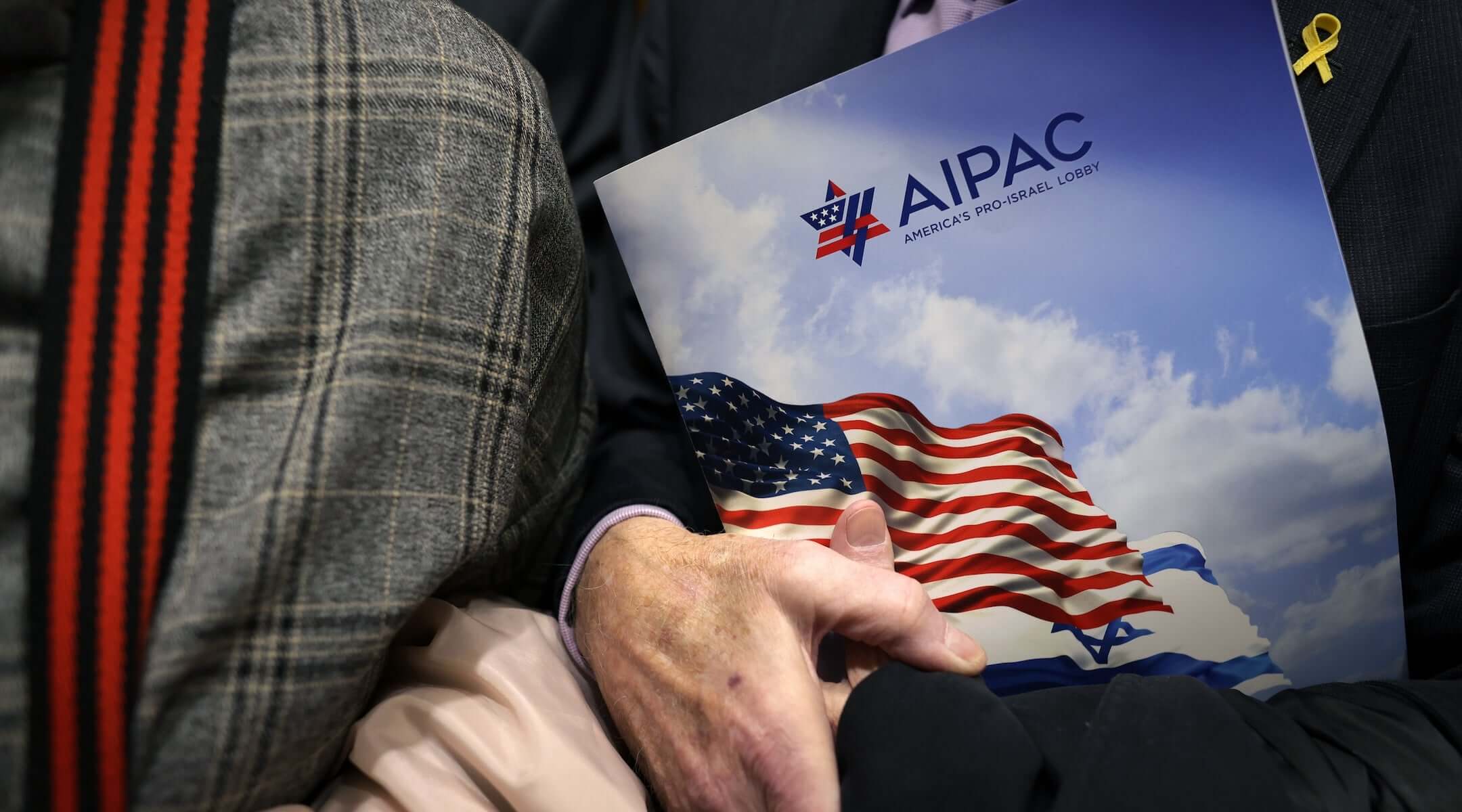
A visitor holds an AIPAC folder in an elevator in Rayburn House Office Building on March 12, 2024 on Capitol Hill in Washington, DC. Photo by Alex Wong/Getty Images
(JTA) — The flood of recent spending by a PAC affiliated with the American Israel Public Affairs Committee against a Democratic congressional candidate in New Jersey had many observers scratching their heads: Why would the pro-Israel lobby go after someone who describes himself as pro-Israel, when there was a much more strident critic of Israel in the race?
The PAC’s answer: Tom Malinowski had expressed openness to conditioning U.S. aid to Israel — and that was now AIPAC’s red line.
“We are going to have a focus on stopping candidates who are detractors of Israel or who want to put conditions on aid,” Patrick Dorton, a spokesperson for AIPAC’s super PAC, the United Democracy Project, said in an interview.
The idea that U.S. aid to Israel should be contingent on Israeli behavior was long anathema to most American politicians, advocated only by the far left. But as the war in Gaza dragged on in 2024 and 2025, with Israel continuing its campaign despite the urging of two subsequent U.S. administrations, more lawmakers began to express openness to the idea.
That shift sped up last summer as reports of starvation in Gaza spread, and politicians who’d never previously done so voted to block certain weapons to Israel. Longtime allies in Congress are crossing red lines again and again. The new U.S.-Israel war against Iran is inflaming the discourse once again.
Now, with the November elections coming closer, a hobbled AIPAC is weighing which candidates to back across the country, even as an increasing number of politicians pledge not to accept their endorsement or their affiliated PAC’s money.
Here’s a rundown of who might find themselves in AIPAC’s crosshairs, why, and what they’re saying about the pro-Israel lobby that’s become increasingly toxic among Democratic voters.
Crossing a red line, but open to AIPAC support
Rep. Adam Smith was endorsed by AIPAC in his most recent election cycle, but has since declared his support for conditioning aid to Israel. The Democrat from Washington state wrote last summer that the United States should “stop the sale of some offensive weapons systems to Israel as leverage to pressure Israel” if it did not take a handful of concrete measures, including implementing a Gaza ceasefire, stopping expansion of settlements in the West Bank and taking “serious steps” to reduce violence there.
Smith, a member of Congress since 1997, will face a nonpartisan primary election in August before a November election between the top two candidates. His opponents include Kshama Sawant, a former Seattle City Council member running as an independent on a “working class, antiwar, anti-genocide” campaign. Sawant is in favor of ending all military aid to Israel, and has called its military campaign in Gaza “a new holocaust.”
Smith is walking the tightrope between supporting Israel and criticizing its government and policies — and, by extension, distancing himself from AIPAC. “I don’t know what AIPAC is going to do in my race,” Smith told the Jewish Telegraphic Agency in a statement sent by his campaign manager. “I have certainly taken votes and positions that are the opposite of what AIPAC wanted. On the other hand, I still support the right of Israel to exist, and understand the threats that Israel continues to face from Iran, the Houthis, Hezbollah and Hamas among others.”
Smith added that Israel has a right to defend itself against those threats “even if I don’t always agree with how Israel chooses to exercise that right.”
While Smith has taken positions counter to AIPAC’s mandate, he said he would still welcome support from its members.
“I do have a number of constituents in my district who are active members of AIPAC,” Smith wrote. “I speak with them regularly and yes, I would welcome their support if they choose to offer it even considering where we disagree.”
Illinois Rep. Jonathan Jackson is also among the vanishingly few Democrats to say publicly that they would still accept contributions from AIPAC. He also co-sponsored the Block the Bombs to Israel Act last summer, which would restrict the sale of certain U.S.-made weapons to Israel.
Defying AIPAC, and taking their chances
The list of politicians with pro-Israel voting records who are veering away from AIPAC’s stance is growing. It includes a number of politicians who haven’t publicly commented on whether they’d accept AIPAC contributions or an endorsement, but could become a target of its super PAC’s spending.
Oregon Rep. Maxine Dexter was endorsed by AIPAC and benefited from more than $2 million in UDP spending last election. Nevertheless, she was one of 21 cosponsors of legislation accusing Israel of committing a genocide that was backed by anti-Zionist groups like Codepink and Jewish Voice for Peace.
Dexter also cosponsored the unsuccessful Block the Bombs Act last September. In fact, a number of AIPAC’s 2024 endorsees signed onto the bill since it was rolled out in May, including California’s Robert Garcia, Oregon’s Suzanne Bonamici and Andrea Salinas, Sylvia Garcia in Texas and Steven Horsford in Nevada.
Congresspeople with pro-Israel records and some past AIPAC involvement also voted yes on the Block the Bombs legislation, including California Rep. Mark Takano, who traveled on an AIPAC-affiliated trip to Israel and the West Bank in 2013; and California Rep. Jared Huffman, who also traveled to Israel in 2013 with AIPAC’s affiliated educational nonprofit. Both have regularly been endorsed by J Street, the liberal pro-Israel lobby, and not AIPAC.
Florida Rep. Maxwell Frost voted yes on Block the Bombs, three years after writing in a position paper that conditioning aid to Israel “would undermine Israel’s ability to defend itself against the very serious threats it faces.”
Other erstwhile pro-Israel politicians with increasingly critical stances on Israel have seemingly accepted that they, like Malinowski, could become the target of AIPAC’s spending.
That includes Sue Altman, who’s running in New Jersey’s nearby 12th district. In 2024, Altman won the Democratic nomination in a different district as a pro-Israel candidate endorsed by Democratic Majority for Israel, a centrist lobbying group that often overlaps in its endorsements with AIPAC. Altman lost to AIPAC-backed Republican Thomas Kean Jr. in the general election.
This year, according to audio leaked by Drop Site News, which has an anti-Israel bent, Altman said “a lot has happened” since 2024 and she is “going to be at least as left as Tom [Malinowski], if not more so” on aid to Israel.
“And so I can only anticipate that AIPAC, if they did it in 11, they’re going to do it here in 12,” she said, adding that there “might be other PACs too.” Last month, she posted on X, “AIPAC and countless SuperPACs are destroying our democracy by polarizing and misleading the public.”
Et tu, Senator?
In the Senate, in a landmark indication of shifting sentiment, a majority of Democrats voted in favor of Bernie Sanders-led resolutions last July that would block the sale of certain weapons to Israel.
The “yes” votes included eight senators who’d never previously voted to cut any aid to Israel: Jack Reed of Rhode Island; Tammy Baldwin of Wisconsin, Tammy Duckworth of Illinois; Patty Murray of Washington; Lisa Blunt Rochester of Delaware; Angela Alsobrooks of Maryland; Amy Klobuchar of Minnesota; and Sheldon Whitehouse of Rhode Island, who called himself “ardently pro-Israel” last year.
Reed, who is running for reelection, and Klobuchar, who is mounting a bid for governor, face elections this year. One of Klobuchar’s opponents, community organizer Kobey Layne, says she would prevent the state’s pension systems from “investing in companies facilitating Israeli settlements or military supplies to Israel.”
Delaware Sen. Chris Coons voted against Sanders’ resolutions. But Coons, who has previously spoken at AIPAC’s annual policy conference, said at an event last year he would be open to limiting weapons sales to Israel.
“If there is no change in direction from the Israeli administration, for the first time I would seriously consider that,” said Coons, who added that he has never “voted to withhold weapons from Israel, from the IDF.” Coons is up for reelection with a primary in September.
Meanwhile, not all of the “yes” votes have been seen as necessarily indicating a total shift on Israel.
Alsobrooks’ vote to cut aid drew concern from some members of the Jewish community to whom she’d expressed her support for Israel on the campaign trail. But Ron Halber, CEO of the Greater Washington Jewish Community Relations Council, said at the time that he spoke with Alsobrooks and believed she was casting a symbolic vote on a bill that had no real chance of passing.
“I don’t believe that this is a precursor to a fundamental shift on support for Israel,” he said.
But for AIPAC, voting in favor of one of Sanders’ numerous Israel resolutions is grounds for an attack ad.
Georgia Sen. Jon Ossoff, who is Jewish, voted to block certain weapons sales last July, as well as in November 2024. AIPAC released an ad attacking Ossoff, plus other lawmakers who supported Sanders’ November 2024 resolutions. DMFI endorsed Ossoff in 2020, but neither it nor AIPAC has backed any candidate in this year’s race.
You can’t fire me; I quit
Cognizant of AIPAC’s worsening public image, a growing number of moderate Democrats say they’ll refuse any campaign donations from the group.
One of those candidates — North Carolina Rep. Valerie Foushee — eked out a primary win last week by less than 1% of the vote. Foushee had been a prominent recipient of AIPAC support in 2022, benefiting from more than $2 million in spending by UDP. Her opponent, Nida Allam, was a Bernie Sanders-backed politician who accuses Israel of committing genocide.
AIPAC’s enemies smell blood in the water. Although Foushee says she will not accept AIPAC contributions during the 2026 campaign, the Working Families Party sent out a fundraising email in February in support of Allam, saying their candidate was “up against AIPAC and crypto billionaires.” (In her 2022 campaign that initially won her the House seat, also against Allam, Foushee was backed by pro-Israel PACs, including AIPAC, and a PAC primarily funded by Sam Bankman-Fried, the cryptocurrency entrepreneur who has since been convicted of fraud. Foushee beat Allam by more than 9% that year.)
Another North Carolina incumbent, Rep. Deborah Ross, has sworn off AIPAC donations for this year after having previously taken them. The same is true for Kentucky Rep. Morgan McGarvey, who said last year, “We no longer take AIPAC money.”
Massachusetts Rep. Seth Moulton has gone a step further, saying he would return his approximately $35,000 in donations from AIPAC. Rep. Robin Kelly, who is running for US Senate in Illinois, swore off AIPAC funds and has shifted to a more critical stance toward Israel, including supporting the Block the Bombs Act and accusing Israel of genocide. Texas Rep. Veronica Escobar, who’s received AIPAC contributions, has done the same as Kelly.
Other Democrats, such as New York Rep. Dan Goldman, have sworn off corporate PAC money altogether, including from AIPAC-affiliated PACs as well as DMFI, which recently released its first round of House candidate endorsements.
Goldman has kept his AIPAC ties intact, however, and accepted its endorsement in his campaign against progressive challenger Brad Lander.
It remains to be seen whether UDP will spend in districts like Goldman’s. While a candidate can refuse a contribution, independent ad expenditures may be made without coordination with campaigns. In some instances, those ads are positive and encourage viewers to vote for AIPAC’s preferred candidate.
In the case of New Jersey, AIPAC’s “Anybody but Malinowski” pitch appeared to backfire when a harsh critic of Israel eked out a victory, and only added to the lobby’s growing sense of embattlement.
This is a moment of great uncertainty. Here’s what you can do about it.
We hope you appreciated this article. Before you go, we’d like to ask you to please support the Forward’s independent Jewish news this Passover. All donations are being matched by the Forward Board - up to $100,000.
This is a moment of great uncertainty for the news media, for the Jewish people, and for our sacred democracy. It is a time of confusion and declining trust in public institutions. An era in which we need humans to report facts, conduct investigations that hold power to account, tell stories that matter and share honest discourse on all that divides us.
With no paywall or subscriptions, the Forward is entirely supported by readers like you. Every dollar you give this Passover is invested in the future of the Forward — and telling the American Jewish story fully and fairly.
The Forward doesn’t rely on funding from institutions like governments or your local Jewish federation. There are thousands of readers like you who give us $18 or $36 or $100 each month or year.
Support our mission to tell the Jewish story fully and fairly.