Can James Talarico’s faith-forward politics invigorate the Jewish religious left?
The Texas Democrat brings the language of religion, and a sharp critique of Israel, to his battle for the Senate and against the Christian right
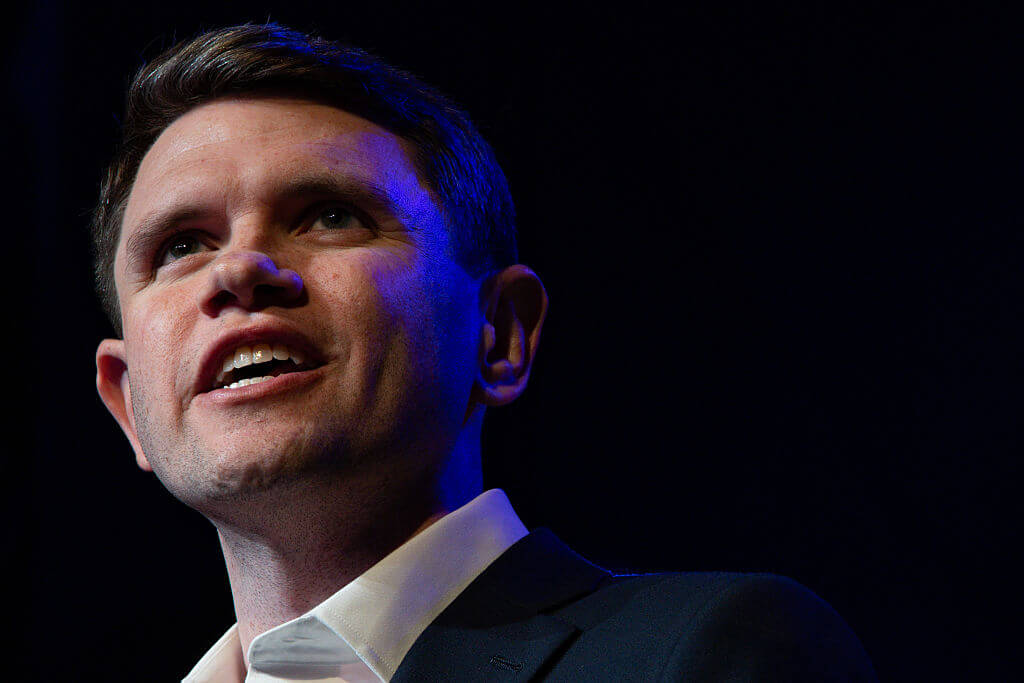
State Representative James Talarico, a Democrat from Texas and US Senate candidate, speaks during a Texas primary election victory speech in Austin on March 4. Photo by Kaylee Greenlee/Bloomberg via Getty Images
By Andrew Silow-Carroll March 19, 2026
(JTA) — In a recent interview for his New York Times podcast, Ezra Klein asked Texas State Rep. James Talarico why the Christian right puts so much focus on abortion and gay marriage.
“I’m Jewish, but when I read the New Testament, I always come away a little bit amazed that politicized Christianity is so worried about gender and sexuality, and so unconcerned with greed,” said Klein.
Talarico, 36, answered in the religious language that has made him not just a political darling in Texas, where he hopes to do the unthinkable and flip a Senate seat from red to blue, but a national figure.
“You’re preaching to the choir,” Talarico responded with a knowing laugh. “Absolutely. Concern for the poor, concern for the oppressed, is everywhere. Economic justice is mentioned 3,000 times in our Scriptures, both the New Testament and the Hebrew Scriptures. This is such a core part of our tradition, and it’s nowhere to be seen in Christian nationalism or on the religious right.”
His response was what the Texas Tribune has called “archetypal Talarico fare”: a blend of religion and “progressive, populist politics.” It has also made him the standard-bearer for a resurgent religious left, which includes more than a few Jews, in Texas and beyond, who have longed for a liberal politician who can speak from and to the language of faith.
“We need the kind of religious values [that] tell us that we are all made in God’s image,” said Joshua Shanes, a historian at the University of California-Davis, explaining why he’s excited by Talarico’s candidacy. “Religious values tell us that the government should be there to create a social safety net and create a healthcare system that helps everyone, and progressive taxation.”
The majority of Jews have tended to consistently support such positions, and vote accordingly. What Talarico adds to the mix is the faith-first rhetoric of the budding minister – which he is, pursuing a degree in theology at a Presbyterian seminary.
While mainstream Democrats will invoke their religious faith on the campaign trail, they rarely make it a signature. When the late Rabbi Michael Lerner, in the pages of his Tikkun magazine in the 1990s and early 2000s, called for the need of a religious left as an alternative to the Christian right, he found few Jewish allies. Jews were long wary of a Christian right that seeks to erase the line between church and state, and, like many liberals, tended to favor what the writer Cynthia Ozick has called the “unadorned public square” — a politics where religion remains a private matter.
Jewish conservatives, meanwhile, had long made peace with the Christian right, sharing its views on public funding for parochial schools and uncritical support for Israel.
In polling done in 2024, however, the Pew Research Center and other surveys indicated that younger progressives are open to candidates whose religious faith motivates social justice commitments, as long as it doesn’t translate into restrictive policy.
Perhaps noting this trend, Pennsylvania Gov. Josh Shapiro, in his recent autobiography, centered his religious Jewish identity in describing his political philosophy. “Now more than ever, we yearn for and need a world defined by faith,” writes Shapiro. “It’s universal, this belief in others to help us through what feels unsettled, uncivil, un-American.”
Shanes, whose specialty is modern Jewish political and cultural history, counts himself among those who were once doctrinaire about a secular public square but who now think Americans crave “the transcendent,” even in their politics. He views Talarico’s political message not just as a novelty, but as a necessity.
“My goal is a humanist morality,” he said, “and I don’t think a secular version of it is going to succeed, not in America.”
Talarico similarly talks about his religion as a source of his political values, but not as a means of coercion. Last year, Talarico opposed legislation requiring the Ten Commandments to be displayed in public school classrooms. “I found it offensive as an educator that we would impose one religious tradition onto all of our students, including students that don’t belong to that particular tradition,” Talarico, who taught language arts at a public school in San Antonio, explained at the time.
“He thinks that protections in the Constitution are good for Christianity, good for Judaism and good for all people and religion, because teaching religion is appropriate in the churches and not in the government,” said Marc Stanley, a Houston attorney, former U.S. ambassador to Argentina and prolific Democratic fundraiser.
Raised in the Austin suburb of Round Rock by a single mother, Talarico grew up attending a Presbyterian church. His grandfather was a Baptist minister. In 2018, he flipped a swing district in Round Rock, becoming the youngest member of the Texas House at 29.
Even before last month’s Democratic primary, he attracted an enormous online following (for a politician) for videos explaining his religious, liberal worldview. On TikTok, where he posts clips with titles like “Love can win” and “There is nothing more un-Christian than stealing from the poor to give to the rich,” he has 1.6 million followers.
But it was his conversation last month with Stephen Colbert that brought him national attention, and arguably led to his victory over U.S. Rep. Jasmine Crockett in the Democratic primary for the Senate seat. When CBS told Colbert that broadcasting the interview on “The Late Show” would violate “equal time rules,” it ran instead on YouTube, where the controversy drove over 7.5 million views.
That interview also suggests another aspect of his appeal to a religious Jewish left: He disdains Christian nationalism, a movement to codify in law and culture that the United States is a Christian nation. “There is nothing Christian about Christian nationalism,” he told Colbert. “It is the worship of power in the name of Christ and it is a betrayal of Jesus of Nazareth.”
“His entire appeal to a lot of people is that he is using scripture to come at the right-wing Christian fundamentalist element in the state of Texas,” said Art Pronin, president of Meyerland Area Democrats in a heavily Jewish part of Houston.
Talarico’s language has won over even Jewish liberals who don’t regard themselves as religious, but see in his message a necessary corrective to the politics of the Texas Statehouse and the Trump White House.
“He has succeeded in reviving a certain kind of humanism which was, going back to the Renaissance, tied to religious belief, tied to Christian values, tied to Jewish values,” said Robert Zaretzky, a historian at the University of Houston and a self-described “cultural” Jew. “And when I talk about Jewish values, what I have in mind is menschlichkeit … a kind of decency for one’s fellow man. And that is just so evident in Talarico’s words, in his actions, and in the way that he has voted in the Texas State Legislature.”
Zaretzky also sees in Talarico a connection to Jewish tradition, whether it is the prophet Micah — “Act justly and love mercy” — or the Talmudic sage Hillel: “What is hateful to you, do not do to others. All the rest is commentary.”
“That is the essence of Talarico’s message, and something that drives Texas Republicans absolutely crazy,” said Zaretzky. Indeed, many conservative Christians regard Talarico’s views as heretical, because he uses church vocabulary to promote liberal views. Angry evangelicals often refer to him as a “wolf in sheep’s clothing.”
Of course, even a politician in such heady company as Micah and Hillel has liabilities. In December, the Jewish news site JNS reported that some Jewish leaders in Texas were “alarmed” by Talarico’s views on Israel. Among other things, he had decried “the atrocities in Palestine,” and pledged that he wouldn’t “fund these war crimes” and will vote “to ban offensive weapons to Israel.”
Talarico also said he wouldn’t accept support from AIPAC, the pro-Israel lobby that has become radioactive on both the left and far right.
Pronin remembers a town hall back in December, when Talarico repeated his criticisms of Israel.
“It has set up a lot of conflicted feelings in the Jewish community on his candidacy,” he said. “On the one hand, he is a very appealing candidate on many other key issues that we would care about, like health care and the economy. Israel? Not as much.”
Stanley, a Talarico supporter, isn’t troubled by the candidate’s views on Israel, which are becoming increasingly common in the Democratic Party.
“I think that we as a Jewish community make a mistake vilifying people or casting people as anti-Israel or antisemitic because they have the nerve to criticize somebody like Netanyahu,” said Stanley.
In January, in an email to Jewish supporters in Texas, Talarico promised that if he is elected to the Senate he will vote for arming Israel with defensive weapons. He wrote that he supports a two-state solution and removing Hamas from power, and referred to Oct. 7 as “the deadliest day for Jews since the Holocaust.”
“I think it is a very balanced and very bold position,” said Stanley.
And for pro-Israel Jews inclined toward progressive domestic politics, it may be a position that they will have to tolerate, or cede elections to Republicans who don’t criticize Israel, but disagree with them on nearly everything else.
Rabbi Nancy Kasten, the chief relationship officer at Faith Commons, an interfaith organization in Dallas, says there is “a lot of enthusiasm” for Talarico in the Jewish community. Still, she acknowledges that some of the things he has said about Israel have given critics the opportunity to pounce.
Kasten also said that some of his religious language is “jarring” for Jews, especially in invoking certain New Testament tropes.
She was looking forward to an upcoming meeting with the candidate, and hopes that he will be open to a conversation about how his language on Israel and religion lands in the Jewish community.
“Personally, I want a voice for separation of church and state, which we don’t have anymore,” she said. That said, she added, “I’m happy that there’s a different religious voice in the public square. Ceding that voice to the white, Christian, nationalist voice is harmful, and so I’m grateful that there’s somebody who seems to have the ear of people who speak that language and desire that language in politics and I’m grateful to have someone like that under the circumstances.”
This article originally appeared on JTA.org.