Who is the new ‘terror group’ claiming responsibility for antisemitic attacks in Europe?
The group calls itself Harakat Ashab al-Yamin al-Islamiya, loosely translating to ‘The Islamic Movement of the People of the Right Hand.’
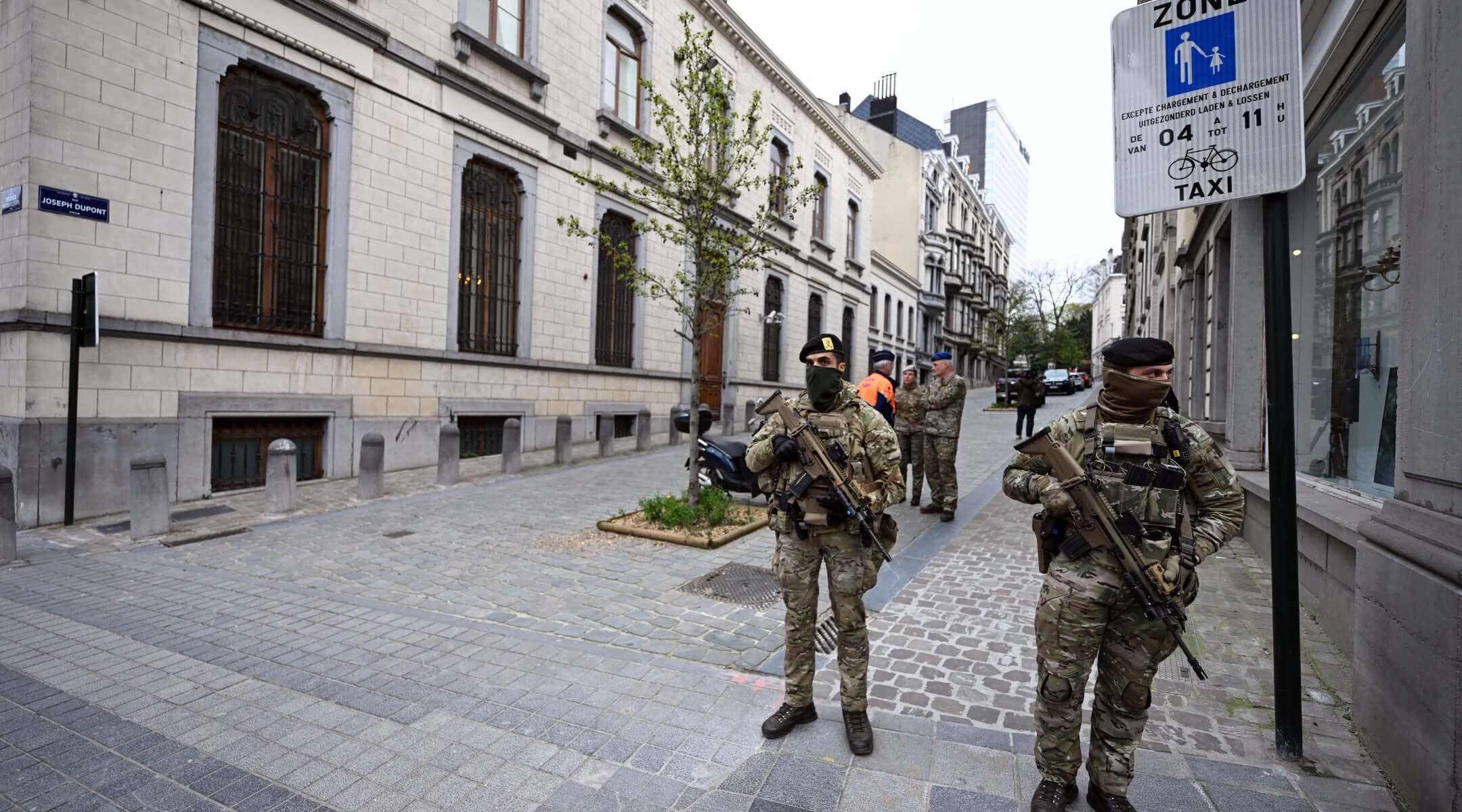
Belgium steps up security around the country as threats escalate against Jewish communities in Europe. (Dursun Aydemir/Anadolu via Getty Images)
(JTA) — Two minors have been arrested in connection with a car burning in the Jewish quarter of Antwerp in what is being treated as an antisemitic attack, Belgian prosecutors say.
The two suspects were arrested shortly before midnight Monday, just minutes after setting the vehicle on fire.
Prosecutors also say the investigation includes a video circulating on social media, in which a group that calls itself Harakat Ashab al-Yamin al-Islamiya, or HAYI, claims responsibility for the attack, the latest in a string of such incidents across Europe.
The group, whose name roughly translates to The Islamic Movement of the People of the Right Hand, was unknown until earlier this month, when it took responsibility for the firebombing of a synagogue in Liège, Belgium on March 9.
Security analysts know little about the group, and aren’t able to confirm its authenticity. As of March 24, however, HAYI or those claiming to speak in its name has taken responsibility for attacks on the following: a synagogue in Rotterdam, Netherlands on March 13; a Jewish school in Amsterdam also on March 13; a series of fires on the Jewish ambulance service in London on March 22; a thwarted attack on a Chabad Hebrew school in Heemstede, Netherlands on Monday; and Monday’s car burning in Antwerp.
None of the attacks have resulted in injuries. All the arrests made in HAYI-affiliated attacks so far have involved young adults or teenagers.
Although information is scarce, some analysts say the group could be tied to pro-Iranian militias with a local footprint in Europe, serving as a cover for their activities. Attacks against Jewish sites in the United States, Europe and Canada have escalated since Feb. 28, when the United States and Israel launched their war on Iran. But some inconsistencies in the group’s messaging and tactics have raised questions about its legitimacy as an Iranian-backed group.
In a video circulated on pro-Iranian Telegram accounts, the group also claimed to have carried out an attack on an unspecified “Zionist target” in Greece on March 11. But there is no public evidence of a terror attack occurring in Greece on that date, according to security analysts. One analysis suggests that particular video may be disinformation, instead depicting an explosion at a residential building in Rotterdam on March 3.
An analysis from the International Centre for Counter-Terrorism described inconsistencies including a typo in the spelling of the group’s Arabic name and weapon imagery in the group’s logo that was inconsistent with pro-Iranian imagery. But the profiles of the perpetrators — young, local recruits — are consistent with Iranian tactics, ICCT said, including exploiting vulnerable youth and possibly paying them for their efforts.
Another possible explanation, the ICCT report said, is that young locals got involved as the result of deepening ties between terror groups and local criminal organizations.
Officials in the Netherlands believe HAYI may also be responsible for a recent explosion at an Amsterdam branch of a U.S.-based bank. A video purportedly from the group warned people in the European Union to “immediately distance yourselves from all American and Zionist interests, facilities, and what is affiliated with them,” before showing footage of the improvised explosive device detonating outside Bank of New York Mellon on Sunday. No one was injured in the explosion.
CBS News reported it received a similar message from the group on Monday.
“We’ll keep threatening U.S. and Israeli interests worldwide until we’ve avenged every child in Gaza, Iran, Lebanon, and the resistance nations,” the message said, according to CBS.
Hours later, the group claimed responsibility for the attack in Antwerp.
Just days earlier, Belgium announced it would step up security at Jewish sites due to the increased security threat.
In an interview with The Independent, Hans-Jacob Schindler, senior director of the New York- and Berlin-based Counter Extremism Project, doubted HAYI was a new terror group.
“Whether the perpetrators are connected, or whether it’s a framework the IRGC is giving them, is up for discussion,” he said, using the acronym for Iran’s Islamic Revolutionary Guard Corps. “ “It’s much more powerful to say that a new terrorist group exists, but given they have claimed five attacks in four countries, it is unlikely that a new group would be able to set up that network within weeks. Posts like these create the impression that there is massive terror against Europe. These actors will post everything they can to insinuate that Europe has become very very unsafe.”
This is a moment of great uncertainty. Here’s what you can do about it.
We hope you appreciated this article. Before you go, we’d like to ask you to please support the Forward’s independent Jewish news this Passover.
This is a moment of great uncertainty for the news media, for the Jewish people, and for our sacred democracy. It is a time of confusion and declining trust in public institutions. An era in which we need humans to report facts, conduct investigations that hold power to account, tell stories that matter and share honest discourse on all that divides us.
With no paywall or subscriptions, the Forward is entirely supported by readers like you. Every dollar you give this Passover is invested in the future of the Forward — and telling the American Jewish story fully and fairly.
The Forward doesn’t rely on funding from institutions like governments or your local Jewish federation. There are thousands of readers like you who give us $18 or $36 or $100 each month or year.
Support our mission to tell the Jewish story fully and fairly.