‘No Kings’ protests fall on Shabbat. So these Jews organized one in walking distance.
Orthodox critics of Trump are planning a Los Angeles rally for Saturday, making visible a progressive minority in a largely MAGA community
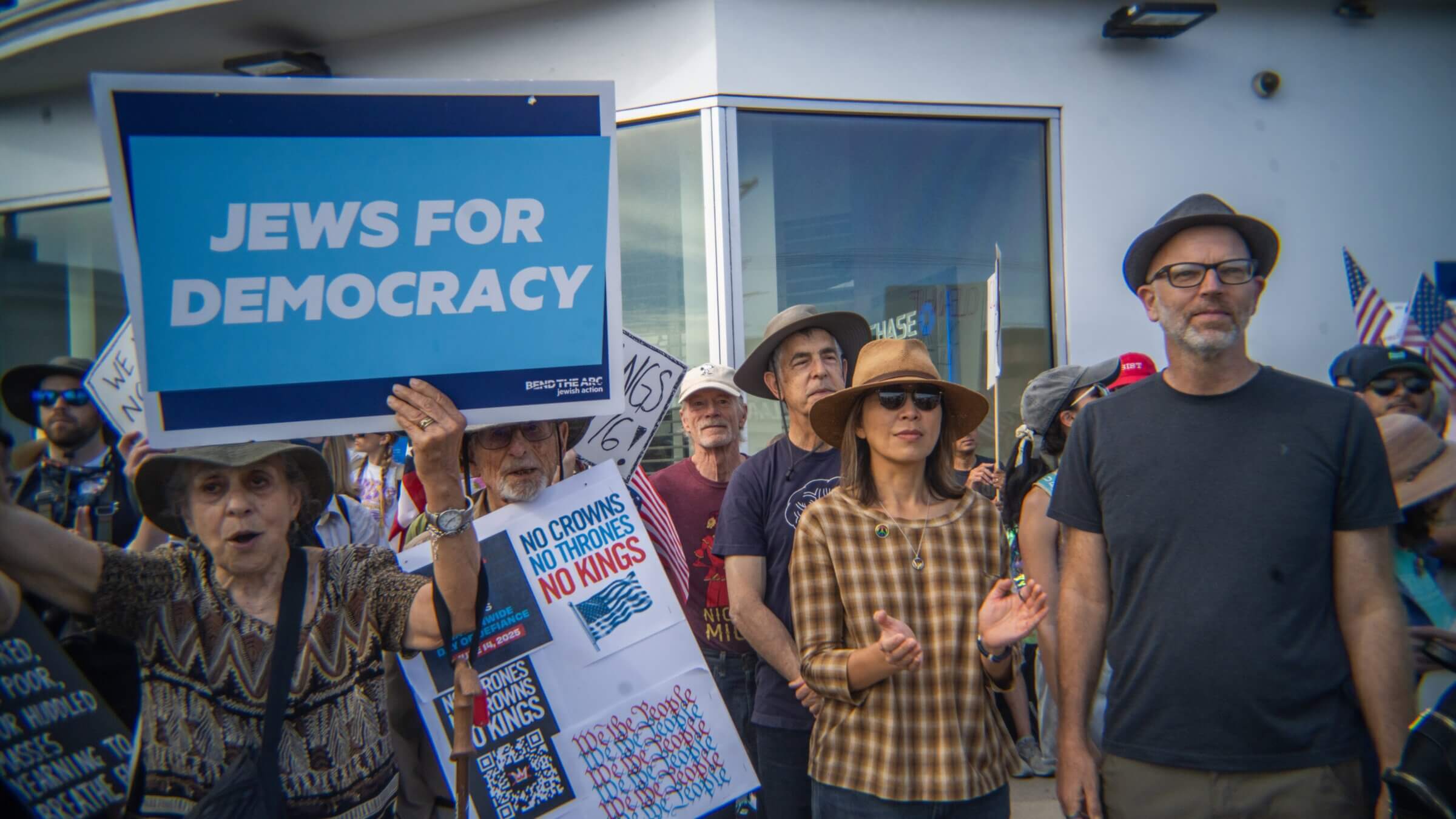
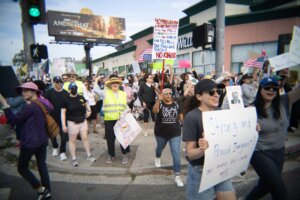
Jewish protesters at a No Kings rally in Los Angeles in 2025. Courtesy of Ronni Hendel
By Louis Keene March 26, 2026
A few hundred people are expected to assemble Saturday at an intersection in West Los Angeles to protest the administration of President Donald Trump. But in doing so they will also be challenging a power structure closer to home: the right-wing consensus that dominates political life in their Orthodox Jewish neighborhood.
Ronni Hendel, an executive coach and consultant, co-organized a No Kings protest in Pico-Robertson, one of the largest Orthodox communities in the country, to enable Shabbat-observant Jews like her — who don’t drive or ride public transportation on the Jewish day of rest — to participate in the demonstrations.
But Hendel said the Pico-Robertson protest, one of some 3,500 “No Kings” demonstrations being held across the country this weekend, will also show that American Orthodox Judaism, a denomination long associated with conservative politics, contains a substantive liberal minority crying out to be heard.
“There’s this sense that the frum (Orthodox) community is pro-Trump,” Hendel said. “I think it’s important for those who aren’t to have a place to say that as an observant Jew, I can put forth an opinion that isn’t necessarily the dominant view.”
Saturday’s protest will be the fourth Hendel has organized during the second Trump administration at the corner of Pico and La Cienega boulevards, about a half-mile from the intersection that gives the neighborhood its name. The voting district covering that intersection swung deep red in the 2024 election, as did heavily Orthodox neighborhoods across the country. Polls showed three-quarters of Orthodox Jews intended to vote for Trump.
Hendel said the seed for a Pico-Robertson protest dated back to January 2017, in the days leading up to the inaugural Women’s March that convened throngs of demonstrators in the first major national protest against the new president.
The Los Angeles protest that day fell on a Saturday and was being held downtown — 10 miles away from Pico-Robertson. Unable to drive and not wanting to miss the event, Hendel and a few likeminded friends booked a hotel. When it came to the “Hands Off!” protest in April 2025 — also a Saturday — they wanted to be able to include more people.
So Hendel planned the Pico-Robertson “Hands Off!” protest for a late afternoon so as not to overlap with morning synagogue services — and picked an intersection that wasn’t quite in the heart of the neighborhood.
“We want to have a voice, but we’re not trying to be in-your-face,” Hendel said.
Hendel and co-organizer Rabbi Aryeh Cohen are part of a broader movement of liberal Orthodox Jews uniting across their communities to make their voices heard. Groups like Smol Emuni and Halachic Left, for example, primarily address Jewish conversation around Israel. The No Kings protests, on the other hand, focus more on domestic issues — particularly concerns about executive overreach.
Jewish people are not the only protesters in attendance at the Pico-Roberston rally, and signs brought to previous events offered a mix of secular and Jewish messages. (One referencing the Messiah read, “Only mashiach is king.”) But the organizers, marshals and medics at the protest are all Shabbat-observant Jews, Hendel said.
“It has a little bit of a block party feel,” Hendel said, “like we are all supporting each other and showing that this community, this neighborhood also has this.”
Saturday’s event will be the first since the U.S. and Israel went to war with Iran, something Hendel is monitoring. Pre-war protests have drawn ire from community leaders, including one neighborhood Jewish security agency that warned of a “pro-Hamas protest.” This time around, Hendel is wary of conflict with her Pico-Robertson neighbors, who she says widely support the war.
While she maintained the war is illegal because Trump did not receive Congressional approval for it, she didn’t plan to make her sign about it.
“I’m really worried about what this does to relationships between Israeli Jews and American Jews, and within the American Jewish community — it terrifies me,” Hendel said.
But, she added, “that’s not my biggest issue right now with Trump. I’d say it’s more the internal stuff with immigration and ICE and health. And there’s a million other issues that I can bring signs about.”
This is a moment of great uncertainty. Here’s what you can do about it.
We hope you appreciated this article. Before you go, we’d like to ask you to please support the Forward’s independent Jewish news this Passover.
This is a moment of great uncertainty for the news media, for the Jewish people, and for our sacred democracy. It is a time of confusion and declining trust in public institutions. An era in which we need humans to report facts, conduct investigations that hold power to account, tell stories that matter and share honest discourse on all that divides us.
With no paywall or subscriptions, the Forward is entirely supported by readers like you. Every dollar you give this Passover is invested in the future of the Forward — and telling the American Jewish story fully and fairly.
The Forward doesn’t rely on funding from institutions like governments or your local Jewish federation. There are thousands of readers like you who give us $18 or $36 or $100 each month or year.
Support our mission to tell the Jewish story fully and fairly.