Democrats to weigh resolution condemning AIPAC, fueling concerns about ‘undercurrent of antisemitism’
The DNC resolution comes as rejecting the pro-Israel lobbying group’s support has become a defining issue in Democratic races
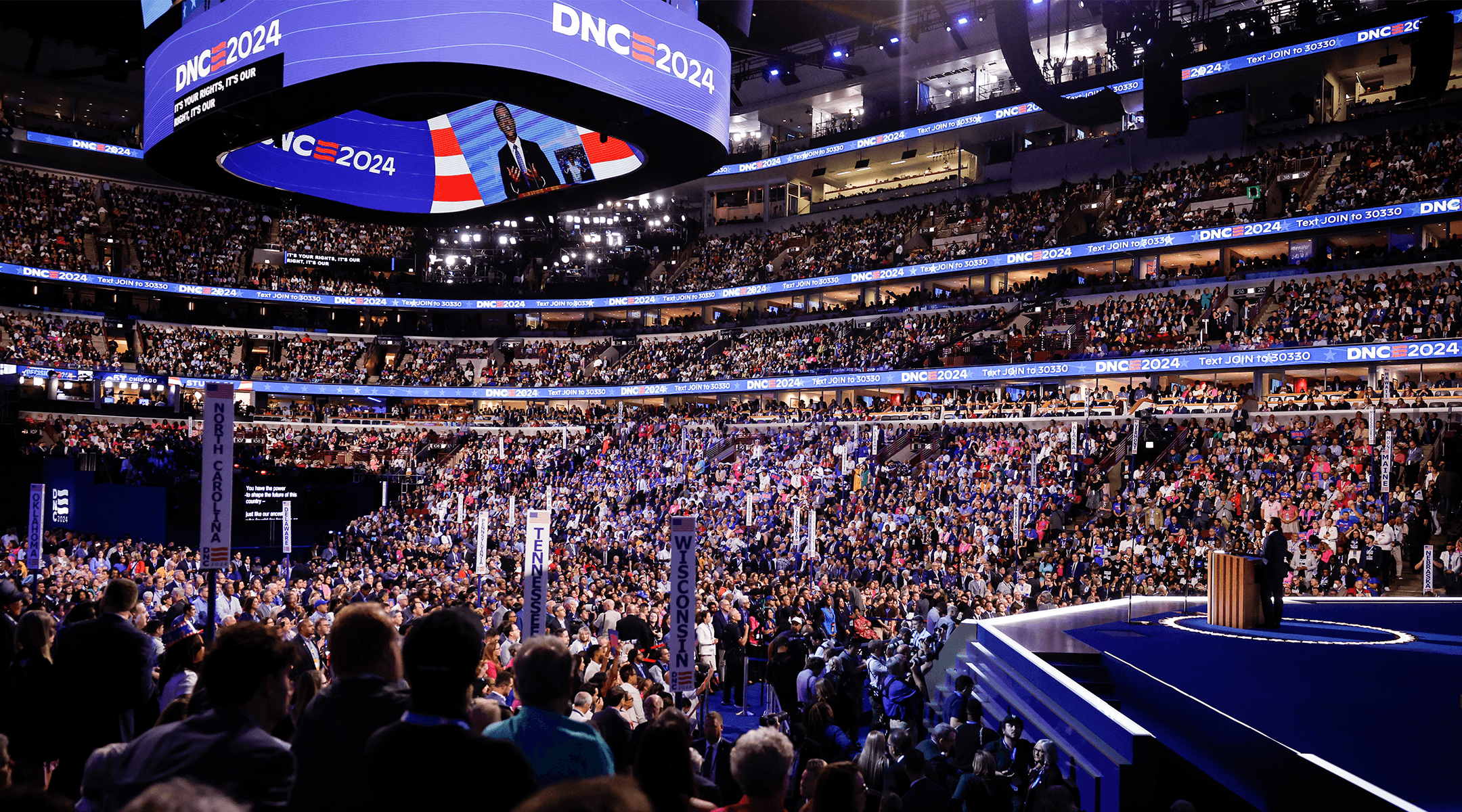
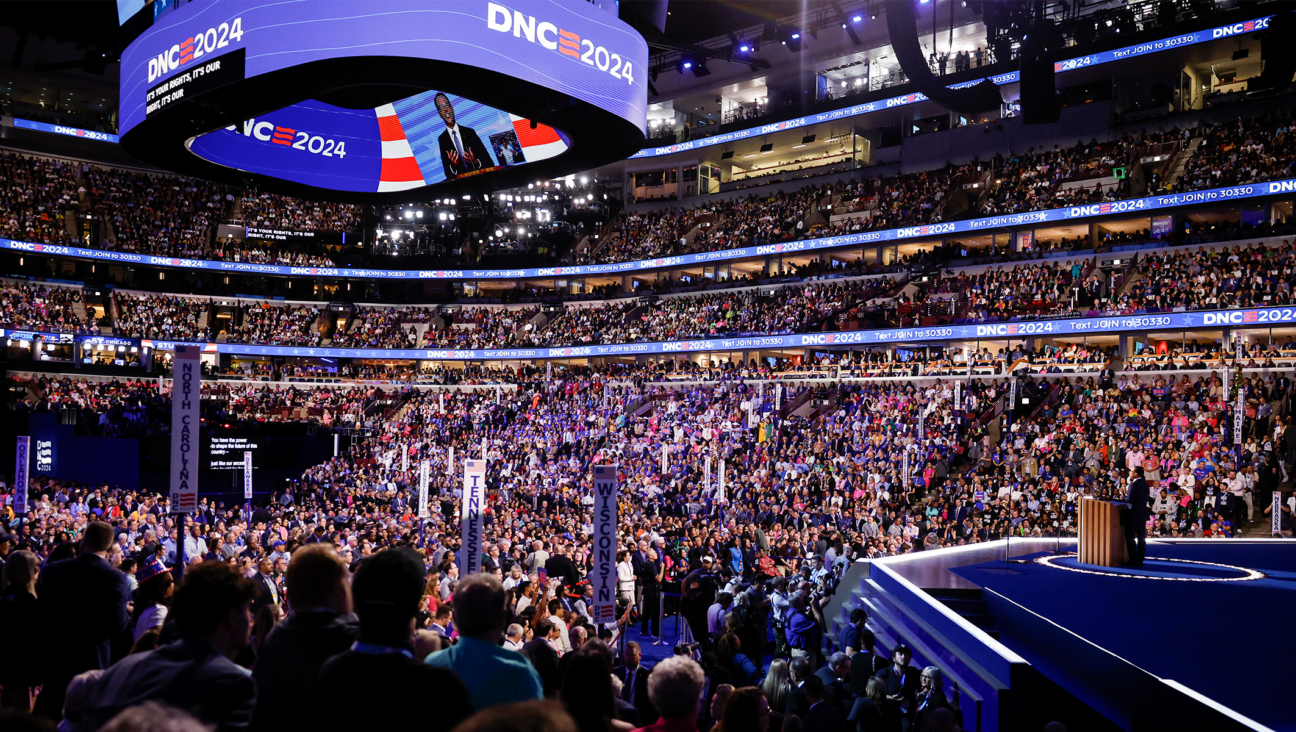
A crowd packs the United Center for the Democratic National Convention, Chicago, Aug. 21, 2024. Photo by Kevin Dietsch/Getty Images
(JTA) — The Democratic National Committee is set to consider a resolution at a meeting next week that “condemns the growing influence” of AIPAC.
The resolution also condemns large-scale outside spending in elections generally but calls out only the pro-Israel lobby specifically, even as other lobbies are pouring similar sums into trying to influence election outcomes.
The meeting is being held during an election cycle in which rejecting AIPAC support has become a defining issue in Democratic races. It also comes amid concerns from some Jewish Democrats — including ones critical of AIPAC — that the group’s emergence as a bogeyman in American politics is inappropriate or even antisemitic.
“I do think there is an undercurrent of antisemitism in the degree to which AIPAC seems to be vilified,” Rep. Dan Goldman told the Jewish Telegraphic Agency last month. Goldman has accepted an endorsement from AIPAC as he seeks a third term, but says he won’t take money from corporate PACs in this election.
The resolution, which is subject to amendments before it is voted on, specifically names AIPAC and its super PAC, United Democracy Project, as having been “one of the largest outside spenders in Democratic contests” in 2024. It also refers broadly to other “corporate money PACs” and sources of “dark money,” though it does not name any specific groups.
Committee member Allison Minnerly, who introduced the resolution, told the Intercept, a left-wing outlet, that formally distancing the Democratic party from AIPAC “could be one step toward” winning back voters who “might really not have felt represented or seen when it came to Gaza or seeing their party support Palestinian rights or stand against military conflict.” Minnerly also introduced a resolution last August calling for an arms embargo on Israel, which was defeated.
A recent NBC poll found that 57% of Democratic voters have a negative view of Israel, compared to 13% who have a positive view of the country.
Meanwhile, a growing number of the party’s congressional candidates — and politicians thought to be seeking its 2028 presidential nomination — are swearing off AIPAC, and crossing its red line of supporting conditions on military aid to Israel.
The group has also spawned opposition online. Track AIPAC, the social media watchdog that posts politicians’ pro-Israel lobbying campaign donation numbers, has amassed 442,000 followers on X since 2024.
At town halls and candidate forums, politicians on the campaign trail are often being asked whether they would accept an endorsement or donations from the group.
Alana Zeitchik, an Israeli-American advocate and writer, said she understands that candidates might be asked about AIPAC in those types of settings, and said that she personally “would love to hear candidates” reject all special interest and corporate dollars. But when they hone in on AIPAC “on their own accord,” she said, she views it as “a political strategy to feed the beast, this hyper-obsession with AIPAC.”
The proposed DNC resolution voices concern over “massive outside spending” on candidates based on their foreign policy positions, pointing specifically to AIPAC’s $14 million spend in a single Illinois primary. The threat of those expenditures “raises concerns about undue influence over democratic debate and policymaking,” the resolution reads, and in “shaping Democratic party positions.”
The resolution condemns “the growing influence of dark money and corporate-backed independent expenditures in Democratic elections.”
AIPAC has remained a major spender in this year’s midterm elections. The group, which is operating with the aim of electing a majority pro-Israel Congress, recently shelled out around $22 million in support of four Illinois candidates, three of whom it backed through shell PACs under different names. Two of its four preferred candidates won.
While it narrows in on AIPAC, the DNC resolution does not address other types of high-spending special interest groups, such as real estate lobbying groups or the burgeoning landscape of pro-AI PACs.
New Jersey Sen. Cory Booker, who has previously received AIPAC donations but is rejecting all PAC money this year, told Politico last week that the particular attention paid to AIPAC has been “problematic.”
“There are Iranian Americans that bundle money. There are Turkish Americans that bundle money. There are a lot of ethnic groups that bundle money, and often for things that I don’t agree with. But somehow AIPAC seems to be drawing a lot of attention, and that’s problematic to me,” Booker said. “[AIPAC] is not the problem in America. The problem in America is money in politics.”
Adam Carlson, head of the progressive polling form Zenith Research, poked fun at Booker’s comments with a facetious tweet that dismissed Booker’s concerns, and pointed out the lack of an AIPAC-sized group for Iranian and Turkish Americans.
“Cory’s right. I am sick and tired of the mainstream media refusing to report on PERSIAPAC and TURKPAC spending hundreds of millions of dollars meddling in primaries to boost their preferred candidates,” wrote Carlson, who is Jewish. “It’s an antisemitic double standard, and he’s a hero for pointing it out.”
Goldman, like Booker, says he isn’t taking corporate PAC money in this election, but he did accept AIPAC’s endorsement. Goldman is currently facing a primary challenge from Brad Lander, a Jewish progressive whose attacks against Goldman have centered the congressman’s AIPAC endorsement.
While the DNC’s proposed resolution suggests that AIPAC is shaping Democratic party positions, Goldman asserted that his views are independent from his endorsements.
“I have personally pushed AIPAC very much to recognize that it is an organization that supports first and foremost the State of Israel and the U.S.-Israel relationship, but that does not mean that they should be unwavering in their support for the Israeli government,” he said.
He added, “I am going to continue to operate independently, based on my own understanding and nuanced view of the situation, and work towards a peace in the region and two-state solution and security for Israel.”
Other Democrats have said they turned down AIPAC because of foreign policy disagreements. In Illinois, Rep. La Shawn Ford said he met with UDP but did not receive its endorsement because he was unwilling to meet its requirement of supporting unconditional military aid to Israel.
Zeitchik said she is not a fan of AIPAC’s “really dirty” tactics, which have included spending on attack ads against pro-Israel politicians because they are open to conditioning military aid — but she, too, has concerns about the particular attention paid to it.
“I think that the hyper-obsession with AIPAC amongst progressives, and making AIPAC the bogeyman, the problem, has an undercurrent of what I’d call an antisemitic worldview, or an antisemitic reaction,” Zeitchik said.
Joel Petlin, the school district superintendent in the heavily Jewish village of Kiryas Joel, outside New York City, wrote that the DNC’s proposed resolution “singles out AIPAC for doing precisely what many other lobby groups are doing every day.”
He added, “If this resolution passes, the DNC can finally stop calling themselves ‘the big tent party,’ because it clearly isn’t large enough for American Jews.”
Similar accounts to Track AIPAC have popped up online, though none have taken off in the same way. Oil PACs Tracker was founded in 2021 and has 43,000 followers. An account called Melt ICE, which tracks candidates’ stance on ICE, has garnered 3,000 followers since being created in January.
Zeitchik said she appreciates how congressional candidates such as Jack Schlossberg, who is running in New York’s 12th Congressional District, have approached the issue by rejecting all special interest money without harping specifically on AIPAC.
“When I see Israel become a wedge issue, and politicians continue to push and make it a wedge issue — that, to me, is alarming,” she said.
This article originally appeared on JTA.org.
This is a moment of great uncertainty. Here’s what you can do about it.
We hope you appreciated this article. Before you go, we’d like to ask you to please support the Forward’s independent Jewish news this Passover. All donations are being matched by the Forward Board - up to $100,000.
This is a moment of great uncertainty for the news media, for the Jewish people, and for our sacred democracy. It is a time of confusion and declining trust in public institutions. An era in which we need humans to report facts, conduct investigations that hold power to account, tell stories that matter and share honest discourse on all that divides us.
With no paywall or subscriptions, the Forward is entirely supported by readers like you. Every dollar you give this Passover is invested in the future of the Forward — and telling the American Jewish story fully and fairly.
The Forward doesn’t rely on funding from institutions like governments or your local Jewish federation. There are thousands of readers like you who give us $18 or $36 or $100 each month or year.
Support our mission to tell the Jewish story fully and fairly.