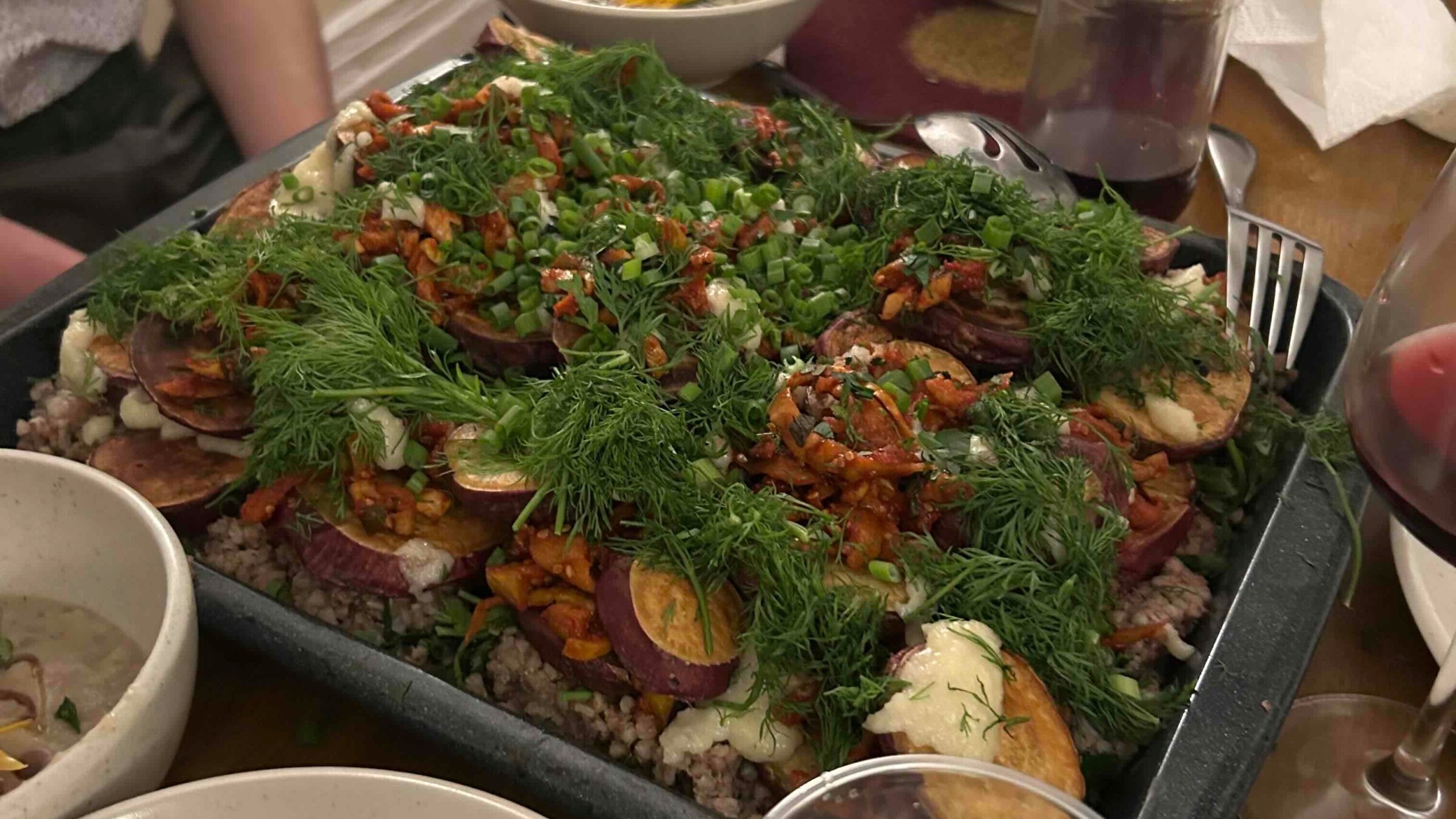
A sweet, starchy, spicy homage to the latke we all know and love. Courtesy of Sam Lin-Sommer

By Sam Lin-Sommer and Ethan BlakeDecember 24, 2024
At a recent Hanukkah cooking workshop, part of a series called Schvitzin’ in the Kitchen, we challenged ourselves to create a feast without the holiday’s mainstream American hit — the latke. Instead, we asked, what are the elements of that famous Ashkenazi Hanukkah staple that have made it a Hanukkah hallmark?
Yes, a celebration of oil, but also of local winter cellar produce; maximal starch for warmth; garnishes for acidity, sweetness, and contrast; and techniques that inevitably involve many people, joining together to make light in darkness.
In deconstructing the latke, we made a blueprint for another delicious fried tuber recipe that you can adapt to the starches, herbs, and oils that are produced near you. In Brooklyn, we used Japanese sweet potatoes; dill, parsley, and oregano; and sunflower, butternut squash, and pumpkin seed oils all produced in the Northeast.
This makes a gorgeous platter of earthy grains and colorful, sweet starches, topped with pops of flavor and herbs. It could be a meal in itself, or a great vegan addition to a larger Hanukkah meal.
Whatever ingredients you use, this is a group project — don’t try it alone. (And let it be a spark for gathering)!
Ingredients
- Lots of cooking oil
- 3 cups of buckwheat groats (dry)
- 1-2 pounds of sweet root vegetables (we used Japanese sweet potatoes), sliced crosswise into ¾ inch slabs
- 1 cup of peeled garlic cloves
- 2 TBSP vinegar or lemon juice
- 1 jar of kimchi (we used a locally farmed and fermented radish kimchi from New Jersey-based Lani’s Farm)
- Scallions
- Two or more bunches of fresh green herbs
- Local finishing oil (in the New York area, pumpkin seed, hemp, and butternut seed grow locally and make delicious oils — but anything rich and aromatic, like sesame oil, will do)
Directions
Kasha sans varnishkes
- In a medium-sized saucepan, toast 3 cups of buckwheat groats for a couple minutes, then add 6 cups of water; bring to a boil and turn down heat to simmer until cooked (alternatively, you can use a rice cooker with a similar groats-to-water ratio).
Pan-fried roots
- Fill a pan with about ¼ inch of oil, and fry your root vegetable over high heat, flipping once the bottoms are lightly browned. When the centers are tender and the outside is crispy, remove and place on a baking sheet lined with paper towels to drain and cool.
Toum
- In a food processor, blend 1 cup of peeled garlic cloves with a pinch of salt and 2 tablespoons of lemon juice, or any vinegar. With the motor running, slowly drizzle in oil (lots!) until you have a creamy emulsion. Let settle for at least 30 minutes before serving; resting helps curb the raw garlic’s sharpness.
To assemble
- Spread a layer of the kasha on a long serving platter. Cover with a layer of the pan-fried roots. In Jackson Pollock drip-style, arrange thick dollops of the garlic toum and kimchi on top. Garnish with generous tears of green herbs and chopped scallions, flaky salt, and finishing oil.
This is a moment of great uncertainty. Here’s what you can do about it.
We hope you appreciated this article. Before you go, we’d like to ask you to please support the Forward’s independent Jewish news this Passover. All donations are being matched by the Forward Board - up to $100,000.
This is a moment of great uncertainty for the news media, for the Jewish people, and for our sacred democracy. It is a time of confusion and declining trust in public institutions. An era in which we need humans to report facts, conduct investigations that hold power to account, tell stories that matter and share honest discourse on all that divides us.
With no paywall or subscriptions, the Forward is entirely supported by readers like you. Every dollar you give this Passover is invested in the future of the Forward — and telling the American Jewish story fully and fairly.
The Forward doesn’t rely on funding from institutions like governments or your local Jewish federation. There are thousands of readers like you who give us $18 or $36 or $100 each month or year.
Support our mission to tell the Jewish story fully and fairly.