How my love for oysters parallels my Judaism
An century-old argument that oysters are kosher captures the essence of Jewish identity
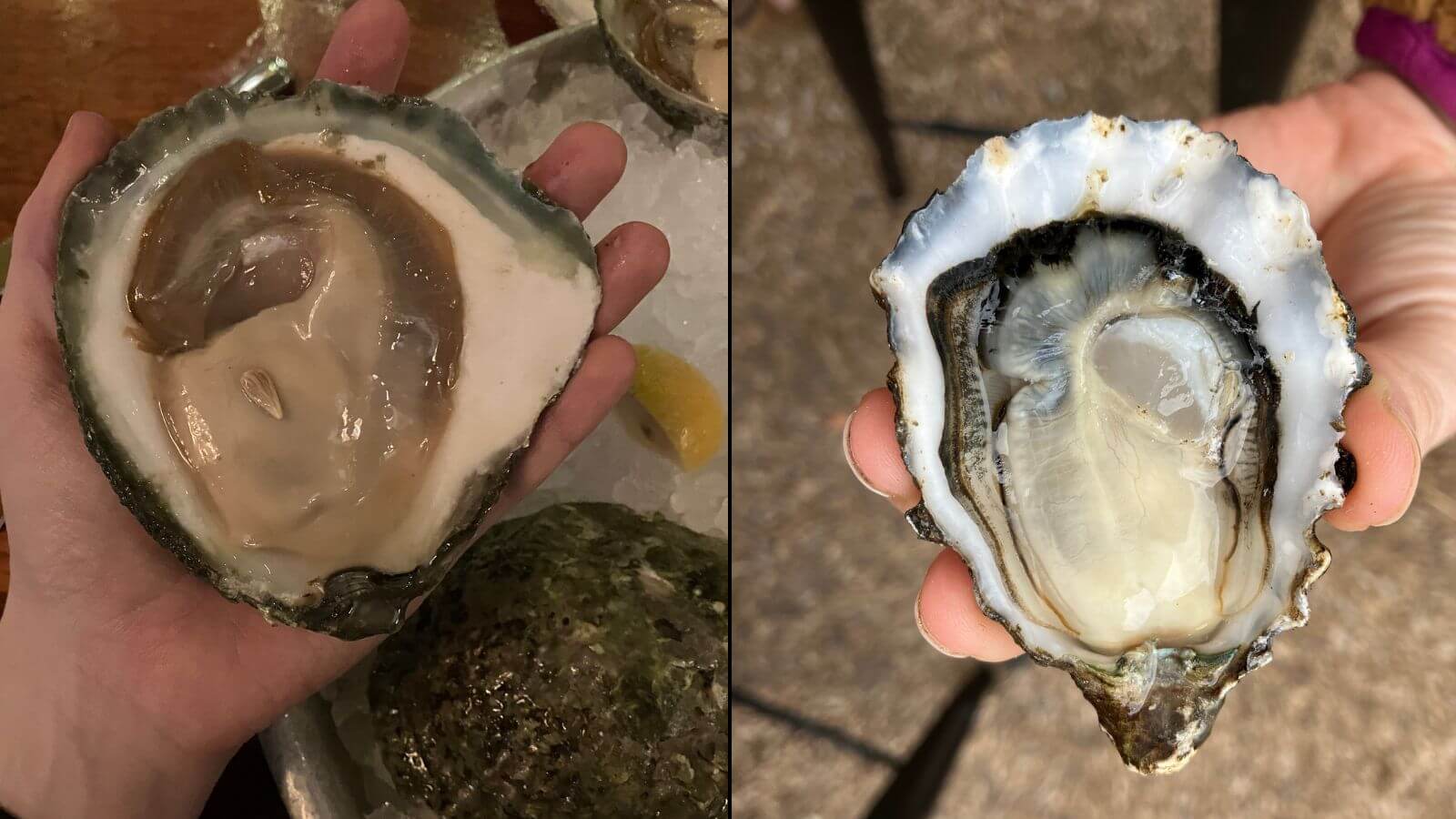
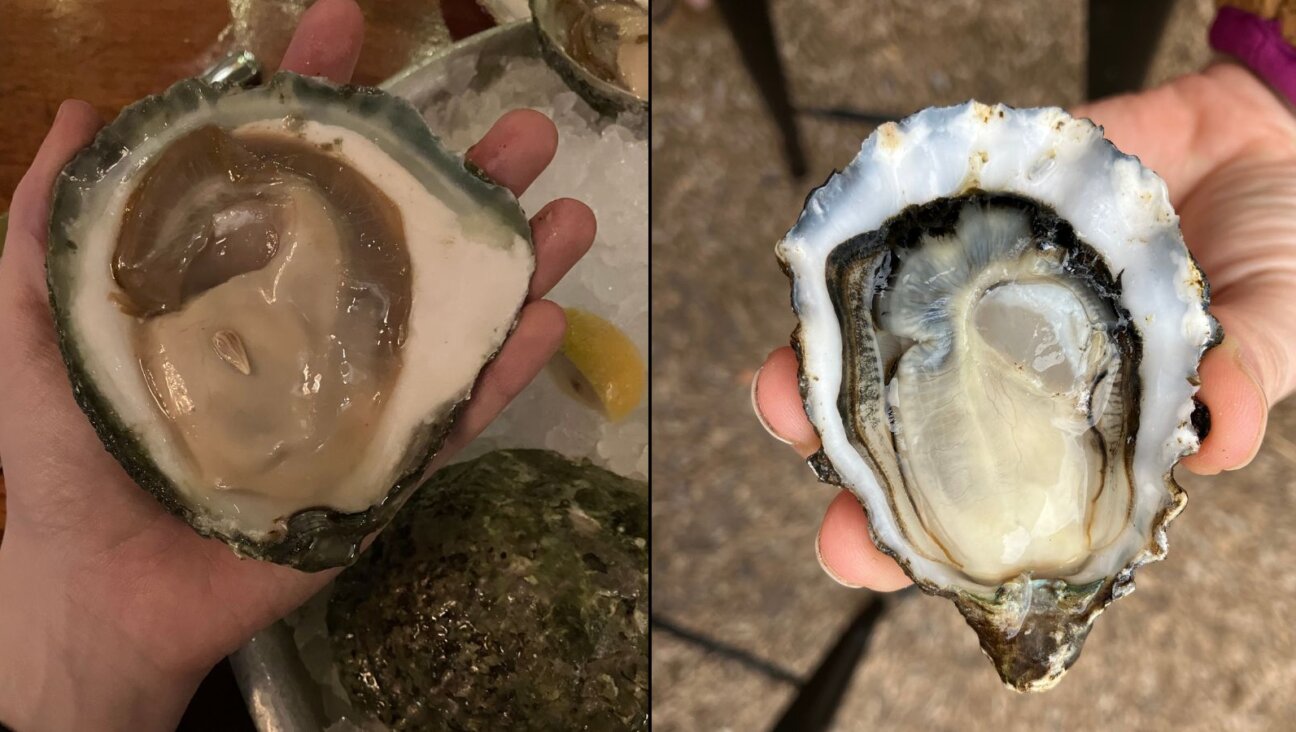
Two very different oysters; the one on the left, the size of my entire hand, tasted coppery and metallic, while the one on the right was sweetly briny. Photo by Mira Fox

By Mira Fox March 13, 2026
Most of the news this week has been of the scary variety, thanks to the war with Iran. But as there is little the average citizen can do to prevent World War III, sometimes it’s nice to have a distraction.
So that’s what I’m bringing you, a deep dive into a niche topic: the Jewish oyster. But I also want to tell you how, and why, this story came to be.
It was born long before the war, when I stumbled upon a Reddit comment about some rabbis in the 1800s who said that oysters could, technically, be kosher; though the Torah says seafood must have scales and fins to be kosher, the fact that oysters “root” on rocks might arguably make them plants. Or something like that.
Now, I famously love oysters — I help out on an oyster farm and have an oyster shucking side-hustle with my partner and some friends. But I do not keep kosher, so the fact that oysters might be Jewishly OK had little practical bearing on my life. I found the idea amusing and joked to a rabbi friend (who very much does keep kosher) that she should come over the next time I’m shucking to try one because they are halachically vegetables. She rolled her eyes.
But as much as I love oysters, I also love religious debate. I have two degrees in religious studies, spent a year at a yeshiva and love nerding out over halachic logic. So I went hunting for the justification for the kosher oyster, and began to dig through archives of Jewish newspapers.
I figured I would find some rogue rabbi who had written some little-known responsa. I did not expect to discover that the oyster was central to the story of American Judaism, and that its biggest proponent was the founder of the main rabbinical school for the Reform movement. I particularly didn’t expect to find out that, at least at some point in time, it was so normal for Jews to eat oysters that they were included in Jewish cookbooks.
I don’t want to just summarize the story here — you should read it to find out exactly how the humble bivalve became, at least temporarily, so important to American Jews. Instead, I want to talk about why it matters that there was a big drama over whether a food that is so clearly not kosher is, in fact, kosher.
I have always been fascinated by religion’s ability to create meaning, and maintain it over time. I particularly love when texts are reinterpreted to mean the complete opposite of what they originally did.
Judaism does this often. Eruvs, for example, allow carrying on Shabbat in what are clearly public spaces, even though doing just that is prohibited. Yet, the rabbis found a way to make sure Shabbat could be a joyful day, not one where you’re trapped inside, because Shabbat is fundamentally a day about being together as a community. That’s the value they were looking to support, not simply the letter of the law — but they didn’t discard that law either. The eruv shows that the rabbis cared about the texts and preserving tradition, but also wanted Judaism to be human and livable. That requires some flexibility.
Plenty of people — including a lot of antisemites — view these reinterpretations as some sort of loophole, a dishonest attempt to flout God’s will. But to me, these moments showcase the beauty and strength of Judaism, its ability to adapt and remain meaningful through the ages. Even when Jews change or reject rules, they remain within the Jewish tradition, engaging with the laws and texts instead of renouncing them entirely. There’s a phrase, machloket l’shem shamayim, which means arguing in the name of heaven. That’s what these changes and debates are — disagreement in Judaism is seen as holy, as long as it’s done with a commitment to remaining a part of Jewish culture, identity and community.
Not every reinterpretation sticks, or is accepted by everyone; the idea that oysters might be kosher infuriated a lot of people. To me, though, that’s just more evidence of Judaism’s strength: It has the capacity to hold different opinions without breaking.
That’s why the idea of a kosher oyster remained with me. What problem did it solve? What piece of Jewish life required oysters?
I don’t want to oversimplify, but to me, the core of the answer to that question is that oysters are good. They’re delicious. They’re healthy. Supposedly they’re an aphrodisiac. And because of that, Jews were eating oysters en masse, kashrut be damned. (They were, importantly, a lot cheaper in the 1800s; today they go for $3 a pop in most restaurants.)
The proponents of the kosher oyster believed two things. First, that it would be good for the future of Judaism if the things Jews were doing anyway didn’t make them any less Jewish, so they needed to find a way to make the oysters they were already eating part of Judaism. Second, and more important, they believed Judaism should be full of good things, good food and enjoyment of life. Oysters, they believed, were part of that equation.
I’m not saying I buy the halachic argument; it seems pretty shaky to me. I understand and support keeping a more traditional form of kashrut, if you want. But I buy the argument that oysters are part of a good life. So is Judaism. At least for me.