‘They need the patience’: Texts show tension between sympathetic university officials and students protesting Gaza war
House Republicans issue 122-page report condemning university response to campus protests
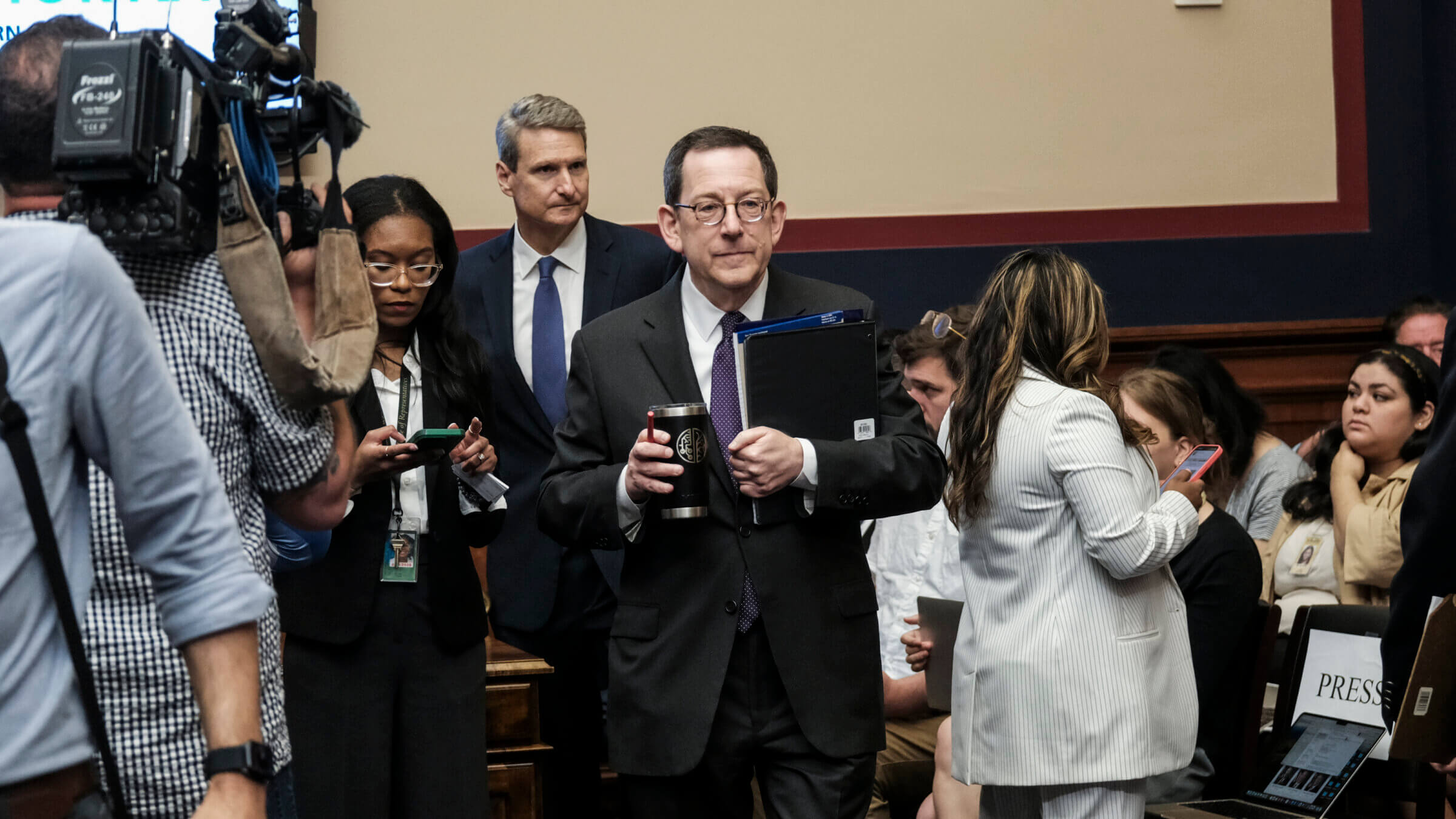
Michael Schill, president of Northwestern University arrives at a hearing called “Calling for Accountability: Stopping Antisemitic College Chaos” before the House Committee on Education and the Workforce on Capitol Hill in May. Photo by Getty Images
By Arno Rosenfeld October 31, 2024
When Northwestern University’s president put together a team of negotiators to meet with students protesting the Gaza war last spring, he tapped two faculty members who were sympathetic to their cause: Jessica Winegar, a Jewish anthropologist who has called for an academic boycott of Israel, and Nour Kteily, a management professor who has published research critical of Israel.
After Kteily joined the team, he wrote to a colleague that he was “inspired by the students” and was “hoping we can get some amazing wins here for them.”
But after a frustrating meeting with demonstrators, Northwestern’s provost, Kathleen Hagerty, texted Kteily that she was “feeling quite frustrated.”
“If the students really cared about actual divestment then they need the patience to actually do the work to make it happen,” Hagerty wrote. ”You suggested some targeted strategies that could put genuine pressure on the trustees but the students just want a quick yes or no.”
“We could really help them but they showed zero interest,” she added. “Real change requires some effort.”
These emails were among 400,000 pages of documents that House Republicans collected from Northwestern, Columbia, Ruthers and UCLA as part of a months-long investigation into campus antisemitism. They were released Thursday as part of a 122-page report by the House Education Committee that called for “a fundamental reassessment of federal support for post-secondary institutions”
The report accuses Northwestern President Michael Schill of “dereliction of leadership” for appointing Winegar and Kteily to the negotiation team, pointing to a suggestion from Kteily that the school consider boycotting Sabra hummus, which is partly owned by an Israeli company.
More broadly, the report argues that the four schools exhibited “a stunning lack of accountability” by meting out minimal discipline to students accused of misconduct and that they failed to properly address the “extremist antisemitic encampments.”
But the excerpts of emails, text messages and draft university communications included in the report offer a behind-the-scenes window into how campus leaders muddled through their initial responses to the Oct. 7 Hamas terrorist attack in Israel, and tried to balance the concerns of students outraged over Israel’s actions in Gaza and Jewish stakeholders who wanted to take a hard line against the protesters.
Many of the schools brought in police officers to clear the encampments, resulting in some 3,100 arrests nationwide. Even at places like Northwestern where negotiations brought the sit-ins to peaceful ends, protesters won few tangible results.
Jonathan Lavine, the chair of Bain Capital and former head of Columbia’s board of trustees, complained to a board co-chair that the school’s protest rules were toothless because “antisemites” in the faculty senate could block enforcement of them.
“What happens if they disproportionately discipline Jews,” Lavine wrote in one message to David Greenwald, the board co-chair. Incredulously, he added: “Also there is another side to supporting rape and terrorism?”
At Harvard, senior officials debated whether to classify “from the river to the sea” as an antisemitic slogan. Penny Pritzker, the billionaire heiress in charge of the Harvard Corporation, compared it to “signage calling for lynchings by the KKK,” in a late October 2023 email to Claudine Gay, the Harvard president who later resigned in part because of her performance at a public hearing of the House committee.
Alan Garber, Harvard’s provost at the time, replied to Pritzker that classifying the slogan as antisemitic was “not as simple as some of our friends would have it.”
“The bottom line is that the phrase can be antisemitic,” he added. “But if we don’t explain in a nuanced way many members of the Harvard community will contest the claim.”
This is a moment of great uncertainty. Here’s what you can do about it.
We hope you appreciated this article. Before you go, we’d like to ask you to please support the Forward’s independent Jewish news this Passover. All donations are being matched by the Forward Board - up to $100,000.
This is a moment of great uncertainty for the news media, for the Jewish people, and for our sacred democracy. It is a time of confusion and declining trust in public institutions. An era in which we need humans to report facts, conduct investigations that hold power to account, tell stories that matter and share honest discourse on all that divides us.
With no paywall or subscriptions, the Forward is entirely supported by readers like you. Every dollar you give this Passover is invested in the future of the Forward — and telling the American Jewish story fully and fairly.
The Forward doesn’t rely on funding from institutions like governments or your local Jewish federation. There are thousands of readers like you who give us $18 or $36 or $100 each month or year.
Support our mission to tell the Jewish story fully and fairly.