Warsaw Jewish cemetery director fired amid clash over who controls the preservation of Poland’s Jewish past
Around 200,000 Jews are buried at the cemetery in Poland’s capital
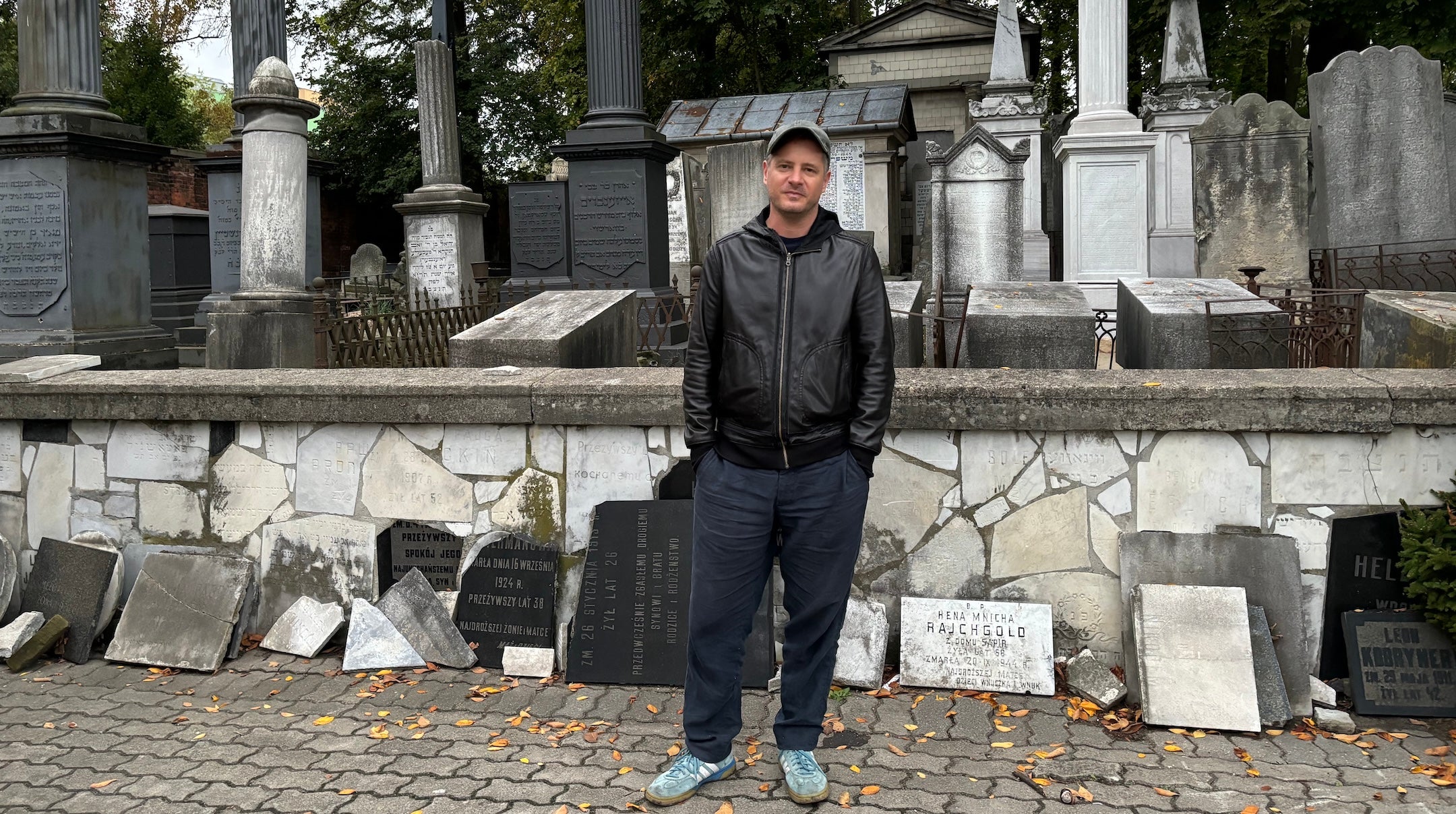
Witold Wrzosinski was the director of Warsaw’s largest Jewish cemetery and a member of the city’s small Jewish community. Photo by Shira Li Bartov
The director of Warsaw’s Jewish cemetery has been fired following a dispute over restoration projects on the site, which he said too often excluded local Jews.
Witold Wrzosinski, the Jewish director, said he was pushed out on Dec. 10 after seeking a new contract with the Polish Cultural Heritage Foundation, which controls public funds for works in the cemetery. The cemetery languished in neglect for decades after World War II, only recently becoming the center of efforts to preserve the history of Poland’s Jews.
Wrzosinski manages the cemetery’s operating budget for the local Jewish community board, but many restoration projects there also depend on public funds invested by the Cultural Heritage Foundation.
The foundation is led by Michał Laszczkowski, who has ties to the right-wing Law and Justice party that governed Poland from 2015 to 2023 and backed Poland’s newly elected president, a Holocaust revisionist. The party promotes historical narratives about Polish victimhood and resistance to the Nazis while delegitimizing research on Polish antisemitism.
Wrzosinski alleges that the current contract between the foundation and the Jewish community board is “abusive,” limiting the influence of local Jews over projects in their own cemetery.
“The whole composition of the contract left us with no power to control the priorities of the foundation,” said Wrzosinski. “We think, as the Jewish community that owns the cemetery, we should have a say.”
Some 200,000 Jews are buried at the cemetery on Okopowa Street in the heart of Poland’s capital. Founded in 1806, it is one of Europe’s largest Jewish cemeteries and holds generations of cultural luminaries, rabbis and activists, along with about 50,000 Jews who were killed by the Nazis and consigned to two mass graves. One portion remains active for the small Jewish community still living in Warsaw today.
In a meeting with the foundation, Wrzosinski said he presented a new arrangement that would safeguard the Jewish community’s input in restoration and conservation projects.
But he said Laszczkowski rejected the arrangement and said the “mental wellbeing of the members of the Jewish community is not a factor” to him.
Laszczkowski did not reply to requests for comment from the Jewish Telegraphic Agency.
The Cultural Heritage Foundation has a stated mission to “protect and promote the national heritage of Poland.” Though it is not specifically dedicated to Jewish heritage, restoring some of Poland’s 1,200 Jewish cemeteries has fallen under its purview. In 2017, the Polish government pledged $28 million to renovate Warsaw’s Jewish cemetery and put the Cultural Heritage Foundation in charge of the funds.
At the time, Warsaw’s Jewish community board was happy to sign this agreement, said Wrzosinski.
“Everybody was so excited that so much money was being pumped into the cemetery that they allowed the foundation to have everything,” he said.
After Laszczkowski rejected Wrzosinski’s proposed new contract, Wrzosinski said the Jewish community would end its agreement with the foundation. Laszczkowski in turn threatened to sue and cut off public funds from the cemetery if Wrzosinski stayed at the helm.

Tombstones at the Jewish Cemetery on Okopowa Street in Warsaw, Poland. (Bildagentur-online/Schoening/Universal Images Group via Getty Images)
Then the Jewish board turned on Wrzosinski, with four out of seven members voting to remove him. They also suspended his member rights and blocked him from communal Hanukkah celebrations, though that ban has already been reversed after a backlash. Wrzosinski said his fellow board members were intimidated by Laszczkowski’s legal threats.
Wrzosinski has directed the Jewish cemetery since 2020, becoming a key figure behind its renovations and rising profile. He began working at the largely abandoned cemetery in 2006, when it looked more like a forest, and led an effort to clean, decode and index the tombstones. He and his colleagues are documenting the graves in an online database, allowing descendants around the world to trace where their family members rest. Wrzosinski has found seven of his own relatives among the graves.
Wrzosinski said the Cultural Heritage Foundation could fall vulnerable to outside forces, including nationalist political leaders, since it was not contractually accountable to local Jews.
He pointed to a 2018 project under the Law and Justice government, which directed the foundation to build the Mausoleum of Jewish Fighters for the Independence of Poland — a reconstruction of a structure originally planned in 1939, just before the outbreak of World War II. Many local Jews see the mausoleum as a political design. It features a large Polish eagle and a Star of David, appearing to intertwine Polish nationalism with Jewish memory.
“People didn’t really feel it’s natural, or that it meets any actual need of the community. It just feels artificial and sent from above,” said Wrzosinski.
That same year, the Law and Justice government passed a notorious law that banned accusing Poland or the Polish people of complicity in Nazi crimes.
The mausoleum was built on a part of the cemetery that hosted some of its oldest graves. During construction, the tombstones were removed and stored in a back area. Wrzosinski said the foundation promised to return them, but after years of pressure from the Jewish community, the stones remain out of sight.
“This is wrong according to the halacha, according to the Jewish law,” he said. “If you know where tombstones are coming from, you shouldn’t keep them far away from that place, and you shouldn’t keep them in mud, somewhere in the back, if you took them from the actual area of the cemetery where people are buried.”
Wrzosinski’s dismissal has ignited a fierce outcry among Polish Jewish historians and museum professionals. Barbara Kirshenblatt-Gimblett, the chief curator of Warsaw’s POLIN Museum of the History of Polish Jews, circulated a petition to reinstate him. Within a few days, it has amassed nearly 700 signatures from across the globe.
“The abrupt dismissal is both incomprehensible and deeply troubling,” said the letter. “The preservation of Jewish heritage and memory — especially in a place so profoundly marked by history — requires expertise and knowledgeable leadership. Such leadership should be protected and supported, not discarded.”
This article originally appeared on JTA.org.
This is a moment of great uncertainty. Here’s what you can do about it.
We hope you appreciated this article. Before you go, we’d like to ask you to please support the Forward’s independent Jewish news this Passover. All donations are being matched by the Forward Board - up to $100,000.
This is a moment of great uncertainty for the news media, for the Jewish people, and for our sacred democracy. It is a time of confusion and declining trust in public institutions. An era in which we need humans to report facts, conduct investigations that hold power to account, tell stories that matter and share honest discourse on all that divides us.
With no paywall or subscriptions, the Forward is entirely supported by readers like you. Every dollar you give this Passover is invested in the future of the Forward — and telling the American Jewish story fully and fairly.
The Forward doesn’t rely on funding from institutions like governments or your local Jewish federation. There are thousands of readers like you who give us $18 or $36 or $100 each month or year.
Support our mission to tell the Jewish story fully and fairly.