Why New York’s Sephardic Jews are more Zionist — and more wary of Mamdani — than their Ashkenazi neighbors
Different histories of exile and migration help explain why some Jews view Mayor Mamdani differently
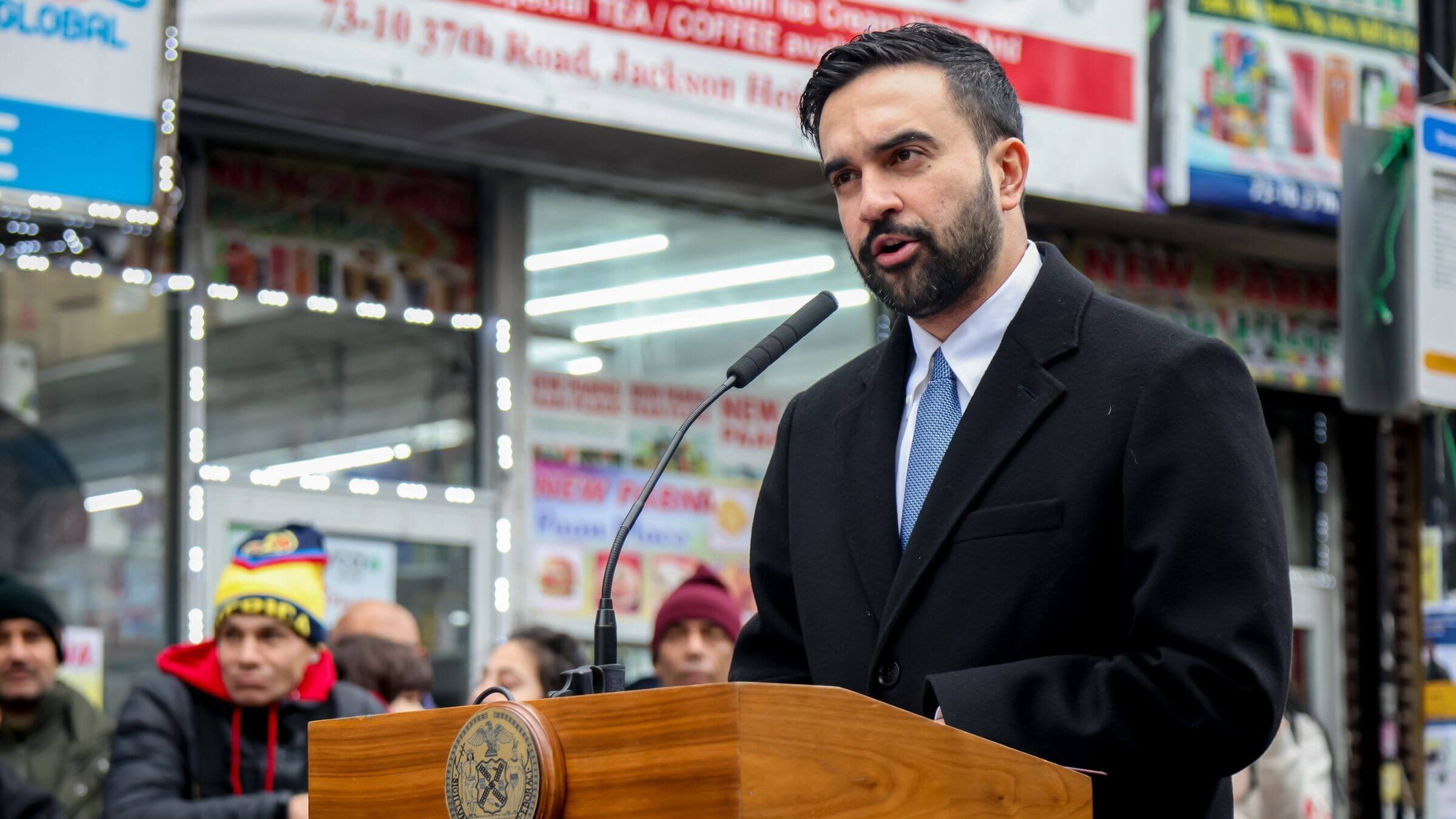
Mayor Zohran Mamdani speaks during a news conference at Diversity Plaza in Queens on Wednesday, Jan. 7, 2026. Photo by Michael Nagle/Bloomberg via Getty Images
By Simone Saidmehr January 22, 2026
Differences between Ashkenazi, Mizrahi, and Sephardic Jews have come sharply into focus since Zohran Mamdani became mayor. In the greater New York City area, 10% of Jews identify as Mizrahi or Sephardic, two groups that report stronger connections to Israel and more conservative political views than Ashkenazi Jews, according to a new national study.
Aaron Cohen, a Moroccan Jew raised in Venezuela, and a New York City–based financial adviser, said, “I think it will be hard to find Sephardic Jews who voted for Mamdani because of how important Israel is to us.” For us, he said, “there is no divide between being against Israel and antisemitism.” He added that many in these communities who escaped socialist countries are also wary of Mamdani’s democratic socialist policies.
Unlike Ashkenazi Jews, most Sephardic and Mizrahi Jews arrived in the United States between the 1950s and 1990s, often fleeing openly anti-Jewish regimes and socialist regimes in the Middle East, North Africa, Central Asia, and Latin America. While some were able to immigrate to the U.S., many found that their only viable refuge was Israel, under the Law of Return, which grants every Jew the right to Israeli citizenship.
“Sephardic Jews are very Zionistic, because the state of Israel changed our lives,” Cohen said. “A lot of Jews from Morocco were saved by the fact that they were able to go to Israel. The same was true for Iranian Jews, Egyptian Jews, and so on.”
According to the study, conducted for JIMENA: Jews Indigenous to the Middle East and North Africa, 31% of Mizrahi Jews and 28% of Sephardic Jews in the U.S. hold Israeli citizenship, compared with just 5% of Ashkenazi Jews. And 80% of Mizrahi and Sephardic Jews say they feel somewhat or very emotionally connected to Israel, compared with 69% of Ashkenazi Jews.
Mamdani has been outspoken in his criticism of Israel and identifies as anti-Zionist. He has repeatedly stated Israel does not have a right to exist as a Jewish state, but rather “as a state with equal rights.” An Anti-Defamation League report from December found that 20% of Mamdani’s administrative appointees have ties to anti-Zionist groups.
Those positions land poorly in these communities where, for many, Israel functioned as a lifeline. Ralph Betesh, a 22-year-old Syrian Jew from Midwood, described the Syrian Jewish community in New York, the city’s largest Sephardic community, as “super, super pro-Israel.” Before the election, he said, “In every Syrian group chat, they were sending things like, ‘Please everyone, go register to vote. This is crucial. It’s a once-in-a-lifetime election,’” Batesh said. “Even in shul, they would urge people to go vote.”
The primarily Syrian congregation Shaare Zion in Brooklyn, one of the largest Sephardic synagogues in North America, sent a letter to congregants before the High Holidays stating that to attend services, one must show proof of voter registration. While the synagogue did not endorse a specific candidate, the letter warned of “a very serious danger that can affect all of us.”
Memories of persecution and socialism
For Yisrael Cohen-Vásquez, a 21-year-old Lebanese, Iranian, Spanish, and Moroccan Jew who grew up in Buenos Aires and moved to New York at 13, the intensity of the reaction is rooted in the proximity of persecution. “The pogroms that happened to us are as recent as the 1990s,” he said. “This is not generational trauma. This is my parents’ trauma that I grew up listening to.”
Michael Anwarzadeh, an Iraqi Jew from Manhattan, expressed a similar view. “We understand, Iraqis, what having someone who is anti-Jewish in power means,” he said. “I can say that because my parents lived through it. I grew up listening to them, and I learned those lessons.”
Cohen-Vásquez is particularly alarmed by Mamdani’s recent decision to revoke the IHRA definition of antisemitism and lift restrictions on boycotts of Israel. “All these policies that are being changed are exactly what was introduced to Mizrahi communities in the ’70s and ’80s,” he said. “These were the indicators, the litmus tests, for the beginning of the pogroms.”
Beyond concerns over antisemitism and Jewish safety, Cohen-Vásquez said his family’s experiences “whether Lebanese, Argentinian, or Iranian” have also made him deeply skeptical of Mamdani’s “socialist policies.”
That perspective, he added, has often left him feeling misunderstood when sharing his views with Ashkenazi peers. “I feel like I had to defend myself and explain my family story,” Cohen-Vásquez said. At the same time, he said he was heartened by conversations with non-Jews in New York who had immigrated from socialist countries and, as he put it, “got it.”
“I felt more seen and understood by the Dominicanos and the Puerto Ricans in Washington Heights, and by African American communities in Harlem and Queens, than by Ashkenazi Jews.”
While Mizrahi and Sephardic Jews emphasize their deep attachment to New York, many describe a relationship shaped by repeated displacement and hard-earned lessons about how quickly safety can erode. “When you talk to anybody in our community now, you say, ‘Okay, where would you go?” Aaron Cohen said. “What’s your plan B? What’s your plan C?’”
This is a moment of great uncertainty. Here’s what you can do about it.
We hope you appreciated this article. Before you go, we’d like to ask you to please support the Forward’s independent Jewish news this Passover. All donations are being matched by the Forward Board - up to $100,000.
This is a moment of great uncertainty for the news media, for the Jewish people, and for our sacred democracy. It is a time of confusion and declining trust in public institutions. An era in which we need humans to report facts, conduct investigations that hold power to account, tell stories that matter and share honest discourse on all that divides us.
With no paywall or subscriptions, the Forward is entirely supported by readers like you. Every dollar you give this Passover is invested in the future of the Forward — and telling the American Jewish story fully and fairly.
The Forward doesn’t rely on funding from institutions like governments or your local Jewish federation. There are thousands of readers like you who give us $18 or $36 or $100 each month or year.
Support our mission to tell the Jewish story fully and fairly.